
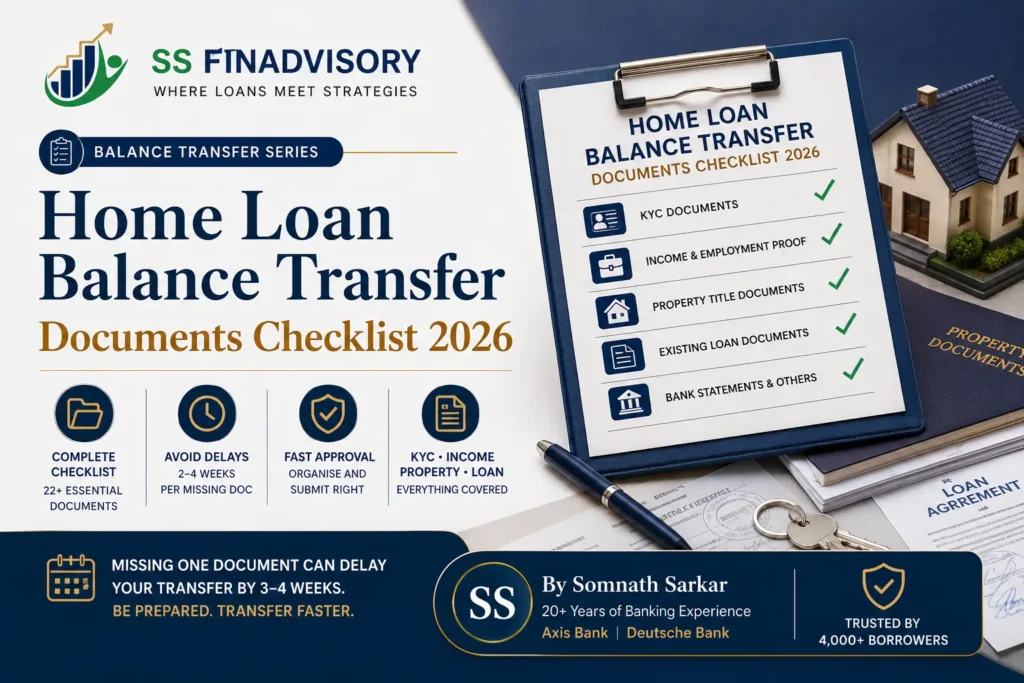
At Axis Bank, we saw roughly 40% of transfer applications stall due to incomplete or missing title documents. This checklist is built from those cases — it is the single most preventable cause of transfer delays.
A home loan balance transfer that should take 15–20 working days can easily stretch to 45–60 days if even one document is missing at application time. And during those extra weeks, you continue paying EMI at the higher old rate — losing ₹3,000–₹8,000 every month in interest you could have saved. This post gives you every document you need, organised by category, with specific notes on when originals versus copies are required.
Why Documentation Is the #1 Cause of Transfer Delays
New lenders conduct full, independent due diligence on every transfer application — they cannot rely on the old bank’s verification. This means re-verifying your identity, your income, the property’s legal status, the chain of title, and your repayment track record. Any weak link in this documentation chain pauses the entire process.
Three common delay triggers I see repeatedly: (1) missing intermediate sale deeds in the title chain (e.g., property was sold 3 times before you bought it, and one prior deed is unregistered or missing), (2) outdated or expired encumbrance certificate, (3) salary slips with a recent job change that the new bank flags for stability review.
The fix is preparation. Assemble every document in this checklist before applying. Scan everything, create a single labelled folder, and submit in one clean package. Transfers prepared this way close in 12–18 days; transfers that arrive piecemeal take 30–45 days.
KYC Documents Required
● ORIG = Original required● COPY = Photocopy acceptable● BOTH = Original for verification + photocopy retained
01Identity & Address Proof
For the primary applicant and all co-applicants
- Aadhaar Card — Both sides, clear photocopy. Linked PAN-Aadhaar status confirmed.BOTH
- PAN Card — Clear photocopy; PAN should be active and not flagged.BOTH
- Passport-size photographs — 4 recent colour photos per applicant.ORIG
- Passport or Voter ID — Secondary ID proof; Passport preferred for NRI applicants.COPY
- Permanent Address Proof — Utility bill (electricity/gas), rental agreement, or Aadhaar with current address.COPY
- Current Address Proof — If different from permanent address.COPY
Income and Employment Documents
This is where requirements diverge significantly between salaried and self-employed applicants. Lenders apply different risk models to each profile.
Salaried
Employment & Income
- Last 3 months salary slips
- Form 16 — last 2 FY
- ITR acknowledgement — last 2 years
- Appointment / offer letter
- Promotion / increment letter
- Bank statement (6 months)
Self-Employed
Business & Income
- ITR + computation — last 3 years
- P&L + balance sheet — audited
- GST returns — last 4 quarters
- Business proof / GST reg.
- Bank statement (12 months)
- Professional qualification proof
Salary change caution: If you changed jobs within the last 6 months, expect additional scrutiny. Some banks require 6–12 months of stability at the new employer. Submit your old Form 16, resignation/acceptance letters, and new offer letter together to show continuity. A salary increase is positive; a salary drop or career break needs a clear narrative.
Property Title Documents Checklist
This is the highest-risk category — incomplete title documentation causes the most delays. The new lender’s legal team will trace the property’s ownership back through every sale and transfer in its history.
02Property Legal Documents
Most of these are held by your current lender and transfer directly to the new lender at disbursement
- Sale deed (registered) — Your purchase deed. Original held by current bank.BOTH
- Prior title chain deeds — All previous sale/transfer deeds establishing ownership chain.COPY
- Encumbrance Certificate (EC) — Last 30 years; obtained from sub-registrar office.ORIG
- Approved building plan — Sanctioned by local municipal authority / development authority.COPY
- Occupancy / Completion Certificate — From local authority for completed construction.COPY
- Builder NOC / Possession letter — For apartments; confirms clearance from builder/society.ORIG
- Society NOC — From housing society confirming no dues.ORIG
- Property tax receipts — Last 2 years; confirms current status.COPY
- Khata / Patta / 7-12 extract — State-specific (Karnataka/TN/Maharashtra).COPY
State-specific variations: Karnataka requires the Khata certificate and Khata extract; Tamil Nadu requires the Patta; Maharashtra uses the 7/12 extract. Andhra and Telangana use Pahani records. Haryana and Punjab require Jamabandi records. Ask your RM for your state’s specific land record document.
Need Help Organising Your Documents?
I will review your document file, flag anything missing or problematic, and help you assemble a clean package ready for submission — avoiding the 40% that stall. Book a Free Document Review Call
Loan Account Documents from Existing Bank
03Current Loan Papers
Request these from your existing lender 7–15 days before applying to the new bank
- Original loan sanction letter — Confirms loan terms: rate, tenure, amount.COPY
- Loan agreement — The signed loan contract with your current bank.COPY
- Latest loan statement — Last 12 months; shows EMI payment track record.ORIG
- Foreclosure letter — Current outstanding principal needed to close the loan.ORIG
- Interest certificate — Latest FY; needed for continued tax deduction claims.COPY
- List of property documents held — Inventory maintained by your current bank’s custody team.ORIG
Once you receive the new bank’s sanction letter, you will need to return to your existing bank for two additional items: the NOC (No Objection Certificate) and the final foreclosure statement with the exact closing amount. These are typically issued on the day of disbursement coordination, but request them in writing 5–7 days in advance to avoid last-minute delays.
Documents Banks Often Request Mid-Process (Be Prepared)
Beyond the core checklist, banks frequently ask for additional documents after initial processing begins. Having these ready avoids scramble moments that can stretch your timeline by 5–10 days.
- Fresh encumbrance certificate — Banks may reject ECs older than 30–60 days. Get a fresh one dated within 2 weeks of application.
- Cheque leaves for ECS/NACH mandate — 6 blank cheques from your primary salary account for auto-debit setup.
- Income tax computation statements — Sometimes requested in addition to ITR acknowledgement, especially for self-employed.
- Existing insurance policy documents — For property insurance and loan-linked life cover (to transfer or reset).
- Marriage certificate — If co-applying with spouse and names differ from original deed.
- Guardian consent / legal heir documents — For inherited properties or joint ownership situations.
- Power of Attorney — If any signatory cannot be physically present at registration.
- Valuation report — New bank performs its own, but some require a prior valuation for reference.
Keep physical originals in a single folder and digital copies in a labelled cloud folder — so when the RM asks for “the 2019 mutation document” you can retrieve it in 30 seconds instead of 3 days. This small discipline is what separates transfers that close in 15 days from those that stretch to 45. See our hidden costs post for how these delays translate into real rupees.
How to Organise Your Documents for Fastest Approval
- Create one master folder — physical and digital. Use dividers for each category (KYC, Income, Property, Loan). Scan everything to PDF at 300 DPI. Banks increasingly accept digital submissions but may still request originals for verification.
- Label every file clearly. “Sale_Deed_2018_Registered.pdf” is better than “Scan001.pdf”. When the RM requests document #17 on a Tuesday evening, labelling saves hours.
- Request existing-bank documents first. The loan statement, foreclosure letter, and list of property documents held — these all come from your current lender and take 7–15 days. Start this process before you even formally apply to the new bank.
- Get a fresh encumbrance certificate. Most banks require an EC dated within 30–60 days of application. Obtain this from your local sub-registrar office (₹500–₹2,000 depending on state).
- Confirm co-applicant documents simultaneously. If your spouse or parent is a co-applicant, all of their KYC and income documents must be ready on day one. Submitting yours first and theirs later creates re-verification cycles.
- Do a dry-run submission with the RM. Before the formal application, share a digital copy of the full file with the new bank’s RM and ask: “Is anything missing?” This 15-minute conversation can save 2 weeks.
- Keep a tracker. Simple spreadsheet: document name, obtained date, submitted date, verified date. This is what I use with every client — and it is why our transfers close in 12–15 days versus the industry average of 25–30.
Frequently Asked Questions
What documents are required for a home loan balance transfer?
Five categories: KYC (Aadhaar, PAN, photos), income proof (salary slips/Form 16 or ITR/business papers), property documents (sale deed, title chain, EC, builder NOC), existing loan papers (sanction letter, statements, foreclosure letter), and bank statements (6 months). Missing any category stalls the transfer by 2–4 weeks.
How long does it take to get an NOC from my current bank?
7–15 working days typically. Request in writing via email or branch. Some banks provide foreclosure statements instantly via net banking, but the physical NOC takes a week. Start this early — NOC has a 30–45 day validity window.
Can I transfer a home loan if I don’t have all the original title documents?
Originals are held by your current lender and transfer directly to the new bank at disbursement. You should never take physical custody of originals during transfer. The new bank does its own title verification using certified copies during the application process.
Is a property re-valuation always required?
Yes — every new lender does its own independent valuation (3–7 days, ₹2,000–₹5,000). This is part of the bank’s risk assessment and cannot be waived. Keep the property accessible for the valuer’s visit.
What if my income documents show a salary change?
A salary increase is positive — provide old and new slips plus promotion letter. A decrease or job change within 6 months may require additional stability proof. If between jobs, wait for 3 months of new payslips before initiating transfer.
Let Me Manage Your Transfer Documentation
I personally review every document, flag issues early, and coordinate with both banks — the reason my clients close transfers in 12–15 days, not 30–45. Book Free Consultation
About the Author: Somnath Sarkar is a home loan strategy consultant with 20+ years at Axis Bank and Deutsche Bank, specialising in balance transfers, prepayment planning, and interest optimisation.
Disclaimer: Document requirements vary by lender, property type, and state. Always verify the final list with your specific bank’s relationship manager before finalising your document file. This article is for educational purposes only.
Last Updated: 29 May 2026 | First Published: 29 May 2026
© 2026 Somnath Sarkar. All rights reserved.