
At Deutsche Bank, self-employed clients often had stronger financial profiles than salaried ones — but they were packaging their case incorrectly. The income was there; the presentation was not.
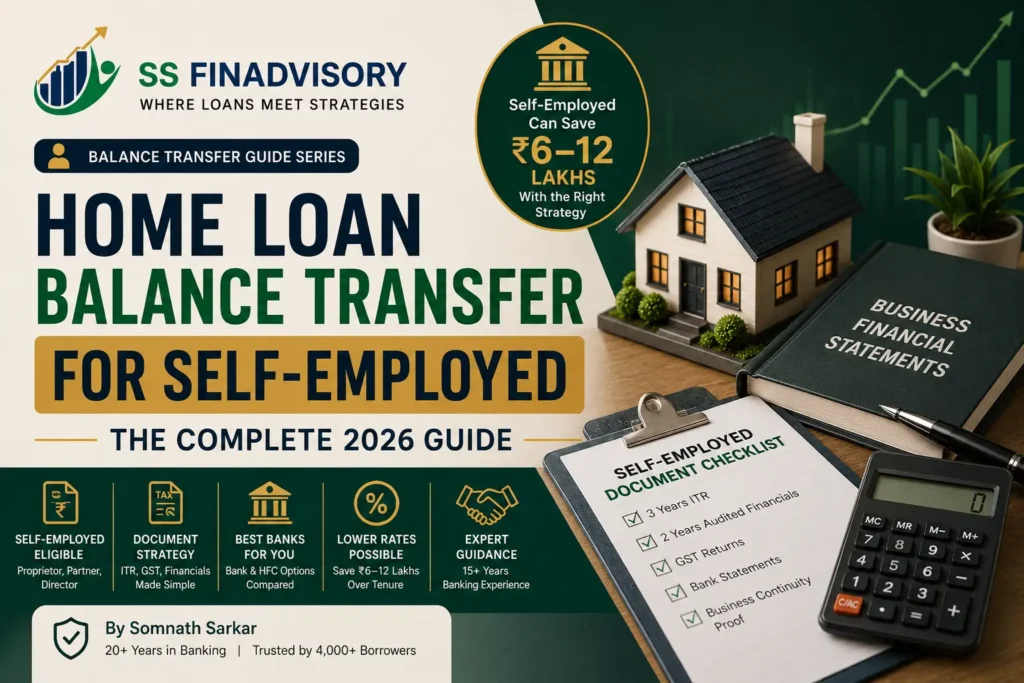
If you are self-employed and considering a home loan balance transfer, you have probably already encountered resistance from bankers. The documentation is heavier, the turnaround is slower, and the first rate offered is typically 0.10–0.25% higher than what a comparable salaried applicant would receive. But none of these are reasons to skip the transfer — a well-negotiated self-employed transfer can still save ₹6–12 lakhs over the loan’s life. The key is understanding how banks evaluate self-employed applications and presenting your case the way they want to see it.
This post covers the documentation strategy by business structure, the banks most friendly to self-employed borrowers in 2026, how to think about savings despite variable income, and the five most common rejection reasons with specific fixes.
Why Self-Employed Borrowers Face More Hurdles in Balance Transfer
Banks prefer salaried applicants for three reasons: (1) income verification is simpler — a salary slip is definitive; (2) employer deductions (EPF, TDS) create a reliable paper trail; and (3) job stability is easier to assess via employment tenure. For self-employed applicants, each of these is more complex.
Your income varies year-to-year. Your P&L numbers depend on how aggressively you have claimed expenses. Your cash flow is visible only through bank statements and GST filings — not through a neat monthly stub. And your business itself could shut down in a way a job typically does not. Banks price this perceived risk into the rate offer and the approval decision.
But here is the insight most self-employed borrowers miss: banks do not reject your application because you are self-employed; they reject it because the documentation does not tell a convincing story. A well-documented self-employed applicant with 5 years of consistent ITR, clean GST filings, healthy bank credits, and a clear CIBIL record is often approved faster than a salaried applicant with a recent job change. Presentation matters enormously.
Income Documentation Strategy for Self-Employed Applicants
ITR vs Bank Statement Approach
There are two primary methods banks use to assess self-employed income: ITR-based and bank statement-based (also called “surrogate income”). Most banks default to ITR-based assessment because it is auditable. But for applicants whose bank statement income (regular business credits) tells a better story than their tax returns, bank statement-based assessment can yield better outcomes.
ITR-based assessment: Banks compute annual income as a 3-year average of your net profit (proprietors) or remuneration + share of profit (partners/directors). A strong ITR-based profile: growing net profit over 3 years, filed on time, audited where required, and free of major revisions. This works best if you have been running a stable business for 3+ years and filing consistently.
Bank statement-based assessment: Some banks (notably HDFC, Axis, Kotak) will consider your primary business bank account — typically requiring 12 months of statements showing regular credits from business activity. Monthly average credits are annualised to estimate income. This works well for applicants who have conservative tax positions (aggressive expense claims reducing shown profit) but strong actual cash flow.
When to choose which: If your ITR income × 4.5 gives a higher eligibility than your 12-month bank credit × your monthly income multiplier, go ITR-based. If bank statements show significantly higher regular credits than what ITR shows as net profit, request bank statement-based assessment. HDFC, Axis, and Kotak are most flexible here. Always ask explicitly during the application discussion — banks do not always offer it by default.
What GST-Registered Businesses Should Highlight
If your business is GST-registered, your GST filings are gold. Four consecutive quarters of GST returns provide banks with clean, audited data on your turnover, compliance, and business continuity. GST-registered applicants typically get faster processing and more favourable rates because the fraud risk is lower.
When applying, provide: GSTIN certificate, last 4 quarters of GSTR-3B filings, GSTR-1 for the most recent 2 quarters (showing actual sales invoices), and your GST challan payments. This package, along with 3 years of ITR, often shortcuts the deeper documentation review.
For businesses with high turnover but below the GST threshold (₹20L/₹40L depending on state), alternative credibility signals include Udyam registration, trade licence, professional certificates (for doctors, CAs, architects), and contracts or purchase orders from regular clients. The more formal your business footprint, the better your application is received.
Entity: Proprietorship
Sole Proprietor
- 3 years ITR
- Audited P&L + BS (2 yrs)
- GST returns (if applicable)
- 12 months bank statements
- Shop Act / Trade licence
- Udyam registration
Entity: Partnership
Partnership Firm
- 3 years firm ITR
- Partner’s personal ITR
- Audited firm financials
- Partnership deed
- Partner remuneration proof
- Firm GST filings
Entity: Pvt Ltd
Director / Shareholder
- 3 years company ITR
- Director’s personal ITR
- Audited company financials
- MOA / AOA + incorporation
- Director remuneration proof
- Form 16A (if applicable)
Which Banks Are Most Friendly to Self-Employed Borrowers?
MOST FLEXIBLE
HDFC Bank
Rates from 8.90%
Willingness to consider bank statement-based income assessment. Strong digital documentation handling. Good track record for GST-registered businesses. Typical turnaround 14–20 days for self-employed.
FAST APPROVAL
Axis Bank
Rates from 8.85%
Relationship manager-led approach works well for self-employed with complex profiles. Flexible on negotiating both rate and processing fee. Especially strong for professionals (doctors, CAs).
SPECIALISED
Kotak Mahindra
Rates from 8.80%
Dedicated products for self-employed professionals. Higher loan amounts for premium segment. Customised pricing for business owners with ₹75L+ loans and strong financials.
LOWEST RATE
SBI
Rates from 8.50%
Lowest rate among banks but strictest documentation — typically requires 5 years of ITR for self-employed. Best suited to long-established businesses. Longer turnaround (20–30 days).
If major banks decline your case, consider Housing Finance Companies (HFCs) — LIC Housing Finance, PNB Housing, and Bajaj Housing Finance often approve borderline self-employed cases that banks reject. Rates may be 0.25–0.50% higher (8.75–9.25% range), but the approval probability is meaningfully higher. If your first 2–3 bank applications are declined, switching to HFCs is usually more productive than trying more banks.
How to Calculate Your Transfer Savings Despite Variable Income
Variable income does not change the savings math — the loan, rate, and tenure drive the savings, not your income. Whether your income is ₹15L steady or ₹12L–₹22L variable, the transfer savings on a ₹50L outstanding at 9.5% → 8.75% are roughly the same.
Self-Employed Borrower: ₹50L Outstanding · 12 Years Remaining · Rate 9.5% → 8.75%
Current EMI₹58,265
New EMI₹55,973
Monthly EMI saving₹2,292
Gross interest saved over 12 years₹3,30,048
Transfer costs (processing + legal + valuation)−₹32,000
Net Savings₹2,98,048 over remaining tenure
Income variability affects eligibility, not the savings itself. What variable income changes is the rate you are offered and whether the bank approves. Banks price 0.10–0.25% premium into self-employed rates to compensate for perceived variability; a well-documented profile can negotiate this down to 0.05–0.10%.
For detailed break-even calculation with your specific numbers, use our free break-even calculator. Enter your actual outstanding, tenure, and the rate offered — the calculator will tell you exactly when the transfer pays for itself.
Self-Employed and Struggling to Get Approved?
I will review your documentation, identify the packaging gaps, and match you with the bank most likely to approve your profile — often making the difference between rejection and approval. Get a Free Case Review
Common Rejection Reasons (and How to Overcome Them)
- Inconsistent ITR filing or missing yearsBanks require 3 continuous years of filed ITR. Any gap is a red flag.Fix: File all pending ITRs (even belated returns with penalty) before applying. Wait until you have 3 continuous years on record, even if one year has negligible income.
- Declining income trend in most recent yearYear 3 lower than Year 2 raises concerns about business viability.Fix: Provide a one-page explanation letter — illness, one-off expense, industry cycle. If the decline is structural, wait for the next year’s ITR (hoping for recovery) before applying.
- Aggressive tax-saving expense claims reducing shown incomeNet profit on ITR is significantly lower than actual cash flow because of aggressive expense claims.Fix: Switch to bank statement-based assessment if your bank supports it (HDFC, Axis, Kotak). Alternatively, moderate expense claims in the year before applying — net higher taxable income but better loan eligibility.
- Mixing personal and business expenses in bank accountsBanks want to see a dedicated business account with clean business credits.Fix: Separate business and personal banking at least 12 months before applying. Route all business receipts through the business account, maintain clean narration, and do not run personal expenses through the business account.
- Low CIBIL score or recent business loan delaysAny defaults or delays on business loans hurt your profile.Fix: Fix CIBIL errors at cibil.com, bring credit card utilisation below 30%, and wait 12+ months after regularising any business loan delays before applying. See our CIBIL impact guide for the full playbook.
Working with a Loan Advisor for Better Approval Odds
For salaried borrowers, DIY applications often work fine. For self-employed borrowers, a loan advisor — especially one with banking insider experience — can dramatically improve outcomes. Not because they know secret tricks, but because they know how each bank evaluates self-employed files, which parts of your documentation to emphasise, and how to structure the application narrative.
Specifically, a good advisor adds value in three places: (1) bank selection — matching your profile to the bank most likely to approve and offer a competitive rate; (2) documentation packaging — organising your ITR, GST, bank statements, and business proof in the format the bank’s underwriting team expects; (3) narrative framing — addressing any weak spots (income dip, aggressive expense claims, recent business loan) proactively with explanatory documentation before underwriting flags them.
For borderline cases — applicants who have been declined by 1–2 banks — an advisor often makes the difference between a third rejection and approval at a good rate. For straightforward cases with strong profiles, an advisor saves time but may not change the outcome. Judge by your specific situation.
Frequently Asked Questions
Can self-employed people do a home loan balance transfer?
Yes. Proprietors, partners, and directors can all transfer home loans. Approval rates (65–75%) are slightly below salaried (85–90%), but well-packaged applications close this gap to 80–85%. Rate premium is typically 0.10–0.25% above comparable salaried profiles.
Which bank is best for a self-employed home loan transfer?
HDFC, Axis, and Kotak have the most flexible self-employed underwriting (rates 8.80–8.90%). SBI offers the lowest rate (8.50%) but requires 5 years of ITR and stricter documentation. HFCs like LIC Housing and Bajaj Housing often approve cases that banks decline — worth considering if your first 2–3 bank applications are rejected.
How many years of ITR are needed for a balance transfer?
Most banks require 3 years of continuous ITR filing. SBI and some PSU banks may require up to 5 years for higher-ticket loans. Any gap in filing is a significant red flag — file all pending returns (even belated) and wait until you have 3 continuous years before applying.
What if my income is irregular — will banks reject my application?
Not automatically. Banks compute income as a 2–3 year average, smoothing variability. What matters: regular business credits, clean GST compliance, and net-positive trajectory. A single weak year is acceptable with explanation. Sharp declines in the most recent year warrant waiting one more year before applying.
Does business loan repayment history affect home loan transfers?
Yes, significantly. Business loans show on both your personal and commercial CIBIL reports. Clean repayment is a strong positive; delays or defaults attract premium pricing or rejection. Wait 12+ months after regularising any business loan issue before applying for a home loan transfer.
Let Me Structure Your Self-Employed Transfer
I will package your documentation the way banks want to see it, match you with the most flexible lender for your profile, and negotiate the best rate — typically turning marginal cases into approved ones. Book Free Consultation
About the Author: Somnath Sarkar is a home loan strategy consultant with 20+ years at Axis Bank and Deutsche Bank, specialising in self-employed loan structuring, balance transfers, and bank matching for complex profiles.
Disclaimer: Approval rates, rate premiums, and eligibility criteria vary by lender and are subject to change. Information is based on industry practice as of March 2026. This article is for educational purposes only and does not constitute financial advice. Consult a qualified financial advisor for your specific situation.
Last Updated: 04 June 2026 | First Published: 04 June 2026
© 2026 Somnath Sarkar. All rights reserved.