Missing chain-of-title documents delayed one client’s LAP by 8 weeks and nearly cost them the business deal they needed the funds for. The cost of that delay: the opportunity itself. Documentation quality matters more than most borrowers realise.
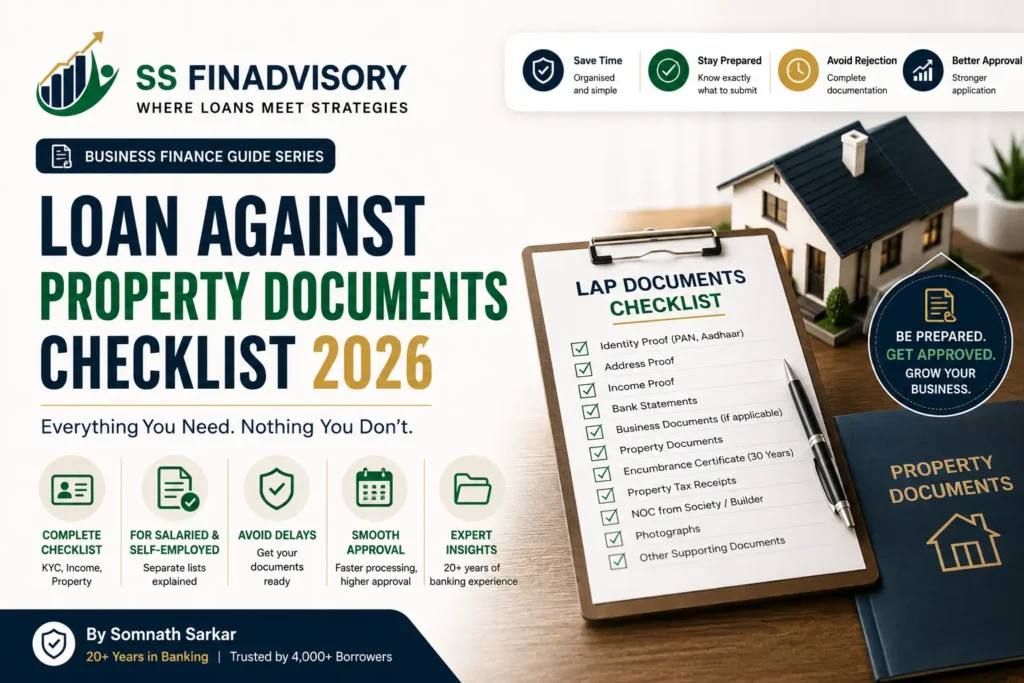
A LAP requires more documents than almost any other loan — typically 25–35 individual papers covering KYC, income, and property. Every one must be current, consistent, and cross-verified by the bank’s legal and credit teams. Missing or outdated documents cause 60% of LAP delays in my experience. This post gives you the complete, organised checklist — so you can assemble everything once, submit clean, and close the loan in 20–30 days instead of 45–60.
● ORIG = Original required● COPY = Photocopy acceptable● BOTH = Original for verification + photocopy retained
KYC Documents (Mandatory for All Applicants)
KYC
Identity & Address Proof
- PAN Card — mandatory for loans above ₹50,000. Must be active and linked to Aadhaar. BOTH
- Aadhaar Card — both sides, clear photocopy. Preferred address proof. BOTH
- Passport — preferred secondary ID, especially for NRIs. COPY
- Voter ID / Driving Licence — additional ID proof if needed. COPY
- Passport-size photographs — 4 recent colour photos per applicant. ORIG
- Utility bill (electricity/gas/telephone) — last 3 months, as address proof. COPY
- Rental agreement — if current address differs from Aadhaar. COPY
- Application form — duly filled and signed. ORIG
For all co-applicants — spouse, parent, child, partner — the same KYC set is required. Gather co-applicant documents simultaneously with your own; banks will not begin processing until all applicant KYCs are in.
Income Documents: Salaried Employees
INCOME
For Salaried Applicants
- Salary slips — last 3 months, with company seal and HR signature. ORIG
- Form 16 — for the last 2 financial years. COPY
- Income Tax Returns (ITR) — last 2 years with computation. COPY
- Bank statements — salary account, last 6 months showing salary credits. ORIG
- Appointment / offer letter — confirms start date and salary structure. COPY
- Promotion / increment letter — if salary increased in the last 12 months. COPY
- Employer certificate — optional, confirms continuing employment. ORIG
- PF/EPF statement — supplementary proof of continuous employment. COPY
Recent job change caution: If you changed jobs in the last 12 months, expect additional scrutiny. Submit your old Form 16, resignation letter, new offer letter, and first salary slip at the new job. Banks typically require 6 months of continuous employment at the new employer for LAP approval; some require 12. If you are between jobs, wait until you have 3 months of payslips from the new employer before initiating the application.
Income Documents: Self-Employed and Business Owners
INCOME
For Self-Employed Applicants
- Income Tax Returns (ITR) — last 3 continuous years with computation. COPY
- Profit & Loss statement — audited, last 2 financial years. COPY
- Balance sheet — audited, last 2 financial years. COPY
- GST registration & returns — last 4 quarters of GSTR-3B. COPY
- Business bank statements — last 12 months, primary operating account. ORIG
- Personal bank statements — last 6 months. ORIG
- Business registration proof — GST, Shop Act, Udyam, or trade licence. COPY
- Partnership deed / MOA & AOA — for firms and Pvt Ltd respectively. COPY
- Board resolution — for Pvt Ltd authorising the loan and signatory. ORIG
- Professional qualification proof — for doctors, CAs, architects. COPY
For the complete self-employed documentation strategy with entity-specific guidance, see our self-employed borrower guide. The principles that apply to home loan balance transfers apply equally to LAP applications.
Property Documents: Residential Property
PROPERTY
Residential Property Papers
- Sale deed (registered) — the primary ownership document. Must be in the applicant’s name. BOTH
- Prior title chain deeds — all previous sale/transfer/gift/succession deeds. Complete chain is critical. COPY
- Encumbrance Certificate (EC) — 30 years from sub-registrar, dated within 60 days. ORIG
- Approved building plan — sanctioned by municipal authority. COPY
- Occupancy Certificate / Completion Certificate — from local authority. COPY
- Builder NOC / Possession letter — for apartment purchases. ORIG
- Society NOC — confirming no dues or disputes. ORIG
- Property tax receipts — last 2 years, paid up to date. COPY
- Electricity bill for the property — confirms occupancy status. COPY
- State-specific land records — Khata (Karnataka), Patta (Tamil Nadu), 7/12 (Maharashtra), Pahani (AP/TS), Jamabandi (HR/PB). COPY
| State | Key Land Record Document | Where to Obtain |
|---|---|---|
| Karnataka | Khata Certificate + Khata Extract | BBMP / municipal office or Bhoomi portal |
| Tamil Nadu | Patta + Chitta | Taluk office / e-Services TN |
| Maharashtra | 7/12 Extract + 8A | Talathi office / Mahabhulekh |
| Andhra Pradesh / Telangana | Pahani (RoR) | MeeBhoomi / Dharani portal |
| Delhi | Property tax receipt + Sub-Registrar index | MCD / sub-registrar |
| Haryana / Punjab | Jamabandi + Mutation | Tehsil office / Jamabandi portal |
| West Bengal | Record of Rights (RoR) | BLLRO / Banglarbhumi |
| Uttar Pradesh | Khatauni / Varasat | Tehsil / Bhulekh UP |
* Each state has its own land record system. Obtaining these requires a visit to the relevant office or use of the state’s online portal. Plan 2–4 weeks depending on state.
Have All Your Documents Ready?
I will review your document file, flag anything missing or problematic, and coordinate with legal/credit teams at the bank — so your application closes in 20–25 days instead of 45–60. Book a Free Document Review Call
Property Documents: Commercial Property
COMMERCIAL
Commercial Property — Additional Requirements
- Commercial sale deed with clear commercial usage indicated. BOTH
- Commercial use permission — from local authority, especially for converted properties. COPY
- Trade licence — if applicant operates from the pledged property. COPY
- Registered rent agreement — if property is leased out to tenants. ORIG
- Tenant undertaking — tenant’s acknowledgement of the mortgage (where applicable). ORIG
- Current rent receipts — last 12 months, if rented. COPY
- Commercial property tax receipts — last 2 years. COPY
- GST registration of commercial unit — if applicable. COPY
- Shops & Establishments Act registration — for office/retail use. COPY
- Factory licence / Industrial registration — for industrial property. COPY
Commercial property LAP applications undergo deeper scrutiny than residential because of usage compliance and zoning concerns. Banks typically require: (1) clear zoning confirmation from municipal records showing the area is designated for commercial use, (2) no conversion violations (e.g., residential property being used commercially without approval), and (3) all statutory licences current. Irregularities in any of these can cause rejection or a lower LTV (from 65% down to 50–55%).
Additional Documents for Co-Applicants
Spouse / Family
Family Co-Applicant
- Complete KYC set (PAN, Aadhaar, photos)
- Income documents if co-earning
- Marriage certificate (if spouse, and names differ)
- Relationship proof for parent/child
- Signed co-applicant consent
Business Partner
Firm / Company Signatory
- Authorised signatory list (for partnership/Pvt Ltd)
- Board resolution authorising loan
- Personal KYC of signatories
- Power of Attorney (if applicable)
- Partner/Director personal ITR
Co-applicants are used to increase eligibility (adding another income) or to overcome individual limitations (age limit, CIBIL). All co-applicants must sign the loan agreement and become jointly liable for repayment. For property owned jointly, every owner must be a co-applicant — there is no way around this requirement.
Tips for Faster Document Verification
- Assemble documents category-first, not bank-first.Gather all KYC, then all income, then all property — regardless of which bank you end up applying to. Documents are largely the same; only minor variations matter. Parallel assembly saves 2–3 weeks versus sequential collection after picking a bank.
- Get the encumbrance certificate first.This is the document borrowers most often underestimate. It takes 7–15 days to obtain in most states, and it must be dated within 60 days of application. Start this process before anything else.
- Digitise everything, labelled clearly.Scan every document to PDF at 300 DPI. Label files precisely: “Sale_Deed_2018_Registered.pdf” not “Scan_001.pdf”. Banks accept digital submissions; clean digital folder speeds up internal bank handoffs.
- Verify your own title chain before the bank does.Trace every transfer in your property’s history. Any missing intermediate deed is the single most common rejection reason. Your lawyer can review in 2 hours and tell you exactly what is missing.
- Do a dry-run with the bank’s RM before formal submission.Share the digital file informally and ask “Is anything missing?” This 15-minute review can save 2 weeks of back-and-forth during formal processing.
- Keep originals safely accessible during processing.Some banks ask for originals during final verification even if the initial submission was digital. Keep all originals in one physical folder, accessible on short notice.
- Refresh supporting documents before application.EC within 60 days, society NOC within 3 months, property tax receipts current. Old supporting documents get rejected and restart verification.
Frequently Asked Questions
What property documents are needed for a loan against property?
Core requirements: registered sale deed in your name, complete title chain (all prior deeds), 30-year encumbrance certificate, approved building plan, occupancy certificate, last 2 years’ property tax receipts, society/builder NOC, and state-specific land records (Khata, Patta, 7/12). Missing intermediate documents in the title chain is the top rejection reason.
Is an encumbrance certificate mandatory for LAP?
Yes — mandatory for every LAP. Banks require 30-year EC dated within 30–60 days of application. Obtained from sub-registrar office (₹200–₹1,000). Format varies by state (Form 15 in Karnataka/TN, Index-II in Maharashtra, online in Delhi). Start this process 2–3 weeks before applying.
Can I apply for LAP with a power of attorney?
Yes, with conditions. POA must be registered (General or Special), not older than 12 months, notarised/apostilled if executed abroad. Banks conduct additional verification with the actual owner. Firms and Pvt Ltd companies use authorised signatory POAs with board resolutions. Properties bought via POA without registered sale deed are typically flagged.
How old can property documents be for LAP eligibility?
Historical documents (sale deed, title chain) can be any age — older properties are fine. Supporting documents must be recent: EC within 30–60 days, property tax within 2 years, society NOC within 3 months, property valuation within 90 days. Refresh all supporting documents before applying.
Do I need a valuation report from the bank, or can I get my own?
The bank conducts its own independent valuation through a panel valuer (3–7 days, ₹3K–₹8K). This cannot be waived. A private valuation before applying is useful for your own planning and can serve as leverage if the bank’s valuation comes in low — but will not replace the bank’s internal valuation.
Let Me Manage Your LAP Documentation
I personally review every document, flag missing or problematic items early, coordinate with the bank’s legal team, and keep the timeline on track — the reason my clients close in 20–25 days instead of 45–60. Book Free Consultation
About the Author: Somnath Sarkar is a loan strategy consultant with 20+ years at Axis Bank and Deutsche Bank, specialising in LAP structuring, documentation management, and SME funding.
Disclaimer: Document requirements vary by lender, property type, and state. Always verify the final list with your specific bank’s relationship manager before finalising your file. This article is for educational purposes only and does not constitute legal or financial advice. Consult a qualified lawyer for property-related legal guidance.
Last Updated: 08 June 2026 | First Published: 08 June 2026
© 2026 Somnath Sarkar. All rights reserved.