
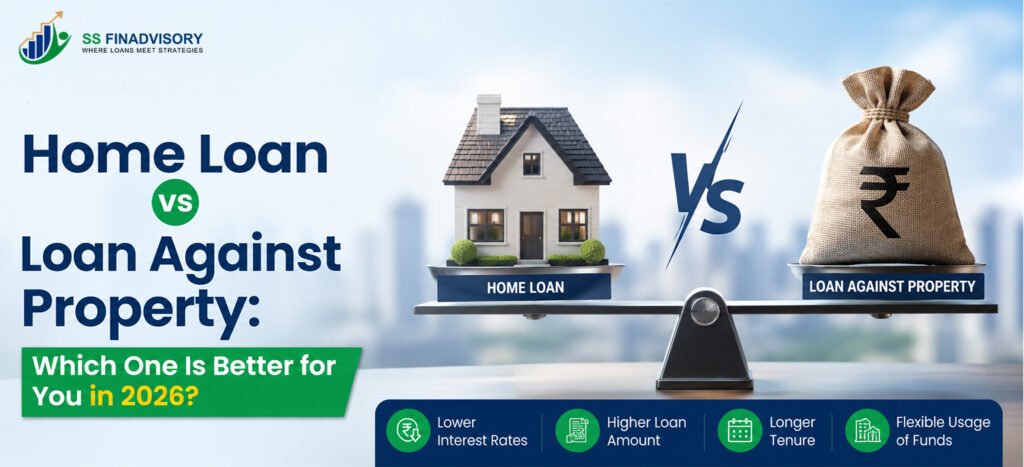
If you’re torn between upgrading your home and funding other big goals, the home loan vs loan against property choice can feel confusing. On paper both are secured loans, but the way they affect your cash flow, risk and long-term plans is very different.
This guide breaks down how each option works in 2026, what banks really look at, and how to choose based on your income, property value and priorities, not just the advertised interest rate.
Understanding Home Loans in 2026
A home loan is meant specifically to buy or build a residential property you plan to occupy or sometimes rent out. The bank funds a major part of the purchase price and keeps a mortgage on the house until you clear the loan.
Most borrowers compare offers based on interest rate and tenure, but smart home finance decisions start with a clear view of total cost, prepayment rules and how EMIs fit into your long-term financial plan.
Key features of a standard home loan
Typical tenures stretch from 15 to 30 years, which keeps EMIs manageable even for middle-income professionals. The longer tenure can be helpful, but it also means you pay more interest if you don’t prepay aggressively.
Lenders closely check your home loan eligibility using income, existing EMIs, credit score and job stability, and they usually cap your EMI at around 40% to 50% of monthly income.
Pros and cons of choosing a home loan
On the upside, rates on a pure housing loan are usually among the lowest in the secured loan market, because banks see these as relatively safe and backed by a real asset.
The flip side is that money from a housing loan can only be used for buying or constructing the specified property, so it’s not suitable if your real need is business expansion, education or high-cost medical treatment.
What Is a Loan Against Property and How Does It Work?
A loan against property, often called LAP, lets you raise funds by mortgaging an existing residential or commercial property that you already own. The property stays in your name, but the lender holds rights over it until you repay the loan.
Because the funding is tied to a real asset, it tends to be cheaper than unsecured options like personal loans or business overdrafts, especially for medium to large ticket sizes.
Core characteristics of LAP
Unlike a housing product where the property purchase drives the lending decision, here the focus is heavily on property financing value, quality of the location and clarity of title documents.
LAP tenures are usually shorter than for a fresh home purchase loan, which keeps the bank’s risk lower but can push EMIs higher for the same amount.
Benefits and limitations of LAP
The biggest attraction is flexibility: funds from LAP can be used for business cash flow, consolidating expensive debts, children’s education abroad or even major medical procedures.
The main limitation is risk concentration; if your business plan doesn’t work or your income drops, the same property that supports the loan is at risk of being sold to recover dues.
Home Loan vs Loan Against Property: Core Differences
To compare home loan vs loan against property properly, you need to go beyond the headline rate and think about purpose, risk, tenure and repayment comfort over time.
Many borrowers start with a rough mortgage comparison based on current offers from a couple of banks, but a more structured view makes the trade-offs clearer.
Side-by-side secured loan comparison
Both options are secured loans, but they behave differently in real life; a careful secured loan comparison should include documentation effort, legal scrutiny and valuation costs, not just EMI.
In practice, lenders often approve a higher percentage of property value for a pure housing product than for LAP, because they know exactly where the funds are going.
Comparing costs and flexibility
Interest rates on LAP generally sit a little higher than on a classic housing product, as banks price in greater uncertainty over how the funds will be used.
If you need money only to buy a house, the effective cost of borrowing usually favors a housing loan vs property loan, especially over tenures longer than 15 years.
When a Home Loan Makes More Sense
If your primary goal is to buy your first flat or upgrade to a bigger one, a targeted mortgage loan comparison tends to show that a dedicated housing product is usually the cleanest fit.
You also benefit from transparent EMIs, clear amortization schedules and, in many markets, tax benefits on both principal and interest components.
Ideal borrower profile for a home loan
Salaried professionals with stable income, clear credit history and moderate other EMIs often get the most value from a standard home finance vs LAP decision that leans toward the housing route.
They don’t usually need the extra flexibility of LAP and prefer lower interest rates, longer tenures and straightforward documentation.
For such borrowers, the best loan option is typically the one that protects their home purchase plan while keeping a safety buffer in monthly cash flow.
When a Loan Against Property Is the Better Choice
LAP becomes attractive when you already own property with decent equity and need sizeable funds for non-housing goals like growing a business or consolidating several expensive loans.
Self-employed professionals and small business owners often find that LAP approvals are more focused on collateral strength than on perfectly stable monthly income.
Situations where LAP stands out
If you’re comparing LAP vs home loan because you want to raise capital for your enterprise, tapping an existing building can be cheaper than taking repeated unsecured loans.
For families facing large one-time costs, such as overseas education or a major medical procedure, LAP can spread the outlay over several years instead of draining savings in one shot.
In those scenarios, a thoughtful loan comparison should still factor in prepayment penalties, processing fees and expected business cash flows, not just the sanctioned amount.
How to Decide Between Home Loan and LAP in 2026
The smartest way to approach home loan vs loan against property is to start with your objective, not with what the bank is ready to approve. Ask yourself whether the priority is owning a new home or funding some other goal while using property as support.
Once you’re clear on purpose, compare EMI stress, interest outgo, tax treatment and worst-case downside if income falls or business profits dip for a year or two.
Practical decision framework
If most of the money will go into a house you don’t yet own, a focused housing loan vs property loan analysis will almost always tilt in favor of a pure housing product.
If you already have a house and want liquidity for non-housing needs, an honest mortgage loan comparison should consider how much equity you’re comfortable pledging and how quickly you can realistically repay.
It’s also wise to compare fixed versus floating rates, top-up options and part-prepayment rules as part of your broader mortgage comparison process.
Making the Right Call for Your Goals in 2026
The big takeaway is simple: let your goal decide the product, not the other way round. Use a home-focused loan if you’re buying or building, and keep LAP as a tool for funding other large needs against property you already own.
If you’d like a professional to walk you through the numbers, stress-test EMIs and fine-tune your choice on home loan vs loan against property, reach out to ss finadvisory for a personalised review before you sign anything.