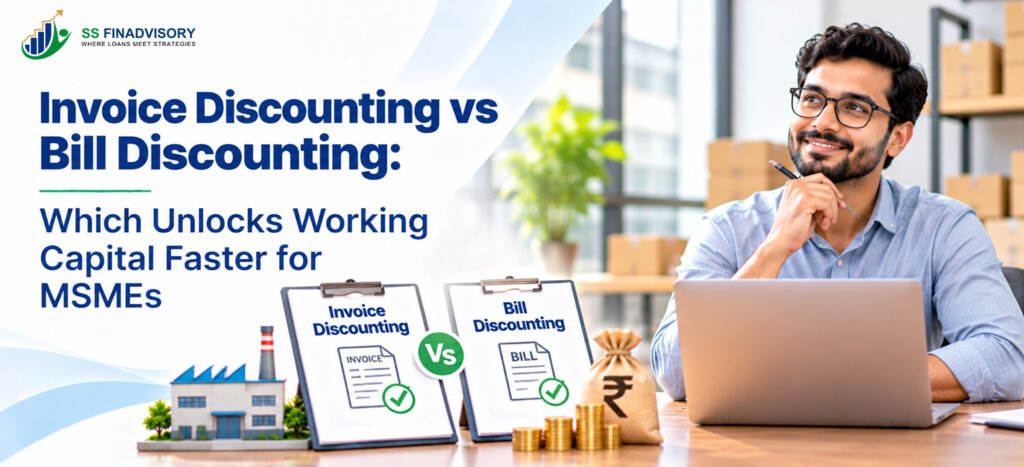
Invoice discounting vs bill discounting is the comparison most MSME owners reach for once bank limits feel tight but customer payments are still stuck in 45 or 90 day cycles. Both routes turn invoices into cash, but they work quite differently and can change how much control you keep over your customer relationships.
If you run a growing MSME in India, you need to know which of these options actually frees up working capital quickly, what it costs in real terms, and how it fits with the credit lines you already use. By the end, you will have a clear view of when to use each option, where TReDS invoice discounting fits in, and what lenders quietly look at before approving limits.
Where MSMEs Actually Get Stuck On Receivables
The real problem is not knowledge of products, it is the gap between your sales growth and the speed at which customers pay. Collections improve slowly, but payroll, rent and vendor payments cannot wait, which is why many MSMEs lean on an overdraft or Working Capital Loan vs Cash Credit type facilities until limits are exhausted.
On paper, receivables look like strong security, yet banks treat them cautiously because disputes, returns and delayed acceptances are common. So founders start searching for invoice discounting India MSME solutions that can sit beside existing bank lines instead of replacing them.
Basics First: What Each Product Really Does
Before you compare invoice discounting vs bill discountingit helps to strip away the jargon and see what actually moves cash into your account. Both are forms of receivables finance, but the underlying documents and process flows differ, which is where speed and control diverge.
In many cases, your banker will pitch these tools right after you discuss a Calculate the Right Working Capital Requirement for a Growing Business style exercise, because they appear as an answer to a clear funding gap in your cash flow cycle.
How Invoice Discounting Works In Practice
With invoice discounting, you raise an invoice on a customer, then share that invoice and supporting documents with a financier who funds a percentage of the invoice value upfront. The customer usually pays into a controlled account, and the financier recovers principal plus charges before passing any balance back to you. If you’d rather hand this part over, it’s the kind of work our Business Loan vs Working Capital Loan team handles every week.
Arrangements may be disclosed or undisclosed to your buyer, but in both cases you retain most of the collection responsibility, and this is why many lenders want to see your ageing report and past collection efficiency before they quote terms on your receivables financing business.
How Bill Discounting Works In Practice
Bill discounting typically involves a bill of exchange or usance bill accepted by your customer, which turns a trade debt into a more formal payment obligation. Once the bill is accepted, a bank or financier discounts it and credits your account, then collects from the customer on the due date.
Because the buyer has accepted the bill, the bank tends to look more at the buyer’s strength than yours, which is why bill discounting often suits MSMEs selling to established corporates rather than a wide spread of small buyers.
Speed Of Cash: Which Option Is Usually Faster
When MSME promoters ask which option releases cash faster, the answer depends on where you are in the documentation cycle. For repeat customers and pre-approved limits, invoice discounting can be quick because the financier already knows your book and systems.
On the other hand, if your buyers are large companies that accept bills promptly, a clean bill discounting line can move funds into your account soon after acceptance, similar in speed to a focused Working Capital Loan for MSMEs disbursal tied to purchase orders.
Role Of TReDS And Digital Platforms
For MSMEs supplying to government departments or large corporates, TReDS invoice discounting has changed the speed and transparency of receivables finance. Once the buyer approves the invoice on a TReDS platform, multiple financiers can bid, which often reduces pricing and cuts negotiation time.
TReDS does not replace traditional limits overnight, but it adds a clean, transaction backed way to monetise approved invoices, especially when your regular bank is already at its comfort limit for your sector.
Control, Risk And Relationship Impact
Choice between these two tools is not only about speed of cash, it is also about who controls collection and how buyers experience the process. With invoice discounting, you usually stay at the center of communication with the customer, even when the arrangement is disclosed.
Bill discounting shifts more of the collection interaction to the bank, which can suit you if your team struggles with follow up. It can also feel heavier for some buyers, because payment delays are now seen as a default on an accepted bill rather than a late vendor payment.
Recourse, Security And Collateral
Most MSME focused invoice discounting lines in India are on a recourse basis, which means if the buyer does not pay, the financier can call on you. Some structures take additional comfort over collateral, similar in thinking to a loan against property for working capitalespecially when limits are large.
Bill discounting can also be recourse, but since the buyer has accepted a bill, banks often feel more comfortable and may ask for comparatively lighter additional security when the drawee is a strong rated corporate.
Cost, Documentation And Fit With Other Limits
From a pure interest rate view, both products usually price slightly higher than your standard working capital cash credit, because they are more transactional and involve extra operational work. The real saving comes when faster cash helps you capture supplier discounts or avoid emergency short term borrowing.
One mistake we see is MSMEs treating these tools as stand alone solutions instead of weaving them into broader Business Loan & Working Capital Planning. If you do not map receivables finance to seasonality and customer mix, you can end up with limits that are idle for half the year.
Operational Effort And Internal Readiness
No lender advertises the back office effort these products need. Someone in your team has to track invoices pledged, reconcile collections, and manage disputes quickly so they do not freeze limits.
Invoice discounting usually demands tighter internal controls, since a larger part of responsibility sits with your accounts team, while bill discounting leans more on buyer acceptance discipline, which can be harder to push if you lack bargaining power.
How To Decide Between The Two Right Now
The practical choice depends on who your customers are, how concentrated your receivables book is, and how modern your invoicing processes already are. If your customers are many and fragmented, and you want to keep collection conversations in house, invoice discounting tends to fit better.
If you sell mainly to a few strong buyers who are comfortable with formal bills of exchange and have clear payment cycles, bill discounting can be simpler, much like deciding between a Business Loan vs Working Capital Loan structure based on a single anchor client contract.
When To Mix Both With Other Options
In practice, many growing MSMEs use a mix of these tools along with term loans and property backed limits. A base cash credit or overdraft handles day to day swings, while receivables finance kicks in when sales spike and approved invoices outgrow existing limits.
Reviewing these options once a year along with policies on prepayment, especially in light of changing rules around Prepayment Charges on MSME Business Loanscan keep your overall cost of capital under control.
Conclusion
For most MSMEs, neither tool is perfect, and the right answer in the invoice discounting vs bill discounting debate usually depends on buyer profile, internal systems, and how cleanly you can track collections. Invoice based solutions tend to be more flexible, while bill based models can be powerful when a few strong buyers dominate your receivables.
Used thoughtfully, both can speed up working capital and reduce pressure on other limits, and this is where a specialist like ss finadvisory can help you align products with actual cash flow instead of just sanction letters. If you are weighing options, now is a good time to map your receivables, list your top buyers, and explore which structure fits your next twelve months of growth.
Frequently Asked Questions
Q1. What is the main difference between invoice discounting and bill discounting?
Ans. Invoice discounting is funding against your sales invoices, where you usually keep control over collections. Bill discounting is funding against accepted bills of exchange, where the bank focuses more on the buyer’s commitment to pay. Both convert receivables to near term cash but follow different documents and processes.
Q2. Is invoice discounting better than a regular working capital loan for MSMEs?
Ans. Neither option is automatically better, they solve different problems. A regular working capital loan or cash credit is good for ongoing needs across customers, while invoice discounting is sharper when you have large, approved invoices with long credit terms. Many MSMEs use both, keeping the bank line for baseline needs and invoice discounting for sales spikes.
Q3. Does invoice discounting affect my relationship with customers?
Ans. It can affect the relationship depending on how visible the arrangement is to buyers and how collections are handled. If the structure is disclosed and the financier communicates directly with customers, buyers may feel more formal pressure around payment dates. When managed well, though, many large buyers treat it as a normal part of vendor finance in supply chains.
Q4. Who can use TReDS platforms for invoice discounting in India?
Ans. TReDS platforms are meant mainly for MSMEs that supply to large corporates, public sector units and government departments that are registered on the same platform. The MSME uploads invoices, the buyer approves them, and financiers bid to discount those invoices. You need to complete registration and basic KYC before using any specific TReDS platform.
Q5. Can I use both invoice discounting and bill discounting at the same time?
Ans. Many MSMEs use a combination, provided the same receivable is not financed twice. For example, you might use bill discounting with a few large buyers who accept bills, while using invoice discounting with a financier for other buyers or exports. Coordination with your bank and clear internal tracking are important so exposures do not overlap.
Q6. What documents are usually needed to start invoice or bill discounting?
Ans. Lenders generally ask for KYC documents, financial statements, GST returns, bank statements and details of your top customers. For invoice discounting, they will look at invoices, purchase orders and delivery proof, while bill discounting requires accepted bills of exchange and related trade documents. Exact checklists differ by bank and platform, so it is better to confirm requirements early in the process.