Commercial property in a Tier 2 city gave a client 55% LTV — not the 70% they expected. Knowing this in advance saves time, prevents wasted applications, and avoids unnecessary CIBIL inquiries.
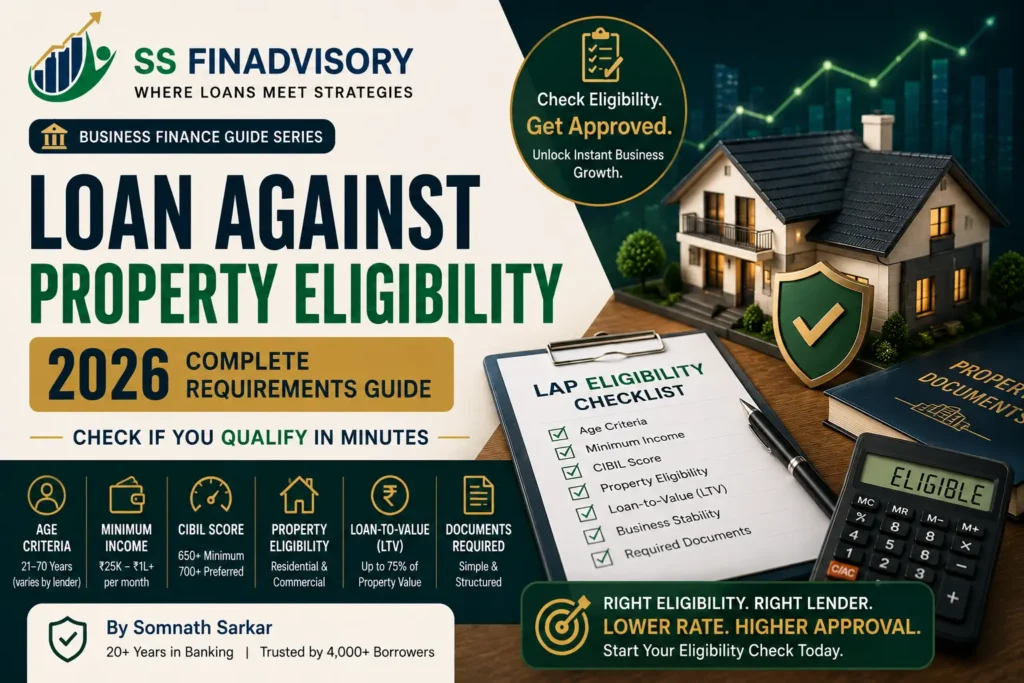
LAP eligibility depends on a combination of borrower profile and property characteristics. Each bank has specific criteria, but most evaluate the same underlying factors: your age, income, credit history, and the property’s type, location, and ownership clarity. This guide walks through every requirement with 2026 benchmarks — and the specific reasons borrowers get rejected, with fixes.
Core Eligibility Criteria for LAP in 2026
Age Requirements (21–65 Years at Loan End)
Most lenders require the borrower to be at least 21 years old at application and not exceed 65 years at loan maturity. On a 15-year LAP, this means you can apply until age 50; for a 10-year tenure, until age 55; for 5 years, until age 60. Some lenders extend upper limits to 70 for pensioners or for shorter tenures. If you are above the bank’s age cap, add a younger co-applicant (spouse, adult child) to bring the combined age profile within limits.
Income: Salaried vs Self-Employed
Salaried
Standard Requirements
- Minimum monthly income ₹25,000 at most banks
- 2 years continuous employment
- Current employer: 12+ months
- Salary credited to a bank account
- Form 16 for 2 financial years
- 6 months bank statements showing salary
Self-Employed
Professionals & Businesses
- 3 years business continuity
- ITR filed for 3 continuous years
- Audited P&L & balance sheet (2 yrs)
- GST returns (if applicable)
- 12 months business bank statements
- Stable or growing income trend
The banks’ income multiplier formulas differ, but a rough benchmark: your total monthly EMIs (existing + new LAP) should not exceed 55–60% of your monthly income. For a salaried borrower earning ₹1 lakh/month, that allows total EMI up to ₹55,000–₹60,000. After deducting existing obligations, the residual capacity determines your eligible LAP amount.
CIBIL Score Requirement (Minimum 650, Ideal 750+)
780+
Best rates unlocked
750–779
Standard rates
700–749
0.25–0.50% premium
Below 700
0.75%+ or rejection
The CIBIL threshold determines both eligibility and rate. Banks set 650 as the practical floor; NBFCs and HFCs accept down to 620–650 at a premium. For self-employed borrowers, banks also check commercial CIBIL — a weak score here can cause rejection even with strong personal CIBIL. Always pull both reports before applying.
Quick CIBIL boost strategies: (1) pay down credit card balances to below 30% of the limit at least 30 days before applying, (2) do not apply for any new credit in the 6 months before LAP, (3) dispute any errors on your CIBIL report. These three steps alone can add 30–60 points in 60–90 days.
Property Eligibility — What Types of Property Qualify?
Not all properties qualify for LAP, and among those that qualify, the LTV and rate vary significantly. Here is how lenders rank property types:
| Property Type | LTV Range | Typical Rate | Notes |
|---|---|---|---|
| Self-occupied residential | Up to 75% | 9.5–10.5% | Best combination — highest LTV, lowest rate |
| Rented residential | 70% | 10.0–11.0% | Slight premium for tenant risk |
| Self-occupied commercial | 60–65% | 10.5–11.5% | Office, shop, showroom |
| Rented commercial | 55–60% | 11.0–12.5% | Lower LTV; rental income considered |
| Industrial property | 50–55% | 11.5–13.0% | Factory, warehouse; often requires additional checks |
| Residential plot / vacant land | 50–60% | 11.0–12.5% | Many banks do not lend; select NBFCs only |
| Agricultural land | Not eligible | N/A | Excluded from LAP at most lenders |
* LTV = Loan-to-Value ratio. Actual LTV depends on property location, age, condition, and the lender’s internal valuation. Tier 1 city properties typically get higher LTV than Tier 2/3.
Additional property requirements: (1) clear and marketable title, (2) no existing mortgage or encumbrance, (3) all statutory approvals in place (building plan, occupancy certificate), (4) property tax paid up to date, and (5) the property must be registered in the name of the applicant (or close family member who joins as co-applicant). Properties under construction, disputed properties, or those with incomplete paperwork are typically rejected.
Loan-to-Value (LTV) Ratio — How Much Can You Borrow?
LTV determines your maximum eligible LAP amount as a percentage of the property’s current market value. The lender’s panel valuer conducts an independent valuation — the sanctioned amount is a percentage of this valuation, not of your claimed value or the circle rate.
Example calculation: you own a residential property currently valued at ₹1.5 crores. At 70% LTV, the maximum eligible LAP is ₹1.05 crores. But your income might cap this further — if your monthly income allows EMI capacity of only ₹70,000, the corresponding loan amount at 10.25% over 15 years is roughly ₹63 lakhs. The lower of (LTV limit × property value) and (EMI capacity × duration factor) becomes your sanctioned amount.
Tier 2/3 city consideration: LTV for properties in smaller cities is often 10–15 percentage points lower than the advertised maximum. A property worth ₹1 crore in a Tier 1 city may qualify for 70% LTV (₹70L loan); the same type of property in a Tier 2 city may get only 55–60% LTV (₹55–60L loan). Valuation adjustments for liquidity and demand risk. If you are in a Tier 2/3 city, factor this into your planning.
Check Your LAP Eligibility with a Free Expert Assessment
I will review your income, CIBIL, and property details — then tell you exactly which lenders will approve you, at what rate, for what amount, before you apply and risk unnecessary credit inquiries. Book a Free Eligibility Call
Common Reasons for LAP Rejection (and How to Fix Them)
- Title defects or unclear ownership chainMissing intermediate deeds, unregistered historical transfers, or disputed ownership typically trigger rejection.Fix: Get a fresh legal opinion and encumbrance certificate. If there are gaps, clear them via registered deeds or court declarations before applying. This is the single most common and most fixable rejection reason.
- Existing mortgage on the propertyA property with a live home loan cannot be pledged for a separate LAP.Fix: Use a top-up loan from your existing home loan lender instead — same collateral, no new mortgage registration. Alternatively, pledge a different unencumbered property.
- High EMI-to-income ratio (above 60%)Total EMIs from all sources (existing loans, credit cards, new LAP) exceeding 60% of your monthly income.Fix: Close smaller personal loans or credit card balances to free up EMI capacity. Alternatively, extend LAP tenure to reduce the new EMI, bringing total below the threshold.
- Low CIBIL score or recent loan delaysCIBIL below 700, or 30+ day delays on any loan within the last 12 months.Fix: Wait 6–12 months after regularising any delays. Bring credit card utilisation below 30%. For self-employed, fix commercial CIBIL errors. See our CIBIL guide.
- Property in non-standard location or typeRural property, agricultural land, or property in a location where the bank has limited exposure.Fix: Apply to NBFCs (Bajaj, Tata Capital) that have broader geographic coverage. Alternatively, pledge a different property in a bank-approved location.
- Inconsistent or incomplete income documentationSalary slips showing recent changes, self-employed applicants with ITR gaps, or unaudited financials.Fix: For salaried: provide old employer Form 16 + new appointment letter together. For self-employed: file all pending ITRs and get audit completed before applying. See self-employed guide.
Eligibility Calculator: Estimate Your Maximum LAP Amount
3-Step Estimation Formula
- Calculate Property-Based CapYour maximum loan based on LTV.
Property Value × LTV % = Property Cap - Calculate Income-Based CapYour maximum loan based on EMI capacity.
(Monthly Income × 55%) − Existing EMIs = EMI Capacity
Then convert EMI capacity to loan amount at the offered rate and tenure. - Your Maximum LAP = Lower of the TwoThe actual eligible amount is whichever cap is lower.
MIN(Property Cap, Income Cap)
Worked Example: Salaried Borrower
Borrower: Salaried professional, ₹2,50,000/month income, existing home loan EMI of ₹55,000, CIBIL 780. Property: Self-occupied residential in Bangalore, valued at ₹2 crores.
Step 1 — Property-based cap: ₹2,00,00,000 × 70% LTV = ₹1,40,00,000.
Step 2 — Income-based cap: ₹2,50,000 × 55% = ₹1,37,500 total EMI capacity. Minus existing EMI of ₹55,000 = ₹82,500 available for new LAP. At 10.25% over 15 years, this EMI supports a loan of ~₹75,50,000.
Step 3 — Eligible amount: MIN(₹1.40 Cr, ₹75.5L) = ₹75.5 lakhs.
Even though the property can support a ₹1.40 Cr loan, income is the binding constraint here. To increase eligibility, the borrower could: extend tenure to 20 years (increases loan to ~₹88L), add a co-applicant with earning capacity, or close the existing home loan first to free up EMI capacity.
Frequently Asked Questions
What is the minimum CIBIL score for a loan against property?
Minimum 650 at most banks (700 practical floor at major lenders). 750+ unlocks best rates. Below 700 faces 0.75%+ premium or rejection. For self-employed, both personal and commercial CIBIL are evaluated. NBFCs accept 620–650 at premium rates.
Can I get LAP on a property with an existing home loan?
No — a property with a live mortgage cannot be used as separate LAP collateral. Alternatives: (1) take a top-up loan from existing lender, (2) close existing loan first (usually uneconomical), or (3) pledge a different unencumbered property. Top-up is the cleanest route.
Is rental income considered for LAP eligibility?
Yes — at 60–75% of gross rent (accounting for vacancy, maintenance, tax). Requires registered rent agreement, 12+ months rent credits in bank statements, property tax receipts. Rental from the pledged property itself is discounted more heavily or excluded.
Can a partnership firm get a loan against property?
Yes — firms, LLPs, and Pvt Ltd companies qualify. Documentation: partnership deed/MOA/AOA, 2–3 years audited financials, GST returns, ITR for firm and partners. Takes longer (30–45 days) with board resolutions. Rates 0.10–0.25% higher than for individual applicants.
What is the minimum property value required for LAP?
₹25–50 lakhs at major banks. SBI and HDFC start at ₹25L property value; Axis and ICICI at ₹50L+. NBFCs like Bajaj Finance accept ₹15–20L. Minimum loan amount ranges ₹5–10L. For smaller property/loan combinations, personal or business loans may be more practical.
Know Before You Apply — Book a Free Eligibility Review
I will review your profile, property, and existing liabilities — then tell you your exact eligible amount across 4–5 lenders before you trigger any CIBIL inquiries. Book Free Consultation
About the Author: Somnath Sarkar is a loan strategy consultant with 20+ years at Axis Bank and Deutsche Bank, specialising in LAP structuring, eligibility assessment, and SME funding.
Disclaimer: Eligibility criteria, LTV ratios, and lender policies vary and are subject to change. Information is based on industry practice as of March 2026. This article is for educational purposes only and does not constitute financial advice. Consult a qualified financial advisor for your specific situation.
Last Updated: 07 June 2026 | First Published: 07 June 2026
© 2026 Somnath Sarkar. All rights reserved.