LAP Rate Range · March 2026
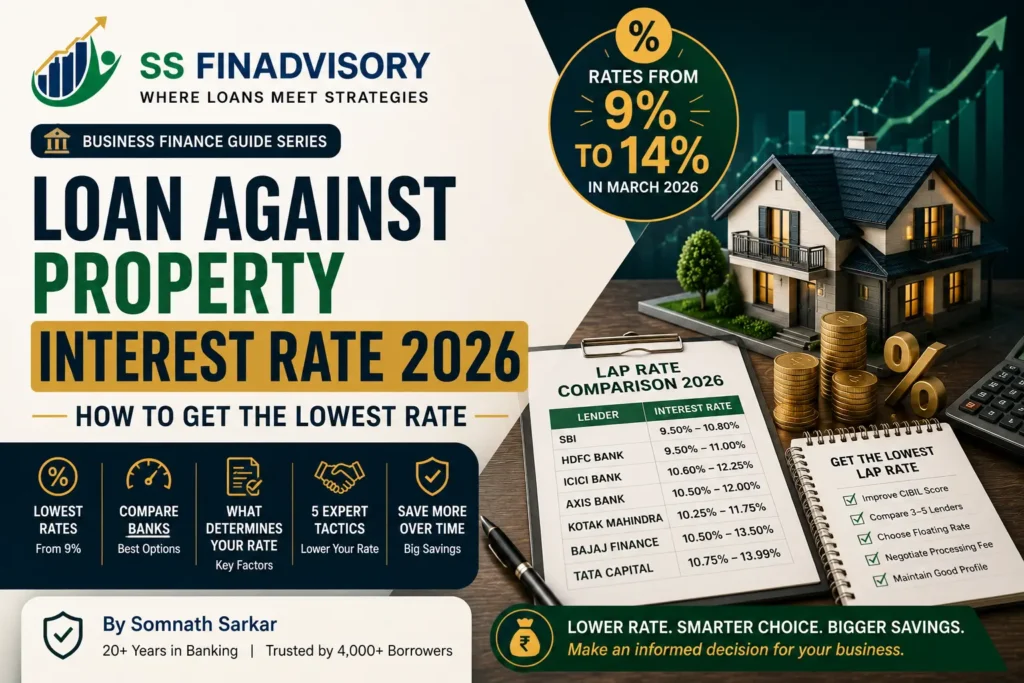
9.0% — 14.0%
The spread between the lowest and highest LAP rate is 5 percentage points. Knowing how to position yourself within this range can save ₹4–8 lakhs over your loan’s tenure.
LAP rates are the most negotiable of all secured loans — most borrowers do not realise how much room there is. A well-prepared borrower with a strong profile and competing offer routinely negotiates 0.25–0.75% below the first quote.
Banks price LAP based on a combination of your profile, property, and the competing offers you bring to the table. A 0.5% reduction on an ₹80 lakh LAP over 12 years saves roughly ₹4 lakhs. That is the size of the opportunity borrowers regularly miss by accepting the first rate offered. This guide covers the current LAP rate landscape, the five factors that determine your specific rate, how to negotiate effectively, and the hidden charges that inflate your effective cost beyond the headline number.
Current LAP Interest Rates in India (2026) — All Major Lenders
| Lender | LAP Rate Range | Processing Fee | Max LTV | Best For |
|---|---|---|---|---|
| SBI | 9.50% – 10.80% | 1% (capped ₹50K) | 65% | Lowest rate |
| Bank of Baroda | 9.60% – 10.90% | 0.5%–1% | 65% | PSU alternative |
| HDFC Bank | 9.50% – 11.00% | Up to 1% (min ₹7,500) | 65% | Service quality |
| Axis Bank | 10.50% – 12.00% | 1% (negotiable) | 70% | Speed + flexibility |
| Kotak Mahindra | 10.25% – 11.75% | 0.5% – 1% | 70% | HNI profiles |
| ICICI Bank | 10.60% – 12.25% | 1% + GST | 70% | Doctor LAP (75%) |
| Bajaj Finance | 10.50% – 13.00% | 1.5% – 2% | 75% | Fast disbursal |
| Tata Capital | 10.75% – 13.50% | 1.5% | 70% | Flexible eligibility |
| LIC Housing Finance | 9.70% – 11.50% | 0.5% – 1% | 70% | HFC alternative to banks |
* Rates verified March 2026 for salaried borrowers with CIBIL 750+ and self-occupied residential property. Actual rate offered may vary based on profile, property type, and loan amount.
The headline takeaway: public sector banks (SBI, BoB) offer the lowest rates but have stricter documentation and longer turnaround. Private banks (HDFC, Axis, ICICI, Kotak) offer competitive rates with better service. NBFCs (Bajaj, Tata Capital) and HFCs (LIC Housing) are the go-to for borderline profiles or faster disbursal, at a rate premium.
What Determines Your LAP Interest Rate? (5 Key Factors)
1
Property Type & Occupation Status
Self-occupied residential property gets the best rate. Rented residential adds 0.25–0.5%. Commercial property adds 0.5–1%. Industrial adds 1–1.5%. Vacant property is most expensive.Impact: ±1.5%
2
CIBIL Score
780+ unlocks best rates. 750–779 gets standard. 700–749 costs 0.25–0.50% premium. Below 700 attracts 0.75%+ or rejection. Self-employed: commercial CIBIL also checked.Impact: ±1.0%
3
Loan-to-Value (LTV) Ratio
Lower LTV = lower rate. 50% LTV gets best rate; 60–65% is standard; 70–75% attracts premium. Pledging property worth much more than you borrow signals lower risk.Impact: ±0.5%
4
Income Profile & Stability
Salaried with stable employment gets best rates. Self-employed with 3+ years ITR comes next. Newer businesses or variable income attracts 0.25–0.75% premium.Impact: ±0.75%
5
Loan Amount & Tenure
Larger loans (₹50L+) often negotiate better rates. Shorter tenure (under 10 years) may qualify for discount. Very small amounts (under ₹10L) may carry minimum-rate constraints.Impact: ±0.25%
6
Existing Banking Relationship
Customers with salary account, prior home loan, or significant deposits with the bank often receive 0.10–0.25% discount. Mention all existing relationships during negotiation.Impact: ±0.25%
The cumulative impact of these factors can move your rate by 2–3 percentage points. A salaried borrower with 800 CIBIL pledging self-occupied residential property at 50% LTV for 10 years will often land 1.5–2% below the maximum rate the same lender charges for a borderline profile.
How to Negotiate a Lower LAP Rate (With Script)
LAP rates are genuinely negotiable — more so than home loan rates or business loan rates. Most lenders have 0.25–0.75% of discretion built into their quoted rates, waiting to be unlocked by an informed borrower. Here is the exact approach:
Rate Negotiation Conversation
YOU“I need a ₹80L LAP against my self-occupied residential property valued at ₹1.5 crore. My CIBIL is 795 and I have been banking with you for 7 years. I have a written indicative offer from SBI at 9.75%. What is your best rate?”
RM“Our standard rate for your profile would be 10.50%. Let me check with underwriting — given your CIBIL and our existing relationship, I might be able to offer 10.25%.”
YOU“10.25% is still 0.50% above the SBI offer. Considering the property is self-occupied, LTV is only 53%, and I have a 7-year clean relationship — can you match 9.75% or at least 10.00%?”
RM[After supervisor approval] “The maximum we can offer is 10.00%, with a 0.5% processing fee waived to 0.25%. Beyond that, I need regional approval which will add 7 working days.”
YOU“Can you please seek regional approval for 9.75%? I am ready to proceed immediately if you can match. Otherwise, I will proceed with SBI.”
Five principles that make negotiation work:
1. Bring a competing written offer. Get an indicative sanction letter from at least one other lender before approaching your preferred bank. Hearsay (“I heard HDFC is offering…”) has no leverage; a written offer has maximum.
2. Highlight your specific strengths. Mention CIBIL, LTV, self-occupied status, property valuation, length of banking relationship, and any existing deposit/relationship balances. Each is a legitimate rate-reducing factor.
3. Ask for rate AND processing fee reduction together. Banks often trade one for the other. If the RM cannot go lower on rate, they may waive/reduce processing fee. On a ₹80L loan, a 0.5% processing fee waiver is ₹40,000 in pocket.
4. Be willing to walk. The biggest rate reductions come when the bank believes you will take the competing offer. Mention your deadline and the alternative in every conversation.
5. Escalate above branch level. Branch RMs have limited discretion. For ₹50L+ loans, ask to speak with the Cluster Head or Regional Manager — they have higher authority and more room to negotiate.
Want to Benchmark Your LAP Rate Against the Market?
I will source indicative offers from 4–5 lenders based on your property and profile, then negotiate the best rate on your behalf — typically saving 0.50–0.75% versus what borrowers negotiate alone. Book a Free Rate Benchmark Call
Floating vs Fixed Rate LAP — Which Is Better?
Floating Rate
Better for Long Tenure
- Starts lower than fixed rate
- Adjusts automatically to RBI repo rate
- Benefits from rate cuts (repo at 5.25% now)
- Zero prepayment charges per RBI rules
- Ideal for 7+ year tenures
- Typically 0.5–1% cheaper than fixed
Fixed Rate
Better for Short Horizons
- Predictable EMI throughout tenure
- Protects against rising rate environments
- Starts 0.5–1% higher than floating
- May carry 2–3% prepayment penalty
- Ideal for 3–5 year defined horizons
- Better for risk-averse cash flow planners
For most LAP borrowers, floating rate is the better choice. The starting rate is lower, you benefit from any RBI rate cuts, and prepayment is penalty-free under RBI’s 2025 Directions. Fixed rate makes sense in specific situations: very short tenures (under 5 years), risk-averse cash flow planning, or when you strongly expect rates to rise.
Most banks allow conversion between fixed and floating during the loan tenure — HDFC charges up to ₹3,000, ICICI and Axis charge 0.25–0.5% of outstanding. Review your rate environment annually; if your fixed rate is now significantly above the prevailing floating rate, a switch may save lakhs.
LAP Rate vs Business Loan Rate: The True Comparison
₹80 Lakh Financing · 10-Year Tenure · Side-by-Side
Business Loan @ 15%EMI: ₹1,29,068 · Total interest: ₹74.9L
LAP @ 10.25%EMI: ₹1,06,766 · Total interest: ₹48.1L
EMI saving with LAP₹22,302/month
Total Interest Saved with LAP₹26.8 lakhs
For comparable amounts and tenures, LAP saves ₹20–40 lakhs versus unsecured business loans. The rate advantage holds across all tenures but becomes especially pronounced over longer horizons where the interest compounds. For the complete comparison framework including non-rate factors, see our Business Loan vs LAP pillar guide.
Hidden Charges That Inflate Your Effective LAP Rate
The advertised rate is only part of your true cost. These charges, often overlooked, can inflate your effective rate by 0.5–1.5%:
- Processing Fee (0.5–2% of loan amount)On ₹80L, a 1% processing fee is ₹80,000. Spread over 10 years, this adds approximately 0.10% to effective rate.
- Property Valuation Fee (₹3,000–₹8,000)Usually one-time. Confirm whether fee is included in processing fee or charged separately.
- Legal Verification & Title Search (₹5,000–₹15,000)Charged for the legal opinion on your property title. Cannot be waived.
- Stamp Duty on Mortgage Deed (₹500–₹30,000 depending on state)State-specific — Karnataka and Maharashtra have higher rates, Delhi is lower. Required for mortgage registration.
- CERSAI Registration (₹500–₹1,500)Statutory registration of the security interest. Must be paid.
- Insurance Bundling (₹20,000–₹80,000 for property/credit cover)Often pushed aggressively. Usually optional — decline politely.
- Rate Conversion Fee (up to 0.5% of outstanding)If you convert fixed → floating or vice versa later. Negotiate down to 0.25% or waiver at origination.
- Prepayment Penalty (2–3% on fixed rate)Zero on floating for individuals under RBI rules. Confirm in writing before signing.
Effective rate reality check: A LAP advertised at 10.25% can easily have an effective cost of 10.75–11% once processing fee, insurance bundling, and fees are factored in. Always calculate the all-in cost across alternatives — the lender with the lowest headline rate may not be the cheapest overall.
Frequently Asked Questions
What is the current interest rate for a loan against property in 2026?
LAP rates range 9.0%–14.0% in March 2026. Major banks: SBI 9.50–10.80%, HDFC 9.50–11%, ICICI 10.60–12.25%, Axis 10.50–12%, Kotak 10.25–11.75%. PSU banks typically lowest for prime profiles; NBFCs 10.5%+ with faster processing.
Is the LAP rate higher or lower than the home loan rate?
LAP rates are 1–2% higher than home loan rates. Home loans at 8.50–9.00% vs LAP at 9.50–10.50% for comparable profiles. Reason: LAP funds go to business/personal use (higher risk vs property acquisition), lower LTV (60–75% vs 80–90%), shorter tenure.
Can I switch from fixed to floating rate on my LAP?
Yes — most banks allow switching with a conversion fee. HDFC up to ₹3,000; ICICI and Axis 0.25–0.5% of outstanding. Switch only if the rate gap is 0.5%+. Floating rate generally better for 7+ year tenures.
What CIBIL score gives the lowest LAP rate?
780+ unlocks the lowest rates. 750–779 gets standard rates. 700–749 attracts 0.25–0.50% premium. Below 700 costs 0.75%+ premium or rejection. Self-employed borrowers: commercial CIBIL also evaluated alongside personal.
Do NBFCs offer lower LAP rates than banks?
Generally no. Banks start at 9.5–10.5%; NBFCs like Bajaj Finance at 10.5–12%. NBFCs compensate with faster processing (10–20 days vs 25–45 days), more flexible eligibility, and specialised products. Better choice if banks decline or speed is critical.
Let Me Negotiate Your LAP Rate
I know which lenders have room to move and how far — having structured 200+ LAP cases. I source competing offers, escalate to the right authority level, and typically extract 0.50–0.75% better than DIY negotiation. Book Free Consultation
About the Author: Somnath Sarkar is a loan strategy consultant with 20+ years at Axis Bank and Deutsche Bank, specialising in LAP structuring, rate negotiation, and SME funding.
Disclaimer: Interest rates and policies vary by lender and are subject to change. Rates verified as of March 2026 — verify current terms directly with lenders. This article is for educational purposes only and does not constitute financial advice. Consult a qualified financial advisor for your specific situation.
Last Updated: 06 June 2026 | First Published: 06 June 2026
© 2026 Somnath Sarkar. All rights reserved.