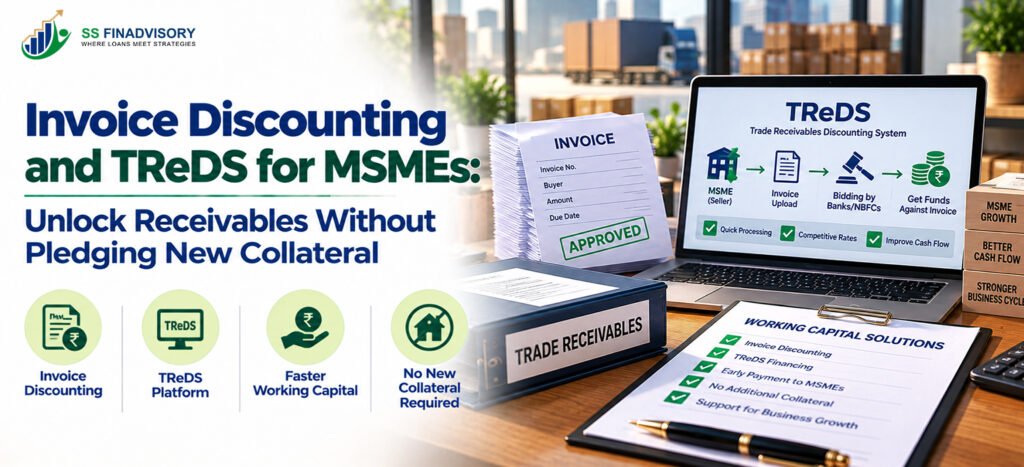
Invoice discounting matters for MSMEs because it turns approved invoices into working cash without waiting 60 or 90 days for customers to pay. For an owner already stretched on limits and collateral, it can be the difference between taking the next order or turning it away.
In the next few minutes we will walk through how bank bill discounting, NBFC invoice programs and TReDS actually work in India, where they fit in your funding mix, and which traps to avoid. We will also touch on how RBI rules and bank practices affect pricing, and where a mix of receivable finance and longer term funding usually works better than just squeezing your cash credit harder. It’s one of the first things we look at in any cash Credit renewal project.
Where Invoice Finance Fits In Your Working Capital Plan
Most MSMEs first look at invoice finance only after cash credit is always near the limit and suppliers start asking for faster payment. At that stage, another traditional loan backed by property often feels impossible because family assets are already mortgaged or the bank is slow to consider a top up.
If your limits are already stretched, a product like Business Loan & Working Capital Planning is usually where you map how much can realistically come from bank loans, how much from receivables, and how much from owner funds. Receivable finance is not a magic tap, it still sits inside that overall structure.
Bank Bill Discounting And Classic Invoice Discounting
Traditional bank bill discounting is the oldest form of invoice finance and still the cheapest in most cases. You submit an accepted bill of exchange or an invoice backed by purchase order and proof of delivery, the bank discounts it and credits your account, then collects from your buyer at maturity. We run into this a lot when clients come to us for home Loan age Limit.
In many branches this runs as a sub limit under your cash credit, so the rate is close to your existing cash credit limit enhancement pricing instead of separate, higher NBFC rates. Where we see problems is when the bank insists on margin, exposure caps on each debtor, or slow internal approvals that defeat the purpose of quick liquidity.
How Much Of Your Book Can You Discount
Banks and NBFCs almost never take your full debtor list, they cherry pick rated corporates, PSUs and repeat export buyers. So a unit that sells 70 percent to small retailers may still find that only 30 percent of its invoices qualify for discounting in a cost effective way.
For mixed books, a structure similar to a business loan vs working capital loan comparison usually helps you decide which buyers should sit under receivable programs and which should be left under regular cash credit limits.
What It Really Costs Per Year
On paper, an MSME might see 14 percent annualised and think invoice finance is cheaper than a short term loan. In practice, you have to include discount days, processing fees and any separate charges for unpaid or delayed bills.
Many owners compare the rate only with previous term loans and forget to compare with their current business loan interest rate and the actual cost of occasional overdrawn positions on cash credit.
TReDS Platforms: How They Differ From Regular Invoice Discounting
TReDS platforms were set up to help MSMEs get faster payment against invoices raised on large buyers, without fresh collateral and with transparent auction based pricing. The key difference from classic invoice discounting is that the buyer approves the invoice on the platform and financiers bid for it based on the buyer’s rating, not just your strength.
Since RBI only allows eligible MSMEs and specified buyers to participate, you first have to check if your main customers are already live on a platform. Many larger corporates that regularly use Seasonal Working Capital for Kolkata Traders type structures as buyers or dealers are also present on at least one TReDS platform, especially if their supply chain is MSME heavy.
Practical Onboarding Steps On TReDS
Onboarding is not complicated, but it does take paperwork and time from your team. You need KYC documents, MSME registration, bank mandates and internal mapping of which branches, units or GST registrations will be using which platform.
We often suggest MSMEs that already use bank limits for Working Capital Loan for MSMEs activate TReDS gradually, starting with one or two anchor buyers who pay slowly but have high repeat orders.
Why Buyers Like Or Dislike TReDS
Large buyers agree to TReDS mainly because it cleans up supplier follow ups and makes their own payment cycles more predictable. Once an invoice is accepted, the platform handles settlement and reporting, which reduces friction with suppliers.
Some buyers resist because they feel it exposes their payment practices or they do not want to commit teams to handling acceptance timelines on yet another system. MSMEs then have to balance that with traditional options like Loan Against Property for Working Capital where the buyer’s behavior stays outside the facility.
Comparing Bank, NBFC And TReDS Options
From a pure cost angle, bank linked invoice finance and TReDS usually sit cheaper than standalone NBFC programs, especially if linked to a strong anchor buyer. NBFCs pay for faster tech and looser documentation by charging more, though they sometimes move quicker where banks are reluctant. Getting it right early saves a lot of rework, and it’s a regular part of our home Loan for Business owners work.
For MSMEs that already work with a business loan for new business specialist, the right mix often comes from actually mapping cash cycles, buyer wise days and existing limits instead of picking whatever product the last relationship manager pitched.
Risk And Recourse: Who Bears The Default
A point many owners miss is who finally bears the risk of non payment. In most domestic programs, even on TReDS, the facility is with recourse to the MSME, which means if the buyer defaults, the financier comes back to you.
True non recourse structures are rare and expensive, so you need to treat these limits as advanced collections, not as sales without risk. A separate option like loan against property for MSMEs may still be needed for long term working capital gaps that cannot be fixed by faster collections alone.
How To Use Receivable Finance Without Losing Control
Used well, receivable finance stops being emergency money and becomes a planned part of cash flow. The starting point is a simple buyer wise report showing invoice values, average days outstanding and how often invoices are disputed or short paid. If you’d rather hand this part over, it’s the kind of work our home Loan Without occupancy certificate team handles every week.
Once that is in hand, your msme loan consultant or internal finance head can decide which invoices to route through discounting or TReDS, and which to leave under standard credit terms or even ask for advances on.
Mistakes We See MSMEs Make
One common mistake is using invoice finance as a substitute for overdue equity or long term funds, which leads to chronic dependence and constant fee outgo. Another is running too many programs across banks and NBFCs without a consolidated view, so the team loses track of total exposure.
Where multiple institutions and products are already in place, a structured review similar to business loan consolidation often reveals that some lines can be closed or merged in favour of a more predictable, cheaper structure.
Where A Consultant Actually Adds Value
An independent adviser who understands both bank policy and day to day MSME cash realities can save you years of trial and error. They can also talk to multiple banks and NBFCs without being locked into a single product.
Owners who already work with a working capital finance for small business specialist usually reach receivable finance only after checking if their existing limits can be restructured, topped up or moved to a better mix of products.
For example, if interest outgo keeps climbing every quarter, it may be time to look at how your current lines sit against your cash flow cycle and compare them with structures discussed in How Businesses Can Reduce Working Capital Interest Costs Without Cutting Their Credit Limit.
Where property backed borrowing already supports core working capital and growth, owners may find that a targeted receivable program plugged into a couple of large buyers works better than pushing banks for fresh business loan advisory services on unsecured lines. If you’d rather hand this part over, it’s the kind of work our Loan Against Property for Business team handles every week.
Conclusion
Used thoughtfully, invoice discounting and TReDS can free up cash from approved sales without pledging new collateral or stretching family property any further. They work best when they sit inside a clear working capital plan and when someone senior is watching cost, recourse and buyer behavior month by month.
If you are unsure where to start, sit with your CA or adviser, lay out your buyer list and bank limits on one sheet, and then talk to a specialist like ss finadvisory before signing any multi year invoices or platform contracts.
Frequently Asked Questions
Q1. Is TReDS cheaper than regular invoice discounting for MSMEs
Ans. TReDS is often cheaper when the buyer is a strong rated corporate and multiple financiers bid for your invoice. The rate is then linked more to the buyer than to your own balance sheet. In other cases the benefit may be small, so you need to compare actual quotes on the same invoice value and tenor.
Q2. Can I use invoice finance if my buyer is a small private company
Ans. Many banks and NBFCs prefer larger, better rated buyers, but some will still consider smaller private companies if there is a stable history. In such cases the pricing can be higher and limits per buyer may be tight. You may need to combine invoice finance on your best buyers with traditional limits for the rest.
Q3. Does invoice discounting affect my existing cash credit limit
Ans. If invoice discounting is structured as a sub limit under cash credit, it uses part of the same overall exposure. In other cases it may be sanctioned as a separate facility with its own limit and security. Your sanction letters and bank discussions will show how the bank is treating it for exposure calculations.
Q4. How fast can funds be received after submitting an invoice
Ans. Once documentation and limits are in place, funds can often come within a few days for bank programs and sometimes faster with tech focused NBFCs. On TReDS the timing depends on how quickly the buyer accepts invoices and how active financiers are in bidding. Delays usually arise during onboarding or when invoices are disputed.
Q5. What documents are usually needed for invoice discounting
Ans. Lenders typically ask for the invoice, purchase order, proof of delivery, KYC documents and financial statements, along with details of the buyer. Export transactions may need extra customs and shipping papers. Each lender has its own checklist, so it is better to get that upfront before promising payment timelines to suppliers.
Q6. Is non recourse factoring available to small Indian MSMEs
Ans. Non recourse facilities exist, but they are less common and usually more expensive because the financier takes on default risk. Many providers still structure deals with recourse to the MSME for domestic transactions. If non recourse is offered, read the fine print carefully to see which risks are actually covered.