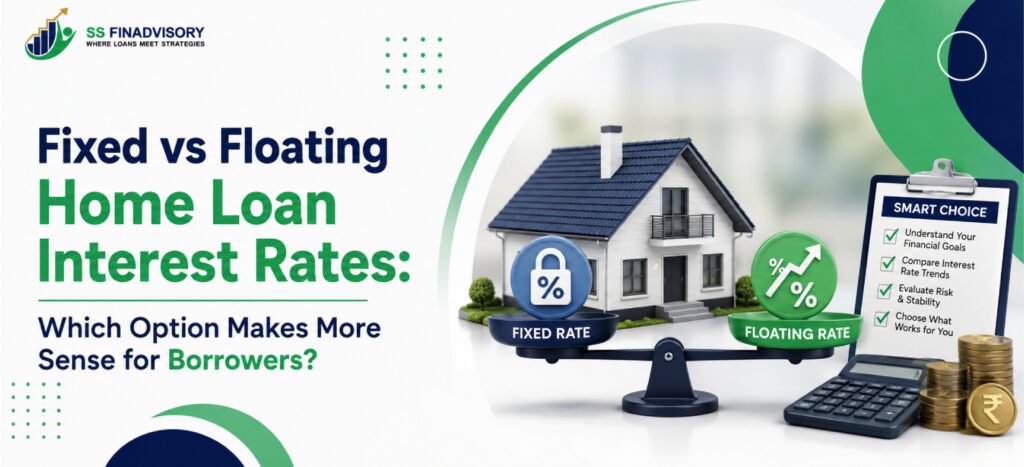
Choosing the right home loan structure can save you lakhs over the life of your loan and protect you from interest rate shocks. As 2026 approaches, many borrowers are asking a crucial question: how to decide between a fixed vs floating home loan when interest rate cycles, inflation expectations, and RBI policy all feel uncertain?
This guide breaks down fixed vs floating home loan options in simple, data-backed terms so you can match your loan to your risk profile, income stability, and financial goals. Using insights from banking practices, past rate cycles, and borrower behaviour, you will learn how to compare interest structures, calculate impact on EMIs, and build a strategy that supports long-term wealth creation.
What Does Fixed vs Floating Home Loan Really Mean?
At its core, the debate on fixed vs floating home loan is about how much interest rate risk you want to carry over the next 10–25 years. Understanding the basics helps you avoid surprises when rates move up or down over time.
Under a fixed structure, your EMI remains the same for a defined period, while a floating structure links your EMI to a benchmark rate set by the lender. Before you sign your agreement, you should clearly understand how the lender defines reset dates, spreads, and conversion fees.
How a Fixed Home Loan Works in Practice
A fixed home loan interest rate keeps your agreed rate unchanged for a lock-in period, often three, five, or ten years. This structure is popular with first-time buyers who want absolute clarity on monthly cash outflows.
Because the lender carries more interest rate risk, the fixed rate is usually higher than a comparable floating rate at the time of sanction. Lenders may also charge penalties if you prepay or refinance during the fixed period, so always read the fine print.
How a Floating Home Loan Works in Practice
A floating home loan interest rate moves in line with a benchmark such as the repo rate or an external lending rate. When the benchmark falls, your effective rate and EMI can reduce over time, which benefits long-term borrowers.
When the benchmark rises, your EMI or loan tenure will increase, depending on your agreement. This structure works better for borrowers who can handle fluctuations and are comfortable tracking monetary policy trends.
Key Differences: Fixed vs Floating Interest Rate Structures
The fixed vs floating interest rate decision affects not only your EMI but also your stress levels and flexibility. You are essentially choosing between price certainty and potential cost savings over the full tenure.
Fixed rates provide stability and make it easier to plan other financial goals such as investments and children’s education. Floating rates can reduce your total interest outgo if the rate cycle trends downward or remains stable for many years.
Home Loan Types in India and Where These Fit In
When you look at common home loan types in India, most banks offer pure fixed, pure floating, and hybrid options. Hybrid structures often combine a fixed period at the start with a floating period later.
Different segments such as salaried professionals, self-employed borrowers, and NRIs may be offered specific variants. Keep in mind that the basic trade-off between stability and variability remains the same across these formats.
Home Loan Comparison 2026: What Should You Expect?
A meaningful home loan comparison 2026 should factor in expected rate cycles over the next three to five years. Many experts anticipate periods of both ups and downs in policy rates as central banks balance growth and inflation.
Instead of chasing the lowest headline rate, evaluate how different structures behave under multiple scenarios. Ask your lender for illustrations that show impact on total interest paid if rates rise or fall by one or two percentage points.
Evaluating the Best Home Loan Interest Rate for You
The best home loan interest rate is not always the lowest one on a comparison chart. It is the rate structure that supports your income pattern, risk appetite, and repayment discipline over long periods.
For a borrower with highly stable income and a long horizon, taking some interest rate risk might create savings. For someone close to retirement, paying a slightly higher but predictable rate can often be the smarter choice.
Home Loan EMI Comparison: Real-World Impact on Cash Flow
A practical home loan EMI comparison shows how small changes in interest translate into real money each month. Even a 0.50% variation in rate can alter your EMI by thousands of rupees, affecting your saving and investment plans.
When comparing offers, calculate EMIs for different tenures at both fixed and floating rates. This will help you understand the trade-off between shorter tenure with higher EMI and longer tenure with more total interest.
Using a Home Loan Interest Rate Guide for Better Decisions
A structured home loan interest rate guide can help you decode complex product brochures and understand key terms. Focus on benchmark type, reset frequency, spread, and any clauses that allow the lender to revise rates independently.
Once you understand how your rate behaves, you can decide whether to keep extra liquidity for prepayments or maintain higher investments as a safety net. This balance is critical for long-term financial health.
Fixed Rate Home Loan Benefits vs Risks
Many borrowers are drawn to fixed rate home loan benefits such as stable EMIs, easier budgeting, and immunity from sudden hikes. These advantages are especially meaningful for families with fixed incomes and tight monthly budgets.
However, you should recognise the risk that market rates may fall while you remain locked at a higher level. Some lenders may allow you to switch, but such conversions often carry fees that reduce overall savings.
When a Fixed Structure Usually Works Better
Fixed structures often suit borrowers who are taking a home loan close to the upper limit of their affordability. The certainty helps them avoid stress if rates rise steeply during the first few years of repayment.
They may also suit those who hold a conservative outlook on interest rate cycles and prefer peace of mind over potential marginal savings. For such profiles, paying a premium for stability can be a rational decision.
Floating Rate Home Loan Benefits vs Risks
For many long-tenure borrowers, floating rate home loan benefits include the chance to benefit from future rate cuts and lower long-term cost. Over a 15–20 year period, multiple downward cycles can significantly reduce total interest.
Floating structures usually have fewer prepayment penalties, allowing you to use bonuses, windfalls, or salary hikes to reduce your principal faster. This flexibility can accelerate your journey to becoming debt-free.
When a Floating Structure Usually Works Better
Floating structures tend to suit younger earners whose income is likely to grow faster than inflation over time. For them, temporary EMI increases are manageable, especially when accompanied by career progression.
They also work well for borrowers who actively track financial markets and are comfortable taking calculated interest rate risk. Such borrowers can pair their loan with an investment strategy that aims to outperform borrowing costs.
How to Decide: Fixed vs Floating Home Loan Strategy for 2026
Choosing between a fixed vs floating home loan in 2026 does not have to be an all-or-nothing decision. You can combine structures or switch later based on clear evaluation criteria and personal circumstances.
Start by mapping your income visibility, job stability, and other big goals such as education or business expansion. Then test how different EMI levels affect your emergency fund, investment plans, and day-to-day lifestyle.
Practical Steps to Build Your Ideal Home Loan Mix
First, shortlist lenders with transparent policies on conversions between fixed and floating options. Then, request scenario analysis that shows how your loan behaves if policy rates change by a few percentage points.
Next, decide what proportion of your loan you want to shield through fixed structures and what proportion can remain open to rate movements. Review this decision every two to three years or whenever a major life event occurs.
- Assess risk tolerance: Decide how much EMI volatility you can handle without stress.
- Review time horizon: Match your loan structure with your expected holding period of the property.
- Compare costs: Look beyond headline rates and factor in fees, penalties, and conversion charges.
- Plan prepayments: Align bonuses and surplus cash with strategic principal reductions.
The right decision on fixed vs floating home loan can put you on a stronger financial footing for decades. By understanding interest structures, comparing realistic EMIs, and aligning your choice with your personal goals, you can use housing finance as a powerful tool for wealth building rather than a source of anxiety. If you want personalised guidance tailored to your profile and city, the advisors at ss finadvisory can help you choose and structure the most suitable option.