
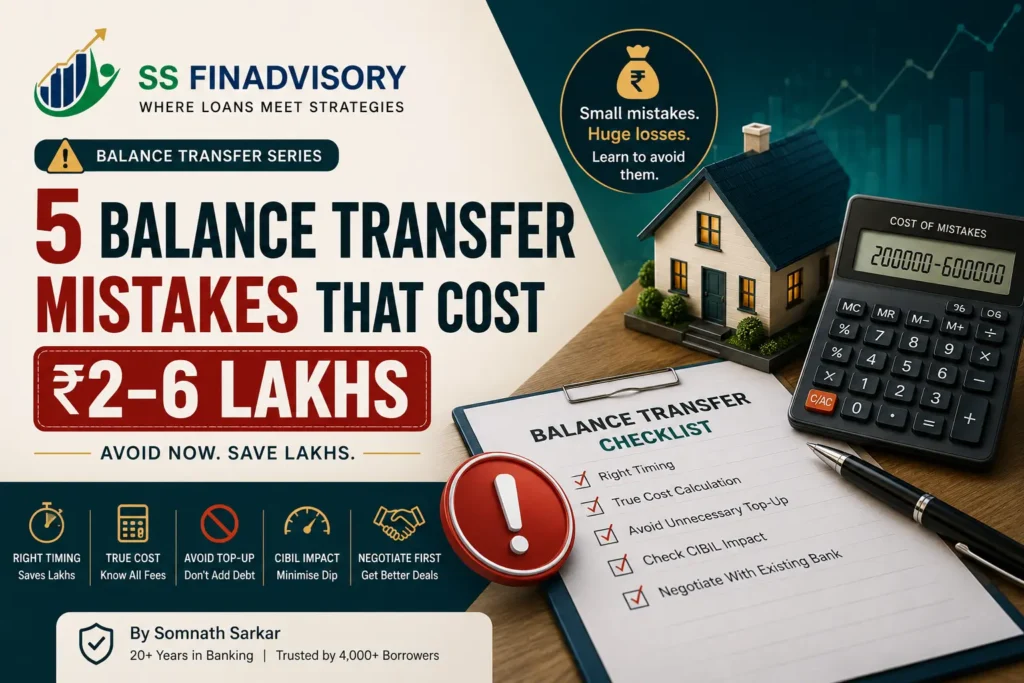
Mistake #5 is the one I find most frustrating — borrowers leave ₹30,000–₹50,000 on the table without even asking their existing bank to match the competing rate. A 10-minute conversation can often capture most of the transfer benefit without any of the transfer costs.
A balance transfer, done right, saves ₹6–14 lakhs. Done wrong, it can actually cost you money. The errors below are not rare — I see them in roughly 40% of the transfer files I audit. Most happen because borrowers focus only on the headline rate difference and ignore the details. Each mistake is explained with its specific rupee impact, a real anonymised case where applicable, and the exact fix.
1ERROR
Transferring Too Late in Loan Tenure
COST: ₹1–3 LAKHS IN LOST BENEFIT
The same rate reduction generates dramatically different savings depending on when you transfer. On a ₹50L loan with 15 years remaining, a 1% rate cut saves ₹8.8 lakhs. With only 5 years remaining, the same rate cut saves just ₹1.4 lakhs — while transfer costs remain the same ₹25,000–₹40,000. The economics often go negative in the final years of the loan.
Real case: A Pune-based senior executive with 4.5 years remaining on a ₹28L outstanding came to me considering a transfer from 9.25% to 8.50%. On paper, a 0.75% rate cut sounds worthwhile. Running the numbers: gross savings of ₹58,000, transfer costs of ₹22,000 — net benefit just ₹36,000. With the time, paperwork, and temporary CIBIL dip factored in, we concluded the transfer was not worth it. Instead, he deployed his ₹5L bonus as prepayment and closed the loan 18 months early, saving ₹1.9 lakhs without any transfer complexity.
Fix: Only transfer if you have at least 7 years remaining, outstanding above ₹20L, and a rate gap of 0.5%+. If your remaining tenure is under 5 years, focus on aggressive prepayment instead. Use our break-even calculator to verify before deciding.
2ERROR
Ignoring Total Transfer Costs (Not Just Rate Difference)
COST: ₹30,000–₹80,000 IN HIDDEN CHARGES
Borrowers fixate on the rate difference — say 1% saved — and celebrate. But they forget to subtract the transfer costs before declaring victory. A 1% rate reduction on ₹50L saves ~₹3,000/month in EMI. Transfer costs of ₹40,000–₹60,000 mean 13–20 months of EMI savings simply recover your upfront spend. If you fall for a “zero processing fee” offer that hides these costs in other line items, the math can turn net-negative.
The six costs borrowers typically miss: processing fee (0.25–0.5%), legal verification (₹3,000–₹8,000), property valuation (₹2,000–₹5,000), stamp duty on new mortgage deed (state-specific, ₹1,000–₹10,000), MODT charges, and CERSAI/franking fees. On a ₹50L transfer, these add up to ₹30,000–₹50,000 even at reasonable banks. Some private lenders push total costs above ₹80,000 with aggressive insurance bundling.
Fix: Demand a complete written cost breakdown before signing the sanction letter. Every fee in writing. Compare the net savings (gross EMI saving minus all costs over 3 years) across 3–4 banks — not the headline rate. See our full hidden costs breakdown for the complete fee list and bank-wise ranges.
3ERROR
Taking a Top-Up Loan You Do Not Need
COST: ₹2–4 LAKHS IN EXTRA INTEREST
Top-up loans are the most aggressively cross-sold product during balance transfers. The pitch is tempting: “Since we are already doing the paperwork, why not take an additional ₹5–10 lakhs at the home loan rate instead of a personal loan?” The rate sounds attractive — 8.5% versus 14–16% for a personal loan.
But the trap is tenure. A ₹5L personal loan at 14% over 5 years costs ₹2.0L in interest. The same ₹5L as a top-up at 8.5% over 15 years costs ₹3.9L — nearly double. You saved 5.5% on the rate but paid for 10 extra years of interest. For discretionary spending (holidays, gadgets, weddings), a top-up is an expensive long-term decision disguised as a short-term saving.
Real case: A Bengaluru client was offered a ₹10L top-up during his balance transfer — “just in case” he wanted it. He accepted, planning to keep it as a reserve. 3 years later, he had used it for a car (₹4L), home renovation (₹3L), and family expenses (₹3L). The additional interest over the remaining 12-year tenure: ₹6.8L. Had he taken dedicated auto loan (5 years) and home improvement loan (7 years) instead, his interest cost would have been ₹3.1L — saving ₹3.7 lakhs.
Fix: Only take a top-up for a specific, legitimate use where no shorter-term financing is available. Never take a top-up “just in case.” If you need emergency liquidity, keep an overdraft or liquid mutual fund — do not anchor emergency funds to a 15-year debt. Decline the top-up offer politely and focus only on the core balance transfer.
About to Make One of These Mistakes?
I will review your draft sanction letter, flag any of these errors, and give you a second opinion — free of cost in a 15-minute call. Get a Second Opinion
4ERROR
Skipping CIBIL Check Before Applying
COST: 0.25–0.75% RATE PREMIUM = ₹1–3L
Many borrowers apply for a balance transfer without pulling their own CIBIL report first. Then they learn — too late — that their score is 720 when they assumed 770, or that an old forgotten credit card delay is dragging them down. By then, multiple banks have already pulled hard inquiries, further hurting the score, and the offers on the table carry a rate premium of 0.25–0.75% above what they could have negotiated with a higher score.
On a ₹50L loan over 15 years, a 0.5% higher rate costs ₹3 lakhs in additional interest. That is the price of not spending 20 minutes on cibil.com before initiating the transfer process.
Fix: Pull your CIBIL report 60 days before applying. Review for errors, dispute any inaccuracies, and bring your utilisation below 30% on credit cards. If your score is below 750, consider waiting 3–6 months to optimise it before applying. See our dedicated CIBIL impact post for the complete optimisation playbook.
5ERROR
Not Negotiating with Your Existing Bank First
COST: ₹30,000–₹60,000 IN AVOIDABLE TRANSFER COSTS
This is the mistake that frustrates me most. Most banks will offer a rate reduction of 0.25–0.50% to retain an existing customer — especially one with a clean repayment history and a high outstanding balance. Some banks will go as far as 0.75% to keep you. That retention reduction captures most of the transfer benefit without any of the transfer costs.
Yet borrowers repeatedly skip this conversation. They fill out the new bank’s application, pay ₹25,000 processing fee, go through 20 days of paperwork — when a 10-minute phone call to their existing bank’s retention team could have achieved nearly the same result for free.
Fix — the exact script: Call your existing bank’s customer service (or visit the branch). Say: “I have a written offer from [Bank X] for a balance transfer at [X%]. Before I proceed, can you match or beat this rate?” Most banks will escalate you to a retention officer who has discretion to reduce your rate. If they match, you save ₹20,000–₹40,000 in transfer costs. If they offer 75% of the gap, evaluate whether the remaining savings justify the transfer effort. Either way, you win.
Pro tip: Get the new bank’s sanction letter in writing first — even if you plan to negotiate with the existing bank. The written letter gives you leverage. Some banks will not negotiate without proof that you have a real alternative offer. The new bank’s sanction letter is valid for 30–45 days, giving you time to use it as negotiating leverage before committing.
The Checklist: Are You Making Any of These Mistakes?
Pre-Transfer Audit Checklist
Go through each item before signing any sanction letter. If you cannot tick all 10, pause and reconsider.
- My remaining tenure is at least 7 years, and outstanding balance is above ₹20 lakhs.
- The rate difference (current vs new) is at least 0.5%, ideally 0.75% or more.
- I have a complete written cost breakdown from the new bank — processing fee, legal, valuation, stamp duty, MODT, CERSAI, insurance.
- I have calculated my break-even point using all costs — it is under 18 months.
- I have pulled my own CIBIL report and verified my score is 750+ with no errors.
- I have contacted my existing bank with the new offer and asked them to match — and documented their response.
- I am declining any top-up loan unless I have a specific, legitimate need.
- I have compared offers from 3+ lenders — not just the first one that approached me.
- My CIBIL report will show “Closed — paid in full” on the old loan post-transfer (I will verify 60 days later).
- I plan to redirect the EMI savings toward prepayment at the new lower rate for maximum combined benefit.
Every item you tick is money protected. Items 1, 2, and 4 are the economic non-negotiables. Items 6 and 7 are where most borrowers leave the biggest rupees on the table. Items 9 and 10 are the post-transfer protective steps that ensure the savings actually materialise.
Frequently Asked Questions
Can I get a better rate by negotiating with my existing bank?
Yes — most banks offer 0.25–0.50% retention reductions, some go to 0.75% for strong customers with competing offers. This captures most of the transfer benefit without any transfer costs. Always approach your existing bank with a written competing offer before initiating the transfer.
What happens if I transfer and rates drop further later?
Your new floating-rate loan adjusts automatically at the next rate reset (3–6 months). You do not need another transfer unless the gap becomes 0.5%+ again. Multiple transfers are legal but each costs ₹20–40K — the rate gap must justify the expense.
Is a top-up loan with balance transfer a good idea?
Only if you have a specific, legitimate use (renovation, education, debt consolidation). Top-up rates (8.5–9%) beat personal loan rates (14–18%), but the 15-year tenure means total interest often exceeds shorter-duration alternatives. Never take a top-up “just in case.”
How do I know if I am transferring at the right time?
Three conditions must be met: (1) 7+ years remaining tenure, (2) 0.5%+ rate gap, (3) ₹20L+ outstanding. Timing-wise, January–March is ideal — aligns with tax year-end and lets you deploy your April bonus as prepayment at the new lower rate.
What if the new bank’s offer looks better but has hidden fees?
Demand a complete written breakdown before signing: processing, legal, valuation, stamp duty, CERSAI, insurance, maintenance. Total should not exceed 1% of loan amount. If costs exceed ₹40K on ₹50L, negotiate — many items are reducible. Evasiveness = red flag; walk away.
Let Me Audit Your Transfer Before You Sign
I will review your sanction letter, flag any of these 5 mistakes, negotiate the hidden costs down, and help you extract the maximum savings — free of cost. Book Free Consultation
About the Author: Somnath Sarkar is a home loan strategy consultant with 20+ years at Axis Bank and Deutsche Bank, specialising in balance transfers, prepayment planning, and interest optimisation.
Disclaimer: This article is for educational purposes only and does not constitute financial advice. Case examples are anonymised; cost ranges are indicative. Consult a certified financial planner before making transfer decisions.
Last Updated: 01 June 2026 | First Published: 01 June 2026
© 2026 Somnath Sarkar. All rights reserved.