
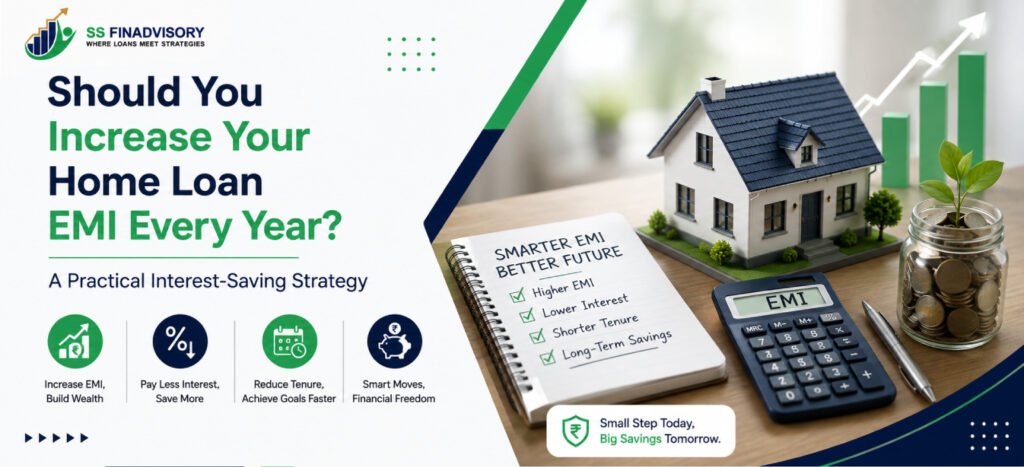
You probably chose your home loan EMI based on what felt comfortable at that time. Now your income has gone up, expenses have stabilised, and you keep wondering if you should increase home loan EMI instead of just letting the loan run for 20–25 years.
This question comes up in almost every home loan conversation in India: “If my salary grows every year, shouldn’t my EMI also grow so that I save interest?” The answer is usually yes – but with conditions. The trick is to step up intelligently, not aggressively.
What Actually Happens When You Increase EMI
Most borrowers think a higher EMI only means better interest saving. That’s half the story. When you increase EMI home loan repayments, three things change at the same time: your interest outgo, your loan tenure, and your monthly cash flow risk.
The extra EMI amount directly hits the principal outstanding. Because interest is charged on the principal, every extra rupee you pay early in the tenure keeps saving interest for the remaining years. Done right, this can shave several years off the loan.
The flip side: once you commit to a higher EMI, you have to live with that obligation every month. If you stretch too far, a job change, a medical emergency, or a new child in the family can make those EMIs feel tight very quickly.
That’s why smart borrowers treat EMI increase like a planned strategy, not an impulsive resolution for the New Year.
Step-Up EMI Vs One-Time Hike: What Works Better?
There are two broad ways to use an EMI step up. One is to opt for a formal step-up EMI structure from the lender, where EMIs start low and rise as per a fixed schedule. The other is to keep a standard EMI and voluntarily increase it with each salary hike.
Formal step-up structures sound attractive to young professionals, but they often backfire. Lenders project very optimistic future incomes and push low EMIs in the initial years, which means your interest cost balloons early on.
Voluntarily increasing EMI gives you more control. You decide when to increase, by how much, and you can pause for a year if your finances are tight. This is far more practical than locking into an aggressive lender-designed structure.
If you want to compare different options in detail, you can read the detailed strategy comparison in step-up EMI vs regular EMI repayment approaches.
How Much Should You Increase EMI Each Year?
Most salaried people in India see some increment almost every year, even if it isn’t huge. Instead of inflating lifestyle with the entire raise, diverting part of it to EMI can be one of the simplest home loan interest saving tactics.
A practical thumb rule is this: for every meaningful salary hike, increase your EMI by 5–10% while keeping your total EMIs (home loan plus other loans) within a comfortable share of your take-home income.
If your income is volatile or you are self-employed, don’t treat annual EMI hikes as automatic. In such cases, combining modest EMI increases with occasional home loan prepayment in good years can be safer than locking into a steep step-up.
When you’re unsure about the safe EMI level, tools like the 50% income rule and cash flow mapping help. A good starting resource is the guide on how much home loan EMI you can afford using the 50% rule.
Increasing EMI Vs Reducing Tenure Directly
Many borrowers ask if they should request the bank to reduce loan tenure or simply pay a higher EMI on their own. Both approaches help you reduce loan tenure, but the mechanics differ slightly.
If you ask the lender to officially revise the EMI upwards, they may also recalculate and shorten the tenure. This gives you a clear revised loan closure date, which is helpful if you like precise targets.
On the other hand, you can also keep the official EMI same and quietly pay extra every month as a part-prepayment. The system will treat it as frequent prepayments, and the effect on interest and tenure can be similar.
For some borrowers, keeping the official EMI lower and using extra funds for regular part-prepayments feels more flexible. This combines the discipline of a higher outflow with the psychological comfort of a lower committed EMI.
EMI Step-Up Vs Ad-Hoc Prepayments And Bonuses
Stepping up EMI is just one way to speed up home loan repayment planning. Ad-hoc prepayments using bonuses, incentives, or business surpluses can work alongside or even better in certain situations.
If your income pattern includes annual variable pay, you may not want to push the monthly EMI too high. A steadier EMI, plus a planned prepayment every year or two, can give you similar or better results on interest savings with far less monthly stress.
For example, instead of forcing a big EMI jump, some borrowers keep the EMI modest and use part of their annual bonus to prepay, while keeping rest for investments and emergencies. This mix keeps both liquidity and loan closure on track.
There’s a full framework for this approach in the article on using annual bonuses for faster home loan repayment without damaging your liquidity.
Where Balance Transfer And Strategy Optimisation Fit In
An EMI increase alone can’t compensate if your interest rate itself is uncompetitive. Before you stress-test your budget, check whether your current rate is in line with what new borrowers are getting for similar profiles in India.
If your rate is significantly higher, a smart move is to combine a balance transfer with an EMI increase. Shifting to a lower rate and then stepping up EMI multiplies your home loan interest saving compared to either move in isolation.
This is where structured home loan repayment planning and professional advice help. A dedicated home loan optimisation plan looks at EMI, tenure, balance transfer opportunities, and prepayments as one integrated strategy rather than scattered decisions.
For a deeper review of whether a balance transfer makes sense for you, the guide on home loan balance transfer vs prepayment covers the trade-offs in detail.
How A Professional Strategy Can Help You Save More
Bank staff rarely suggest the most interest-efficient combination of EMI, prepayments, and tenure. Their goal is to sell the loan, not craft a long-term plan that fits your life in India over 15–20 years.
A structured approach, such as a customised home loan strategy, starts from your income pattern, risk tolerance, family goals, and tax situation. Then it decides how much EMI increase is safe, how often to prepay, and when to consider a balance transfer.
Expert advisory services focused on home loan strategy optimisation can also stress-test different what-if scenarios: job break for higher studies, spouse taking a career pause, or starting a business later.
If home loan planning is just one part of your overall borrowing, combining it with broader loan and credit planning services can avoid a common mistake: improving one loan while creating stress in another.
When Increasing EMI Is A Bad Idea
There are clear situations where trying to increase home loan EMI every year does more harm than good. For example, if you already have high credit card or personal loan EMIs, your priority should be closing those costlier debts first.
If your job is unstable, or a major life change is coming (new baby, parental medical costs, relocation), locking into a much higher EMI can reduce your flexibility right when you need it most.
In such phases, it can be wiser to keep EMI stable and hold surplus cash in safe, liquid instruments, using selective part-prepayments instead of a permanent EMI jump.
Simple Framework To Decide Your EMI Increase
To turn this into a clear plan, use a simple three-step framework. First, confirm your safe EMI range using your income, other EMIs, and monthly expenses.
Second, decide a modest annual step-up rate that you can realistically commit to, such as 5–10% EMI step up aligned with your usual salary revision cycle.
Third, review once a year: if your cash flow is easy, increase as planned; if life is tight, hold the EMI flat for that year and aim for a small part-prepayment instead when money allows.
EMI Increase Vs Other Interest-Saving Tools
Increasing EMI is one tool in a larger toolkit. Alongside it, you have balance transfer, one-time and periodic prepayments, home loan overdraft accounts, and tax optimisation.
Your mix of these tools should change over time. Early in the loan, the focus is usually on higher EMI and prepayments for maximum impact. Later in the tenure, peace of mind and liquidity may matter more than shaving the last bit of interest.
Resources like the guide on reducing home loan EMI without extending tenure can help you sequence these tactics sensibly instead of reacting to each rate hike or SMS from the bank.
Conclusion
Deciding to increase home loan EMI every year is one of the most effective yet underused strategies for interest saving, provided it fits your income, risk comfort, and long-term goals in India.
A thought-through plan that combines EMI step-ups, sensible prepayments, and timely balance transfer can shorten your loan by several years; if you’d like that plan designed around your situation, ss finadvisory can help you structure the right increase home loan EMI strategy and next steps.
Frequently Asked Questions
Q1. How often should I increase my home loan EMI?
Ans: In practice, many borrowers review their EMI once a year, usually after salary appraisal. If your income has gone up and your monthly budget is still comfortable, increasing EMI at that point can work well. The key is consistency rather than a one-time big jump.
Q2. Is it better to increase EMI or make lump sum prepayments?
Ans: Both can work, and the best mix depends on your income pattern. If you get predictable yearly hikes, a steady EMI step up is easier to follow. If your income is irregular or bonus-heavy, keeping EMI stable and using surplus cash for planned home loan prepayment can be more practical.
Q3. How does increasing EMI help reduce my loan tenure?
Ans: Every extra rupee you pay above the scheduled EMI goes straight to principal, so future interest is calculated on a lower balance. Over time, this compounding effect brings down the outstanding faster and can significantly reduce loan tenure compared to just following the original schedule.
Q4. Can I ask my bank to officially reduce tenure instead of just paying more EMI?
Ans: Yes, you can request the lender to recast your loan so that a higher EMI leads to a shorter tenure. This gives you a clear revised closure date. Alternatively, you can keep the official EMI unchanged and pay extra voluntarily, which also helps reduce loan tenure without a formal change in the agreement.
Q5. How much should I increase EMI if I live in India and my expenses are already high?
Ans: Start small, even a modest 5% increase can help over time, especially early in the loan. First check that your total EMIs stay within a comfortable portion of your take-home pay, after accounting for rent (if any), school fees, and family commitments common in India. You can always raise it further once you see the impact.
Q6. Does increasing EMI affect my home loan interest rate?
Ans: No, simply increasing EMI doesn’t change your interest rate; it changes how fast you repay the principal. To tackle the rate itself, you’d need to negotiate with your lender or consider a refinance or balance transfer. Combining a rate review with a planned EMI step up usually delivers the best long-term interest saving.