
If you're planning to raise a large loan using your home, shop, or office as security, getting your loan against property documents right can be the difference between quick approval and weeks of back-and-forth with the lender.
The good news is that most lenders broadly ask for the same set of papers, and once you understand the logic behind each requirement, the entire process feels far less intimidating.
Why lenders care so much about loan against property documents
A lender is taking a big risk by offering a high-value loan on the strength of your real estate, so they want to be absolutely sure of two things: who you are, and whether the property can be legally sold if you stop paying.
This is why lenders stick to a fairly standard set of LAP documents, but they may ask for a few extra items depending on your profile and the city where the property is located.
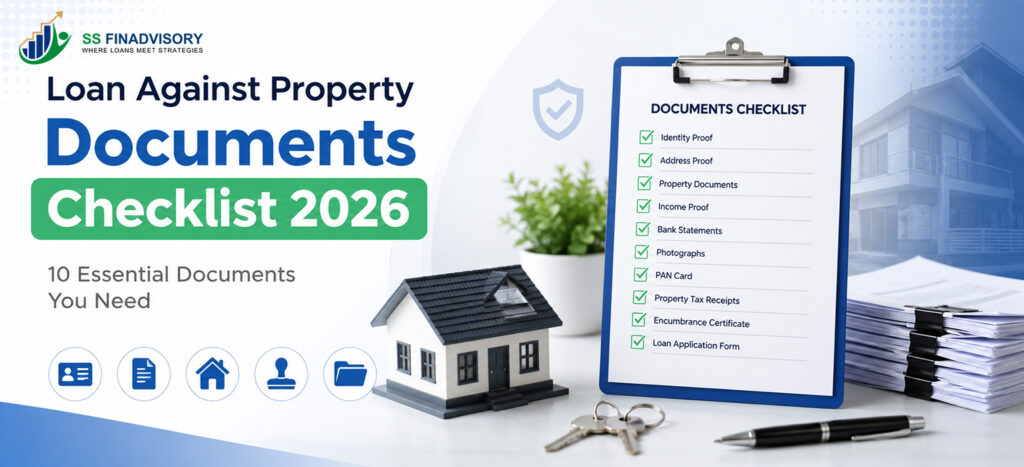
The core loan against property documents: 10 essentials
Most banks and NBFCs have a standard property loan documents checklist that covers both your personal profile and the asset you're mortgaging.
If you assemble these in advance, there's a good chance your file will move faster and you'll get fewer follow-up calls from the credit team.
1. KYC and identity proof
Every lender is required by regulation to verify your identity using standard KYC documents such as PAN, Aadhaar, passport, voter ID, or driving licence.
The most common identity proof for loan applications is your PAN card, but lenders usually ask you to submit at least one more photo ID to cross-check details.
2. Address proof and contact details
Lenders need a valid, current address proof that matches what you write on the application form, so it's worth checking that your bills and IDs show the same spelling and pincode.
Acceptable papers often include electricity bills, registered rent agreements, and bank statements where your mailing address is clearly printed.
3. Income proof and repayment capacity
Even though the loan is backed by property, underwriters still test your income proof carefully to make sure EMIs are affordable and won't stretch your cash flow too thin.
Salaried applicants are typically asked for salary slips, Form 16, and six to twelve months of bank statements that show the salary credit consistently.
4. Documents for self-employed borrowers
If you're a business owner or professional, expect extra mortgage loan documents such as audited financials, GST returns, and business bank statements.
Lenders also look at your profit margins and stability of revenue over the last two or three years instead of just a single year's performance.
5. Property ownership documents and title proof
Clean property ownership documents are non-negotiable because the lender should be able to enforce its rights easily if the loan goes bad.
Depending on the state, you may be asked for a registered sale deed, latest mutation entries, and records that show an unbroken chain of ownership.
Key property papers lenders scrutinise closely
Beyond identity and financials, the most time-consuming part of the process is usually the legal and technical check on your property papers.
This step protects both you and the lender from disputes over boundaries, illegal constructions, or claims from other family members.
6. Approved plans and building-related papers
For constructed properties, lenders request approved layout plans as part of their loan document checklist so that they can verify the structure follows local rules.
If your building is part of a large project, the bank's lawyer may also ask the developer for commencement certificates and occupation certificates.
7. Land and tax records for independent houses and plots
With independent houses and plots, legal teams dig deeper into land-related records and may ask you for specific property papers from the local revenue office.
They usually insist on up-to-date property tax receipts so they can be sure there are no hidden municipal dues attached to the asset.
8. Chain of title and older property loan documents
If the property has changed hands multiple times, lawyers want to see the full chain of title, including older registered deeds and relevant encumbrance certificates.
In some cases, they might also review earlier property loan documents to confirm those loans have been closed or will be cleared before the new mortgage is created.
Practical checklist to organise your LAP file
Instead of waiting for the lender to ask for items one by one, it helps to create a simple loan document checklist at home and store soft copies in well-named folders.
This preparation is especially useful if you're applying with multiple lenders and don't want to scramble every time a new officer calls for clarifications.
9. Personal and financial paperwork to keep ready
For individuals, it's smart to maintain a small envelope of updated KYC documents along with your latest three months of salary slips or business statements.
Many people also keep their last three years' income tax returns clipped together so they can be shared quickly whenever fresh income proof is requested.
10. Property file essentials to keep in one place
On the property side, use a separate folder to store the original registered deed, tax receipts, and any property ownership documents given by the builder or society.
Keeping photocopies of sanctioned plans in the same folder makes it easier to respond quickly if the bank's technical team asks extra questions about layout or area.
Common mistakes that delay approval
Most rejections don't happen because of a weak profile but because the loan against property documents were incomplete, inconsistent, or hard to verify.
Taking an hour to cross-check spellings, dates, and signatures before you submit your file will often save you days of follow-up and rework.
Mis-matched names or addresses
If your name is spelt differently across IDs, or if your address proof shows an old location, the lender is almost certain to raise a query.
Correcting these details in advance, even if it means a visit to the local office, is usually faster than trying to convince a credit manager to make an exception.
Unclear ownership or shared family rights
Issues also arise where the legal heirship hasn't been documented, or where older family members still appear on property papers but are not available to sign.
It's safer to resolve such matters with proper documentation or succession records before you pledge the asset for a large mortgage loan.
The bottom line on getting your documents right
If you treat your application like a small project and assemble all required loan against property documents in advance, the rest of the process usually feels far more predictable.
For personalised help in structuring your file, choosing a suitable lender, and double-checking every paper, you can speak with a professional advisor at ss finadvisory before you submit your forms.