
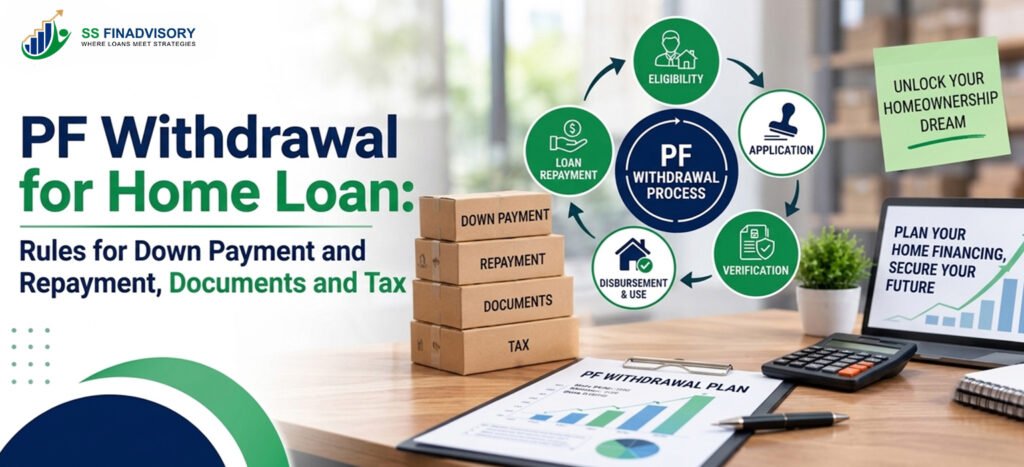
You’ve found the right property, the bank has approved your home loan, but the down payment is stretching your savings. That’s usually when people start asking about PF withdrawal for home loan and whether tapping EPF is actually a smart move.
If you get it wrong, you can block your retirement money, lose tax benefits and even face issues with the PF office later. This guide walks through the real rules, practical use-cases and paperwork so you can decide calmly, not in a rush at the builder’s office in India.
How EPF Rules For Home Loan Work In India
EPF money isn’t a free-for-all. You can withdraw only under specific conditions and only to a limit. For housing, those rules are stricter than most people expect.
For home purchase or construction, the EPF scheme generally allows withdrawal after you’ve completed a minimum number of years of PF membership, subject to a cap linked to your wages and PF balance. The money can be used for buying a flat, building a house, or buying land for construction.
The withdrawal is usually paid directly to the builder, seller or housing society, not to your personal bank account, unless your PF office follows a different process under their internal guidelines. So you need your property paperwork in place before you even apply.
Using PF Withdrawal For Down Payment: How Much And When
Most salaried buyers in India first look at PF to cover their down payment gap. In many cases, EPF withdrawal can bridge that last 5–10% when the builder’s demand is higher than what the bank will finance.
The actual amount you can pull out depends on your years in service and your and your employer’s contribution sitting in the PF account. There is also a rule-based upper limit tied to a multiple of your last drawn wages or to the total cost of the property.
You should start the EPF withdrawal process only after you have a signed agreement for sale and a fairly firm idea of the bank’s loan amount. That way, you aren’t withdrawing more than you need, and you’re not stuck because the PF office is waiting for property papers.
If you’re already speaking to a home loan advisor, share your PF statement with them so they can help you decide what portion to use for the down payment and what to keep as an emergency cushion.
PF Withdrawal For Home Loan Repayment Or Prepayment
Some borrowers don’t touch EPF during purchase, then get worried about EMI pressure and plan to use PF for prepayment instead. This can work, but it needs clear thinking.
EPF rules also allow withdrawal to repay outstanding home loan principal in certain situations. Typically, you must have completed a minimum period of PF membership and the property should be in your or your spouse’s name. The withdrawal usually goes directly to the lender to reduce the loan balance.
If you use PF this way, treat it like a one-time heavy prepayment. Combine it with a careful plan to reduce home loan interest rate through negotiation or refinance, so the retirement money you’re using actually translates into long-term savings, not just a small EMI reduction.
Borrowers who are evaluating a refinance should also look at whether a smaller EPF prepayment can improve their eligibility for a better offer from a new bank, similar to how a home loan balance transfer consultant would structure the numbers.
Eligibility Conditions Before You Plan PF Withdrawal
Before you start counting your EPF as part of your budget, check whether you even qualify for housing withdrawal. This is where many buyers miscalculate.
Common eligibility conditions include a minimum number of years of PF membership, use only for residential property, and limits on how often you can withdraw for housing. If you’ve already withdrawn for a plot or renovation, you may not be able to withdraw again for a flat.
Joint withdrawals are possible when both spouses are EPF members and co-owners of the property. In such cases, the combined PF balance can be used, which gives couples more flexibility in planning their contribution and home loan amount.
When PF Withdrawal May Not Be A Good Idea
EPF is primarily retirement money. Pulling out too aggressively for housing can leave you short at 55 or 60, which then pushes you towards extending your working years or taking new loans later.
Using PF for down payment is usually not advisable if you have high-interest personal loans or credit card dues running. Clearing those first often leaves you better off than rushing to become “loan free” on the home by sacrificing retirement savings.
Documents Required For PF Withdrawal For Home Loan
The paperwork for EPF housing withdrawal is where people lose time. If you assemble the documents early, the process feels far less stressful.
At a minimum, you’ll usually need the filled withdrawal claim form (online or offline), your latest PF passbook or statement, and identity and bank details as per PF records. Many claims fail simply because the bank account name or IFSC doesn’t match the PF database.
For property-specific documents, you’ll be asked for the agreement for sale, allotment letter, or builder-buyer agreement, sanctioned plan where relevant, and documents that prove ownership and cost. For repayment-related withdrawals, lenders’ loan account statements and an outstanding certificate are typically required.
If the PF office is paying the builder directly, be ready with the correct payee name and bank details on the builder’s letterhead. This is one of those small steps everyone forgets and then spends days fixing.
Coordinating With Your Home Loan Bank
Ideally, plan the timing of PF withdrawal along with your bank’s disbursement schedule. Builders often raise payment demands linked to construction stages; your EPF claim should be filed a little before a big demand so the money arrives in time.
Many first-time buyers underestimate how slowly EPF and bank processes can move. A planned approach, similar to the thinking behind home loan strategy optimisation, helps you avoid penalty interest from delayed payments and rushed decisions on top-up loans or personal loans.
Tax Treatment Of PF Withdrawal For Home Loan
People often worry that PF withdrawal for home loan will get taxed heavily. The reality depends on your years of continuous PF contribution and the reason for withdrawal.
If you’ve completed the required period of PF service, withdrawals for permitted purposes such as housing are generally treated more favourably from a tax perspective than early withdrawals taken for other reasons. But tax treatment can change and also depends on how your employer and PF trust operate.
What you definitely lose is future compounding on that withdrawn amount. The interest that money would have earned inside EPF is tax-efficient for long-term savers, so factor that into your decision, not just your current EMI relief.
Comparing PF Withdrawal Vs Home Loan Prepayment From Savings
Before you rush to file a withdrawal, compare it with using spare bank savings or bonuses for prepayment. Sometimes, a mix of a small PF withdrawal and regular savings gives a better balance between lower EMIs and preserving retirement funds.
If you’re mapping out a multi-year home loan prepayment planning approach, include PF only as one part of the strategy, not the only lever you pull.
Strategic Use Of PF Alongside Other Home Loan Decisions
EPF is just one tool in your home finance toolkit. Used well, it can reduce your borrowing or shorten your tenure. Used casually, it can leave you asset-rich but retirement-poor.
For many salaried borrowers, PF withdrawal makes most sense when you’ve already negotiated hard on your interest and structured your EMI to fit your income growth. Reading up on how to negotiate a lower home loan interest rate with your existing bank is usually a smarter first step than touching retirement money.
If you’re mid-way through your loan, combining a modest PF withdrawal with a carefully timed part-prepayment can cut years off your tenure. Resources on home loan part-prepayment strategy can help you see the impact of different prepayment amounts over time.
Borrowers who are also evaluating a refinance or balance transfer can study the pros and cons of moving their loan before or after using EPF by going through the material in the home loan balance transfer category.
Getting Local Advice When You’re Stuck
EPF rules, bank policies and builder demands rarely line up perfectly. When your numbers are tight or you’re coordinating a complex purchase in a city market like Kolkata, bringing in a specialist can be worth it.
An experienced home loan consultant in kolkata or home loan agent in kolkata can help you line up the PF timing, loan sanction and payment schedule so you aren’t paying unnecessary penalties or blocking too much retirement money.
Conclusion
PF withdrawal for home loan can be a helpful tool if you understand the EPF rules, respect the paperwork and use it in combination with other smart home loan decisions in India. The mistake many borrowers make is treating PF as an easy pot of cash rather than a piece of their long-term retirement plan.
If you’d like help balancing EMI pressure, interest savings and retirement security, a specialist team like ss finadvisory can structure your PF use, loan amount and repayment pattern so your home purchase supports your future instead of straining it.
Frequently Asked Questions
Q1. How much PF can I withdraw for home loan down payment?
Ans: The amount you can withdraw from EPF for housing is capped by specific rules linked to your wages, years of PF membership and your available PF balance. It can only go up to a percentage of the property cost or a multiple of your monthly pay, not the full balance. Always check your latest PF statement and scheme rules before finalising your budget.
Q2. Can I use PF withdrawal to reduce my existing home loan EMI?
Ans: Yes, EPF can be used in some cases to part-prepay an existing home loan, which reduces your outstanding principal. You can then either cut your EMI or shorten your tenure, depending on what your bank allows. Pairing this with a plan to reduce home loan interest rate can magnify the total savings over the remaining years.
Q3. What documents are needed for PF withdrawal for home loan in India?
Ans: You’ll typically need the EPF withdrawal claim (online or offline), your PF passbook, identity and bank details that match PF records, and property documents such as the agreement for sale or builder allotment letter. For repayment-related withdrawals, banks’ loan statements and outstanding certificates are usually required. Local PF offices may ask for extra documents, so always confirm their checklist.
Q4. Is PF withdrawal for home loan taxable?
Ans: Tax impact depends mainly on your years of continuous PF contribution and the nature of the withdrawal. If you’ve been contributing for the minimum period prescribed in the scheme, permitted withdrawals such as for housing are treated more favourably than early withdrawals. Since tax rules can change and personal situations differ, it’s sensible to check the latest guidance or talk to a tax advisor before filing your claim.
Q5. Should I use PF or savings first for home loan prepayment?
Ans: There’s no one answer, but many borrowers keep EPF as a backup and first use surplus bank savings, bonuses or one-off income for prepayment. A structured home loan prepayment planning exercise can help you see how different combinations affect your EMI, tenure and retirement corpus. The goal is to reduce interest without hollowing out your long-term safety net.
Q6. Can a home loan advisor help with PF withdrawal decisions?
Ans: A good home loan advisor can’t change EPF rules, but they can interpret how those rules interact with your loan eligibility, EMI and future goals. They can work through scenarios like using PF for down payment versus mid-tenure prepayment or combining it with a balance transfer. For borrowers juggling multiple obligations, that outside view often prevents costly mistakes.