
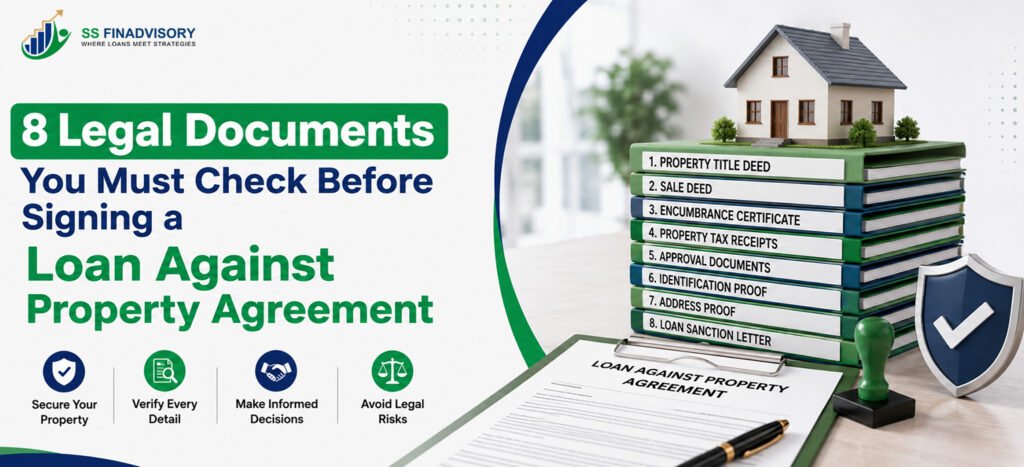
Signing a loan against property agreement without checking the right loan against property legal documents is like buying a flat without seeing the building plan. It may look fine on the surface, but one missed page can cost you lakhs and years in court.
If you’re pledging your home, shop, or land to raise funds, the paperwork isn’t a formality. It decides who really controls the property, what happens if there’s a delay in EMI, and how hard it’ll be to get your documents back once the loan is repaid.
Why Legal Documents Matter In A Loan Against Property
Most borrowers focus on interest rate and tenure, then rush through the mortgage agreement at the last minute. That’s exactly how hidden charges, unfair clauses, and title issues slip through. Once you’ve signed, your bargaining power drops to almost zero.
Good documentation protects both you and the lender. For you, it confirms clear ownership, defines exact repayment terms, and limits the lender’s rights over the property. For the lender, it reduces the risk of future disputes, especially around property legal verification and recovery.
1. Sanction Letter And Draft Loan Agreement
Your first checkpoint is the sanction letter and the detailed loan agreement the lender shares before disbursement. Don’t treat the sanction letter as a simple approval note; it’s the summary of rate, tenure, type of interest (fixed, floating, or mixed), fees, and special conditions.
Read the detailed agreement line by line. Check how interest is calculated, the reset frequency on floating rates, prepayment and foreclosure conditions, and penalties on EMI bounce. Many borrowers ignore clauses on cheque swapping charges and legal costs, then get shocked when the loan contract allows the bank to debit thousands for small issues.
2. Title Deed And Property Ownership Proof
The lender will ask for the original title deed, but you should examine it first with a property lawyer. Confirm that the seller in your old sale deed matches your current ownership, that the property description (survey number, flat number, area) is accurate, and that there are no unrecorded rights or life interests mentioned.
If the property was inherited, partitioned, or gifted, gather every property ownership proof leading to you: succession certificate, family settlement deed, registered gift deed, or partition deed. Any gap in the ownership trail is a red flag and can delay or derail the loan.
3. Encumbrance Certificate And Previous Loans
The encumbrance certificate (EC) from the sub-registrar’s office tells you whether there are registered charges, sales, or mortgages on the property over a defined period, typically 13–30 years in Indian practice. Don’t rely on a 1–5 year EC; go as far back as records permit in your state.
Verify that all past loans have been closed and releases registered. If the EC shows an existing mortgage and you don’t have closure documents, insist on a clear explanation and documentary proof from the owner or previous lender before moving ahead with legal due diligence.
4. Mortgage Agreement And Deposit Of Title Deeds
In most Indian cities, banks create an equitable mortgage agreement by depositing original title deeds with the bank. You’ll sign a memorandum of deposit of title deeds, which is often registered and may attract stamp duty and registration charges.
Check that the property details in the mortgage paperwork are correct and match the title documents. Confirm who will keep custody of which originals, and get an itemised list of the documents being taken, on the lender’s letterhead, signed and stamped.
5. Property Legal Verification Report
Before sanction, the bank’s empanelled lawyer prepares a property legal verification report. Most borrowers never ask for a copy, but you should. It summarises the chain of documents, ownership, encumbrances, and any legal risks.
Scan it for words like “subject to”, “defect”, “unregistered”, or “unavailable”. If the advocate has relied on photocopies or missing links in the chain, you’re sharing the risk. Take the report to an independent lawyer, especially for high-value loans or complex titles.
6. Building Approvals And Occupancy Documents
For flats and commercial units, lenders often ask for copies of building plan approvals, commencement certificate, and completion or occupancy certificate. Many borrowers ignore these because the bank seems satisfied, but missing approvals can cause trouble during future sale or redevelopment.
Match the flat number, wing, and carpet or built-up area on these approvals with what appears in your sale deed. This is part of practical property ownership proof, not just compliance. Any mismatch should be explained in writing by the builder or housing society.
7. Key Clauses To Watch Inside The Loan Paperwork
Beyond the big pieces, focus on specific clauses buried in the fine print. Start with default and acceleration: how many missed EMIs count as default, and when can the bank demand full repayment at once? Check the grace period and whether default interest applies from day one.
Look at the lender’s rights over the property: power of sale, right to appoint receivers, or right to take symbolic possession under the SARFAESI Act. Confirm that the loan agreement doesn’t allow the bank to change major terms unilaterally, except where law or regulatory changes require it.
8. Guarantor, Co-Borrower, And Insurance Documents
If a spouse, parent, or business partner is a co-borrower or guarantor, their liabilities should be clearly spelled out in the mortgage agreement annexures. Many guarantors sign without understanding that they’re equally liable if the main borrower defaults.
Review any insurance linked to the loan: term cover, property insurance, or credit shield. Check who is the owner of the policy, who’s the nominee, and how premiums are collected. Don’t let unwanted policies get bundled into your mortgage paperwork just because it’s “recommended”.
How To Organise Your Legal Property Documents
Disorganised files cause panic when banks ask for an extra proof at the last minute. Create a simple, labelled folder structure—physical and digital—so you can access any paper within minutes during discussions on property legal verification or loan terms.
Segregate sale deeds, tax receipts, approvals, legal opinions, and correspondence. Keep scanned copies of every signed page of the loan contract and all property documents, stored securely with backups.
Loan Against Property Legal Documents Checklist
Before you sign, run through a practical checklist so nothing slips through in the rush. This is especially useful if you’re dealing with multiple lenders or refinancing an existing loan.
- Original title deed and full chain of documents
- Recent encumbrance certificate for the maximum available period
- Approved building plans and occupancy/completion certificate, if applicable
- Latest property tax, electricity, and water bills with receipts
- Bank’s legal and valuation reports, with any qualifications highlighted
- Sanction letter and full loan agreement draft with all annexures
- Memorandum of deposit of title deeds and list of documents held by bank
- Guarantor and co-borrower declarations, if any
- Loan-linked insurance documents and premium schedule
When To Involve A Property Lawyer
You don’t need a lawyer to read every standard clause, but you do need one when titles are complicated. Joint family properties, converted agricultural land, or buildings with unauthorised floors should never be mortgaged without independent legal due diligence.
A good property lawyer can review the loan agreement, point out risky clauses, and draft side letters or clarifications. The fee is usually a small fraction of one EMI and can save you from years of regret.
Practical Tips Before You Sign Anything
Never sign blank or partially filled forms. Insist on filled, legible copies of every document you’re asked to sign. Double-check names, PAN, property details, and loan amount in all places, especially in the loan contract and security documents.
Ask for a soft copy of the final signed set or at least scanned pages. Keep email confirmation from the bank on key promises like processing fee waivers, rate offers, or special conditions that don’t appear in the standard mortgage paperwork.
Conclusion
Taking a loan against your home or commercial property is a big step, and the only real protection you have is what’s written in the loan against property legal documents you sign. Slowing down for a day to review them is far cheaper than fighting a dispute for years.
If you’re unsure about any clause or title issue, get an independent opinion before you commit; firms like ss finadvisory work precisely in this space. Treat your signatures as final, read every key page, and don’t hesitate to walk away from a deal where the paperwork doesn’t feel right.