At Deutsche Bank, DSCR below 1.3x was an automatic referral to the credit committee — most applicants had no idea this ratio existed or that it was the single most important number in their application. They focused on turnover and CIBIL; the credit team focused on whether the business actually generated enough cash to service the loan.
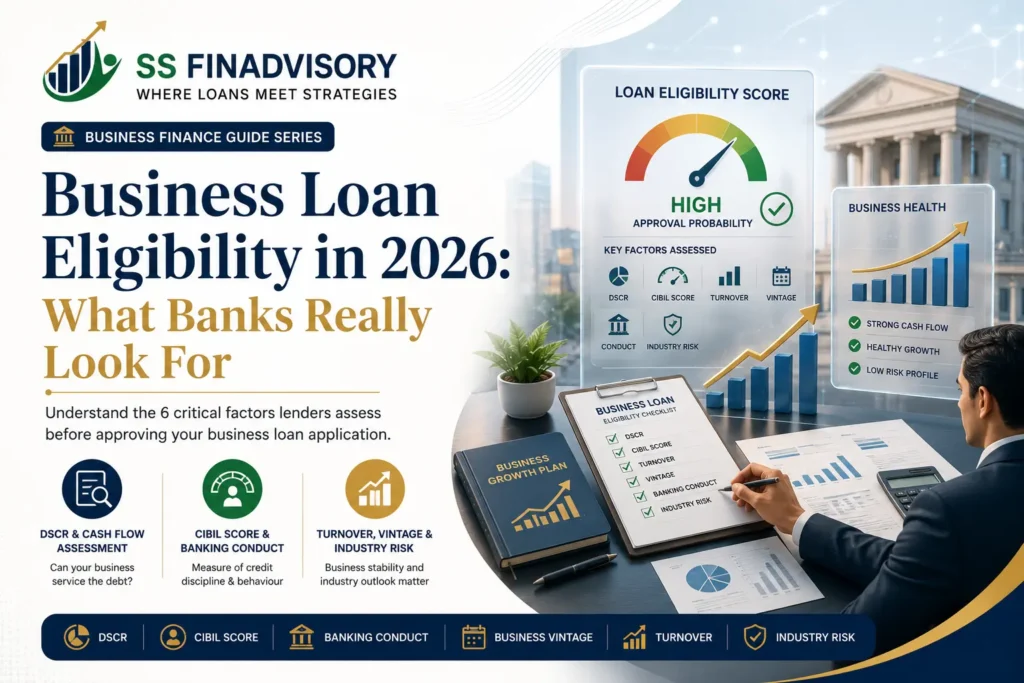
Business loan eligibility is not a single score — it is a layered assessment across six distinct factors. Banks evaluate your business from multiple angles: can you generate cash to repay (DSCR), have you historically repaid well (CIBIL), does your business have substance (turnover, vintage), and is the broader context acceptable (banking behaviour, industry). Understanding each factor and where you stand lets you strengthen weaknesses before applying, rather than discovering them at rejection.
This guide walks through each factor with 2026 benchmarks, shows exactly how to calculate your DSCR, lists seven high-impact ways to strengthen eligibility in 60–90 days, and covers options for newer businesses under 2 years old. By the end, you will know your approval probability before you apply.
The 6 Core Eligibility Factors Banks Assess
Business Vintage (Minimum 2–3 Years)
1
Business Vintage
Weight: 12%
Most lenders require at least 2–3 years of continuous business operation with consistent ITR filings. Vintage is not just about age — banks want to see that the business has survived a full operating cycle, has established customers and suppliers, and has demonstrated commercial viability.
Benchmark by Lender TypePSU banks: 3+ years typically required (5 years for ₹1 Cr+ loans) · Private banks: 2–3 years · FinTech NBFCs: 6–12 months accepted with GST-based assessment · MUDRA: No minimum vintage for Shishu/Kishore tiers.
The vintage clock typically starts from GST registration date or first ITR filing — whichever is later. Businesses that pivoted or renamed may face reassessment of effective vintage. If you bought an existing business, the purchased business’s vintage generally transfers to you, subject to documentation.
Annual Turnover and Revenue Trends
2
Annual Turnover and Revenue Trends
Weight: 15%
Banks check both absolute turnover (does the business generate enough revenue to support the loan) and turnover trend over 2–3 years (is the business growing, stable, or declining). A declining turnover in the most recent year is a significant red flag even if total turnover exceeds benchmarks.
Turnover Benchmarks by Loan SizeLoan ₹10–25L: Turnover ₹40–60L · Loan ₹25–50L: Turnover ₹60L–1.5 Cr · Loan ₹50L–1 Cr: Turnover ₹1.5–3 Cr · Loan ₹1–5 Cr: Turnover ₹5–15 Cr · Loan ₹5 Cr+: Turnover ₹25 Cr+
Critical in 2026: turnover on ITR must match GSTR-3B declarations. Discrepancies trigger immediate red flags in AI-driven underwriting. Reconcile your GST and ITR numbers 60 days before applying.
Debt Service Coverage Ratio (DSCR)
3
Debt Service Coverage Ratio (DSCR)
Weight: 25% · Most important
DSCR measures whether your business generates enough cash to service the proposed debt. This is the single most important metric after CIBIL — many good-looking applications get rejected because DSCR comes in below the threshold. We cover the full calculation in the next section.
DSCR ThresholdsAbove 1.5x: Comfortable approval · 1.3–1.5x: Conditional with additional scrutiny · 1.15–1.3x: Usually rejected or downsized · Below 1.15x: Automatic rejection
Personal CIBIL Score (Promoter)
4
Personal CIBIL Score (Promoter)
Weight: 22%
Banks evaluate the personal CIBIL of the business promoter (and often co-promoters/partners). Even for established businesses with commercial CIBIL, the promoter’s personal score matters because it reflects personal credit discipline — a proxy for how they run business finances.
CIBIL Impact on Approval & Rate780+: Best rates, easy approval · 750–779: Standard rates · 700–749: Approved with 0.5–1% premium · 680–699: Possible with conditions · Below 680: Most PSU/private banks decline
For established businesses, also check Commercial CIBIL (MSME Rank) — a scale from 1 to 10, with 1 being the best. Lenders prefer MSME Rank of 1–5. Pull both reports before applying.
Banking Behaviour (Statement Analysis)
5
Banking Behaviour (Statement Analysis)
Weight: 18%
Your business bank statement for the last 12 months reveals more than any single document — it shows actual operations, not declared numbers. Banks analyse: average balance, monthly credits pattern, cheque bounces, minimum balance maintenance, overdraft utilisation, and any “window dressing” patterns (large inflows just before month-end, unusual credits not linked to operations).
What Banks Want to SeeConsistent credits: Regular inflows matching declared turnover · Average balance: Above minimum + buffer for operations · Zero or minimal cheque bounces: Any bounce in 6 months is a red flag · OD utilisation: Below 60–70% consistently · No unexplained large transfers
Clean your banking operations 6–12 months before applying. Separate business and personal accounts, avoid last-minute large inflows before application, and maintain healthy average balances.
Industry Risk Classification
6
Industry Risk Classification
Weight: 8%
Banks classify industries into risk categories. Your rate and approval probability are meaningfully affected by whether your industry is considered low, medium, or high risk. This is largely outside your control, but awareness helps you target the right lenders.
| Risk Category | Typical Industries | Rate Impact |
|---|---|---|
| Low risk | Healthcare, education, essential consumer goods, IT services, CA/legal practice | Base rate |
| Medium risk | Manufacturing (stable), food processing, auto components, retail trade | +0.25–0.75% |
| Higher risk | Construction, real estate, hospitality, entertainment, textiles, capital goods | +0.75–1.5% |
| Sector-specific | Agriculture, aviation, telecom — specialised underwriting | Varies widely |
How to Calculate Your DSCR and What 1.5x Means
DSCR is the ratio banks use to determine if your business can comfortably service the proposed debt. A DSCR of 1.5x means every rupee of annual loan obligation is covered by 1.5 rupees of available cash flow — a 50% safety buffer. Below 1.3x, banks see thin margins; above 2x, they see low risk.
DSCR Formula and Worked Example
DSCR = Net Operating Profit (available for debt service) ÷ Total Annual Debt Service
Annual Revenue₹3,50,00,000
Operating Expenses (COGS + Opex + Taxes)₹2,90,00,000
Net Operating Profit (available)₹60,00,000
Existing Loan EMIs (annual)₹15,00,000
Proposed New Loan EMI (annual)₹25,00,000
Total Annual Debt Service₹40,00,000
DSCR = ₹60L / ₹40L1.5x — Strong approval case
Above 1.5x
Comfortable
approval
1.3 – 1.5x
Conditional
approval
1.15 – 1.3x
Likely rejected
or downsized
Below 1.15x
Auto
rejection
Banker nuance: Different lenders calculate DSCR slightly differently. Some use “EBITDA / Total Debt Service” (more generous), others use “Net Profit / Principal + Interest” (stricter). Before your bank meeting, ask the RM which DSCR formula they use — then back-calculate to see if you meet their specific threshold. Most PSU banks use the stricter version; private banks are more flexible.
If your DSCR is below 1.5x, you have options: (1) increase loan tenure to reduce annual EMI, (2) reduce loan amount, (3) add a co-applicant with additional income, (4) wait until business profits grow to improve the ratio. Option 1 is the most common — a 5-year loan becoming a 7-year loan drops annual EMI by ~20%, often pushing DSCR across the threshold.
Check Your Business Loan Eligibility — Free
I will run your numbers through the same scorecard banks use — DSCR, CIBIL, banking conduct, turnover benchmarks — and tell you approval probability, likely rate, and which lenders fit your profile. 15 minutes, no CIBIL hit. Book a 15-min Eligibility Call
How to Improve Your Eligibility Before Applying
Most eligibility weaknesses are fixable in 60–90 days with deliberate action. Applying weak and getting rejected triggers a hard CIBIL inquiry, damages your score, and makes subsequent applications harder. Fix first, apply second.
- Reconcile GST and ITR turnover (60-day impact)Pull your GSTR-3B filings for the last 4 quarters and compare with ITR. Identify discrepancies and file revised returns or explanation. A matched GST-ITR pair removes the biggest red flag in 2026 AI underwriting. Prevents automatic rejection
- Clean up banking conduct (90-day impact)Review 12 months of primary business bank statement. Close cheque bounces by ensuring sufficient balance. Maintain minimum balance + 20% buffer. Bring OD utilisation below 60%. Avoid large unexplained inflows. Improves approval likelihood ~15%
- Boost personal and commercial CIBIL (60–90 days)Pay down credit card balances to below 30% of limit 30 days before applying. Do not apply for new credit in the 6 months before business loan. Dispute errors at cibil.com. Address any business loan delays immediately. See our CIBIL optimisation guide. 30–60 point CIBIL boost possible
- Strengthen DSCR via tenure or amount adjustment (immediate)If DSCR is 1.3–1.5x, apply for longer tenure (stretches EMI, improves DSCR). If DSCR is below 1.3x, reduce loan amount or add co-applicant income. Do not submit an application with DSCR below 1.3 — rejection is almost certain. Converts borderline → clear approval
- Build Udyam and GST compliance history (ongoing)Register on Udyam portal if not already done. File GST returns on time every month. Keep GSTIN status active. File all pending returns. Consistent compliance is a structural positive in underwriting. Unlocks CGTMSE + government schemes
- Get ZED-certified (60–90 day impact)ZED (Zero Defect Zero Effect) certification costs ₹10K–₹80K but improves CGTMSE guarantee coverage from 75% to 90% and can reduce interest rate by 0.25–0.50%. Pays for itself on any loan above ₹25 lakh. Rate reduction 0.25–0.50%
- Prepare a specific, numbers-backed business plan (30 days)2–3 page business plan: current state, proposed use of funds, revenue projections, and repayment source. Cash flow projections for 3 years. Generic plans get rejected; specific plans with numbers get approved — and often at better rates. Noticeable approval impact
What to Do If You’re Just Starting Out (< 2 Years)
Most traditional lenders decline businesses under 2 years. But options exist — you just need to target the right products and lenders.
Option 1
MUDRA Loans
Shishu (₹50K) and Kishore (up to ₹5L) accept businesses as young as 3–6 months. Collateral-free. PSU banks most supportive.
Option 2
FinTech NBFCs
FlexiLoans, Lendingkart, Indifi accept 6–12 months of GST data. Approvals in 3–7 days at 18–26% rates. Good for quick, smaller amounts.
Option 3
Startup India Programs
DPIIT-recognised startups access Startup India Seed Fund (₹50L) and CGTMSE Startup (₹20Cr coverage from Feb 2026). For innovative, tech-led businesses.
Option 4
Stand-Up India
₹10L to ₹1 Cr for SC/ST and women entrepreneurs with relaxed vintage requirements. Interest at MCLR + 3%. PSU banks are the main channels.
Option 5
Loan Against Property
Uses promoter’s personal property value, not business vintage. Amount 60–75% of property value. 15-year tenure possible. Rate 9.5–11% — cheaper than any business loan for young ventures.
Option 6
Secured Loans (FD/Gold)
Loans against fixed deposits, gold, or LIC policies. 80–90% of pledged value at 1–2% above FD rate. Fastest possible — 1–3 days. No vintage requirement.
For young businesses, the fastest path to growth capital is often a combination: a small MUDRA or FinTech loan for operational needs, plus an LAP against the promoter’s property for larger capital needs. This structure lets you scale without waiting 2–3 years for traditional business loan eligibility.
Key insight for new businesses: Most banks internally have a “relationship manager discretion” category — they can override vintage requirements if the promoter has strong personal income, clean CIBIL, and a compelling business case. Request this review specifically if you have 12–18 months of business operations. It is informal but widely used, especially at private banks.
Frequently Asked Questions
What is the minimum turnover for a business loan?
Varies by loan size. Up to ₹25L loan: ₹40–60L turnover. ₹50L loan: ₹1.5–3 Cr. ₹1Cr loan: ₹3–5 Cr. ₹5Cr loan: ₹15–25 Cr. PSU banks stricter (1.5–2x these benchmarks); private banks accept lower range. FinTech NBFCs accept ₹20–40L turnover via GST-based assessment. MUDRA has no turnover threshold.
What CIBIL score is needed for a business loan?
Minimum 680 at most banks (700+ preferred). 750+ unlocks best rates. Below 650 typically rejected at PSU/major private banks. Commercial CIBIL (MSME Rank 1–10) preferred 1–5. NBFCs accept 650–699 at 2–4% rate premium. Both personal and commercial CIBIL evaluated for established businesses.
Can a 1-year-old business get a loan?
Possible via: MUDRA Shishu/Kishore (6+ month old), FinTech NBFCs (6–12 months GST data, 20–26% rates), Stand-Up India (SC/ST/women), CGTMSE Startup (DPIIT-recognised), LAP against promoter property (uses property not vintage), or secured loans (FD/gold). Expect 3–5% rate premium versus established business rates.
How does a high DSCR help in loan approval?
DSCR is the single most important metric after CIBIL. Above 1.5x = comfortable approval. 1.3–1.5x = conditional. Below 1.3 = usually rejected. High DSCR (2x+) unlocks better rates — typically 0.25–0.75% discount versus borderline cases. Strengthen DSCR by stretching tenure (reduces annual EMI) or reducing loan amount.
Does having an existing business loan hurt my new application?
Not automatically. Well-serviced existing loan demonstrates credit discipline. Hurts only if: proposed loan pushes combined DSCR below 1.3, any missed EMIs on existing loan, cheque bounces or minimum balance issues, OD utilisation above 70%. Ensure 6+ months perfect EMI history and combined DSCR above 1.5 before applying.
Will GST filing history affect my business loan application?
Significantly. GST filings are a top-3 input in 2026 AI-driven underwriting. Banks check: GSTIN status, regular GSTR-3B/1 filings for 12+ months, GST-ITR turnover match, GST compliance rating. Any discrepancy between GST and ITR turnover = automatic red flag. File all pending returns, reconcile with ITR, ensure 12 months of clean filings before applying.
Know Your Approval Probability Before You Apply
I will score your business across the 6 factors banks assess, identify weak spots, build a 60–90 day action plan to strengthen them, and then match you to the lender most likely to approve — all before any CIBIL inquiry is triggered. Book Free Consultation
About the Author: Somnath Sarkar is a loan strategy consultant with 20+ years at Axis Bank and Deutsche Bank, specialising in business loan structuring, eligibility assessment, and SME funding optimisation from the credit side.
Disclaimer: Eligibility criteria, DSCR thresholds, turnover benchmarks, and scheme details vary by lender and are subject to change. Information is based on industry practice as of March 2026 and observed PSU/private bank scoring models. This article is educational only and does not constitute financial advice. Consult a qualified financial advisor for your specific situation.
Last Updated: 12 June 2026 | First Published: 12 June 2026
© 2026 Somnath Sarkar. All rights reserved.