
A Pune manufacturer I advised took a ₹30L term loan for working capital needs. He ended up paying interest on the full principal for 3 years, even when he only used 40% of the funds in any given month. It cost him ₹1.8 lakhs more in interest than an overdraft would have. This is the single most common costly mistake I see in business funding.
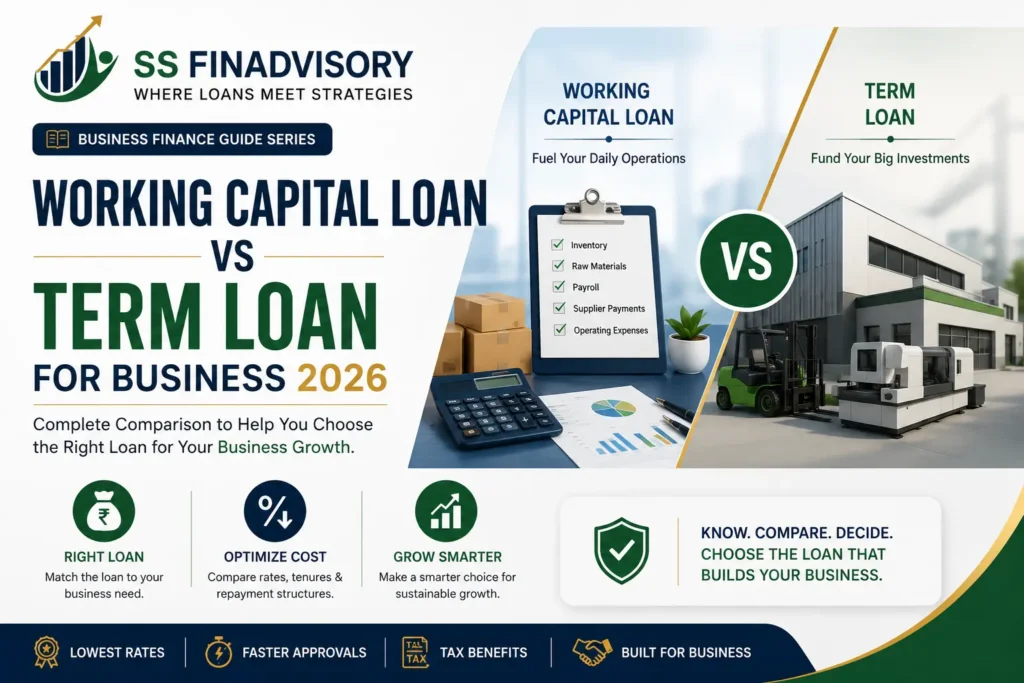
Working capital loans and term loans are often discussed as alternatives, but they are solving different problems. A term loan funds a specific purchase — machinery, property, equipment. A working capital loan funds the ongoing gap between money going out (to suppliers, payroll) and money coming in (from customers). Using the wrong one for your need costs lakhs over the loan’s life. This guide explains when each fits, with a worked case study showing the difference on a ₹30 lakh requirement.
Core Difference: Purpose-Based vs Need-Based Funding
The fundamental distinction is what each loan is designed to fund:
Term Loan = Purpose-Based. You borrow for a specific, one-time purpose — buying a machine, fitting out an office, acquiring equipment. The full amount disburses upfront, and you repay it in EMIs over a fixed tenure matching the asset’s useful life. Interest accrues on the outstanding principal balance, which reduces month-by-month as you repay. Once repaid, the loan closes.
Working Capital Loan = Need-Based. You get a sanctioned limit (say ₹30L) that acts as a revolving facility. You draw against it when you need cash, pay back when customers pay you, and draw again for the next cycle. You pay interest only on the amount drawn at any given time, not on the full sanctioned limit. The facility renews annually; it does not “close” in the traditional sense.
This structural difference has massive implications. A term loan for working capital needs forces you to hold borrowed cash you are not using — paying interest on idle funds. A working capital loan for asset purchase may have insufficient tenure and creates annual renewal uncertainty on a long-term asset.
Working Capital Loan: When and Why to Use It
- Seasonal inventory build-up. Retailers stocking inventory 2–3 months before peak season and selling it over the season. WC limit covers the inventory gap.
- Receivables gap financing. You invoice customers with 30–90 day payment terms. WC bridges the gap between supplier payments and customer collections.
- Payroll management. Service businesses with lumpy cash flow — fund payroll during the month, pay off when client invoices clear.
- Emergency liquidity buffer. Sanctioned line that you do not regularly draw from, but available when unexpected expenses arise. Costs nothing when unused.
- Marketing campaign funding. Short-term expense with measurable ROI in 3–6 months. Draw, execute campaign, repay from increased revenue.
- Project-based cash flow. Consultants, event managers, contractors — fund project expenses upfront, repay when client settles final invoice.
Structures to know: Cash Credit (CC) is backed by hypothecation of inventory/receivables — common for manufacturing and trading. Overdraft (OD) is linked to your current account with an approved limit — more common for service businesses. Invoice discounting / bill discounting converts specific invoices into immediate cash at a discount — fastest and most specific. All three are forms of working capital facility; the choice depends on your business nature and bank’s product suite.
Term Loan: When It’s the Right Choice
- Machinery or equipment purchase. Defined cost, defined asset, defined useful life. Match loan tenure to asset life — 5-year machine gets 5-year term loan.
- Business premises purchase or renovation. Large, one-time capital expense. Typically structured as a term loan with the property or fit-out as collateral.
- Vehicle fleet financing. Each vehicle gets its own term loan matched to the vehicle’s useful life (3–7 years for commercial vehicles).
- Business acquisition. Buying out another business or a partner’s stake. Large, one-time deployment repaid from the combined entity’s cash flow.
- Technology infrastructure. ERP systems, server infrastructure, one-time software licensing — capital expenditures with multi-year useful life.
- Expansion capex. Opening a new branch, setting up a new production line, entering a new market. Defined project with defined cost.
The test for a term loan: is this a one-time expense with a defined, discrete cost? If yes, term loan. If the cost is recurring or fluctuating, it is working capital — even if the total amount is similar.
Rate and Tenure Comparison
| Parameter | Working Capital Loan | Term Loan |
|---|---|---|
| Interest Rate Range | 11% – 17% | 10% – 15% |
| Typical Tenure | Revolving (annual renewal) | 1 – 10 years fixed |
| Interest Calculation | On drawn amount only | On full outstanding principal |
| Disbursal Pattern | Draw as needed | Lump-sum upfront |
| Repayment Structure | Interest monthly, principal flexible | Fixed EMI (principal + interest) |
| Collateral | Hypothecation of current assets | Primary security (asset) + often collateral |
| Processing Fee | 0.5% – 1% (one-time for limit) | 1% – 2.5% |
| Annual Renewal Fee | 0.1% – 0.25% of limit | None |
| Loan Amount Range | ₹5L – ₹25 Cr | ₹5L – ₹100 Cr+ |
| Prepayment Flexibility | Unlimited, no penalty | Usually 2–5% penalty (floating: 0) |
| Tax Deductibility | Yes, Section 37(1) | Yes, Section 37(1) |
* Green-shaded cells indicate the winner on each parameter. Neither is universally better — they serve different purposes.
Tax Deductibility: Interest on Both Loan Types
Both working capital loans and term loans offer identical tax treatment: interest is fully deductible as a business expense under Section 37(1) of the Income Tax Act, with no upper cap (unlike home loan interest, which is capped at ₹2 lakhs under Section 24(b)). The key requirement is documentable business use of the loan proceeds.
Worked example — tax benefit comparison: A manufacturing SME pays ₹3.5 lakhs in annual working capital interest. At the 30% marginal tax rate, the tax saving is ₹1.05 lakhs. Effective cost of ₹3.5L interest after tax benefit: ₹2.45L. The same business paying ₹4.0 lakhs on a term loan saves ₹1.2L in tax — effective cost ₹2.8L. Tax treatment is identical; the differences in total interest cost come from how each loan type is structured and utilised, not from tax treatment.
Documentation requirements: keep the loan sanction letter, bank-issued interest certificate (requested annually), and evidence showing business use of funds (invoices, vendor payments, payroll records). For working capital facilities, the business linkage is usually self-evident from bank statements showing inflows/outflows match business operations. For term loans, the specific purpose (machinery invoice, property sale deed, etc.) should be documented.
Not Sure Which Type Your Business Needs?
I will analyse your cash flow pattern, funding purpose, and growth trajectory — then recommend the exact loan structure (or mix) that fits. Many SMEs benefit from both simultaneously, structured efficiently. Get a Free Funding Structure Analysis
Case Study: ₹30L Need — Which Loan Saves More?
Consider a retail business owner who needs ₹30 lakhs. The usage pattern varies by season: ₹30L drawn in peak months (Oct–Dec), ₹12L drawn in average months, ₹5L drawn in lean months. Average monthly utilisation across the year: ~₹15L.
₹30L Funding Need · 3-Year Horizon · Average Monthly Draw ₹15L
Option A: Working Capital (OD) ₹30L Limit
Sanctioned limit₹30,00,000
Rate (floating)13.0%
Avg monthly drawn amount₹15,00,000
Annual interest paid₹1,95,000
Processing fee (one-time)₹30,000
Annual renewal (₹30L × 0.2%)₹6,000 × 2 = ₹12,000
3-year Total Cost~₹6,27,000
Option B: Term Loan ₹30L · 3 Years
Loan amount₹30,00,000
Rate12.5%
Tenure3 years
EMI₹1,00,331
Total interest over 3 years₹6,11,916
Processing fee (one-time)₹60,000
Opportunity cost of idle funds~₹1,80,000
3-year Effective Cost~₹8,52,000
Verdict: Working capital OD saves approximately ₹2.25 lakhs over 3 years for this usage pattern. The key insight: term loan interest accrues on the full ₹30L regardless of how much you actually use, while OD interest is only on the drawn amount.
The verdict flips if usage is different. If the business used ₹30L consistently every month (not fluctuating), the term loan at 12.5% becomes cheaper than OD at 13%. The decision depends entirely on your actual drawdown pattern — a factor most borrowers fail to analyse before picking the product.
Can You Use Both Simultaneously?
Yes — and this is often the optimal structure for growing SMEs. A well-funded business typically carries both: a term loan for major asset purchases + a working capital facility for operational needs. Banks are happy to extend both, as long as your total debt service (combined EMI of term loan + average interest on WC) stays within 55–60% of cash flow.
Example optimal structure for a ₹5 Cr turnover manufacturer:
• Term Loan ₹1 Cr @ 12% over 5 years for new machinery installation — EMI ₹22,244/month. Tax-deductible interest.
• Working Capital CC ₹1 Cr limit @ 13% for inventory and receivables funding — pay interest only on drawn amount (typically ₹40–70L). Tax-deductible interest.
The machine (asset) is financed by the term loan, matched to its useful life. The operational cash flow gap is managed through the WC facility, flexed to actual need. Both are tax-deductible. This separation mirrors the underlying economics — one-time asset versus recurring operational need — and minimises total interest cost.
Common pitfall: Some businesses end up with two term loans when they should have had one term loan and one working capital facility. Sign of this: you have ₹50L in a term loan sitting in your current account because you do not need it right now, while still paying interest on the full ₹50L. If this describes you, refinance — convert the underutilised portion of the term loan into a working capital facility.
Frequently Asked Questions
What is a working capital loan used for?
Funding day-to-day operations — inventory, raw materials, payroll, rent, utilities, supplier payments. Used for recurring cash flow gaps, not one-time purchases. Typical uses: inventory stocking, bridging supplier-customer payment timing, payroll management, marketing campaigns. Structured as OD, CC, or revolving facility — pay interest only on drawn amounts.
Which is cheaper — a working capital loan or a term loan?
Term loans have lower headline rates (10–15% vs 11–17%). But working capital with 40–60% average utilisation often costs less overall because you pay interest only on drawn amounts. For short-term fluctuating needs: WC cheaper. For long-term fully-utilised funding: term loan cheaper. Match product to usage pattern — more important than rate difference.
Can I convert a term loan to a working capital facility?
Not directly. Options: (1) prepay term loan and take fresh WC facility, (2) take WC alongside term loan if eligibility supports, (3) refinance via larger WC to prepay term loan. Each has costs: term loan prepayment penalty (0% floating for individuals, 2–5% fixed), new facility processing fee (0.5–1%).
Is interest on working capital loan tax deductible?
Yes — fully deductible as business expense under Section 37(1). Uncapped (unlike home loan’s ₹2L cap under 24B). On ₹3L annual interest at 30% bracket, tax saving is ₹90K — effective cost drops by a third. Maintain sanction letter, annual interest certificate, evidence of business use.
What is the maximum tenure for a business term loan?
Unsecured business term loans: up to 5 years. Secured (property/machinery-backed): 7–10 years. LAP used for business: up to 15 years. Match tenure to asset life — 3-year machinery gets 3–5 year loan, not 10. Mismatched tenure creates cash flow stress or excess interest cost.
Let Me Structure Your Optimal Funding Mix
I will map your cash flow pattern, funding purpose, and growth plans — then recommend the exact product mix (WC alone, term alone, or both) that minimises total interest cost while giving you flexibility. Book Free Consultation
About the Author: Somnath Sarkar is a loan strategy consultant with 20+ years at Axis Bank and Deutsche Bank, specialising in working capital structuring, term loan sizing, and SME funding optimisation.
Disclaimer: Tax provisions, interest rates, and eligibility criteria vary by lender and are subject to change. Information is based on industry practice as of March 2026. This article is educational only and does not constitute financial or tax advice. Consult a qualified CA and financial advisor for your specific situation.
Last Updated: 11 June 2026 | First Published: 11 June 2026
© 2026 Somnath Sarkar. All rights reserved.