
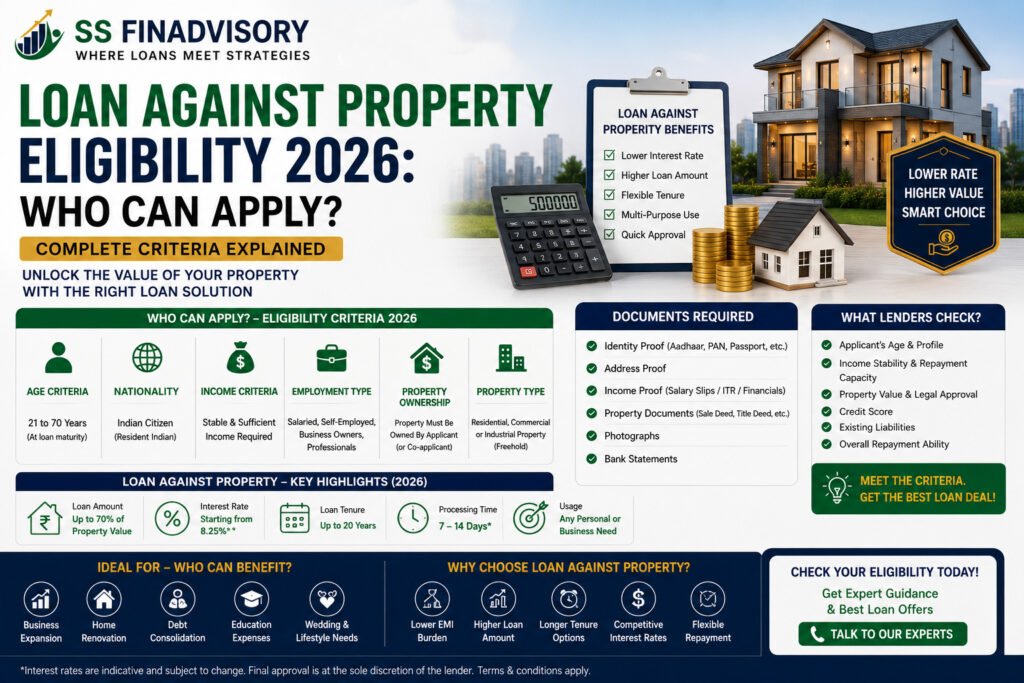
If you’re considering a big-ticket goal like business expansion, debt consolidation, or funding a child’s education, a loan against property eligibility check is usually where the journey really starts. Before any bank or NBFC talks about limits or interest rates, they quietly run the numbers on you and your property to decide how much risk they’re taking on.
Getting clear on this early saves a lot of guesswork. You know what you can realistically qualify for, which lender to approach, and what to fix first if your profile isn’t quite there yet. Let’s break down the 2026 norms in plain language so you understand how lenders think and how to improve your chances.
What Does Loan Against Property Eligibility Really Mean?
At its core, loan against property eligibility is a risk assessment. Lenders ask a simple question: if we give this customer a large secured loan, how confidently can they repay us on time without stressing their finances?
To answer that, they look at three pillars: your income stability, your repayment track record, and the quality of the property you’re pledging. The decision isn’t random; it follows internal policies, RBI guidelines, and years of data on which borrower profiles tend to default.
Key factors lenders usually check
Every lender has its own rulebook, but several themes keep showing up. They want to see predictable cash flows from salary or business, a sensible existing EMI burden, and a property that can be sold quickly if things go wrong.
On top of this, they examine your age, location, and type of employment. A professional with a steady history of tax returns usually passes the first screening of LAP eligibility faster than someone with erratic income proofs.
How eligibility connects to loan amount and tenure
Your property loan eligibility doesn’t just decide whether you get approved; it also shapes how much you can borrow. If your income comfortably supports the EMI, you may qualify for a higher percentage of the property’s market value.
Tenure works the same way. Younger borrowers with room before retirement often get longer tenures, which lowers EMI and improves apparent affordability, making approval more likely.
Standard Loan Eligibility Criteria in 2026
Even though every bank positions itself as flexible, the loan eligibility criteria for a mortgage-style product tend to be surprisingly similar across the board. If you scan lender websites, the same patterns repeat.
First, they want your EMI outgo, including the new loan, to stay within a safe slice of your monthly income. Second, they aim for a loan-to-value ratio that leaves a buffer between the sanctioned amount and current property price.
Typical income and EMI thresholds
Most lenders are comfortable when total EMIs stay under 50–60% of net monthly income. If you’re already close to that limit, they might ask you to close or reduce another loan before sanctioning a new one.
This is why many borrowers first check secured loan eligibility before even shortlisting lenders, because tweaking tenure or co-applicants can dramatically change where you stand.
Property-related checks that matter
On the property side, lenders prefer clear titles, approved building plans, and locations with active resale markets. They may reject properties with major legal disputes or very old, poorly maintained structures.
The valuer’s report can significantly shrink or lift your mortgage loan eligibility, as the sanctioned amount is tied to the lower of market value or distress sale value.
Minimum Income and Job Profile Requirements
One of the most common doubts is whether your salary or business income is”enough” for a property-backed loan. Lenders don’t just look at the number; they also care about how steady and well-documented it is.
They’ll often ask for salary slips, bank statements, ITRs, and sometimes Form 16 or GST returns. Missing or inconsistent paperwork usually leads to a lower sanctioned amount, even if your actual cash flow is higher.
Minimum income thresholds for urban borrowers
Lenders frequently set an internal minimum income for LAP, especially in metros and large cities, to keep ticket sizes commercially viable. In many cases, this threshold is higher for self-employed profiles than for salaried ones.
If your income is just at the cutoff, expect closer scrutiny of stability, such as how long you’ve been in the same job or running the same business.
For salaried applicants, banks typically like to see at least six to twelve months in the current job, with minimal gaps in employment over the past few years. A clean bureau report with on-time credit card and loan payments helps a lot.
This is why many working professionals ask about salaried loan eligibility before they commit to a property valuation or processing fee, so they don’t waste money on an application that was unlikely to pass in the first place.
Self-employed applicants face more detailed scrutiny because business income can swing month to month or season to season. Lenders will dig into profit trends and cash reserves to get comfortable.
For shop owners, freelancers, consultants, and small manufacturers, understanding self-employed LAP eligibility upfront can prevent last-minute surprises around sanctioned amount or requested collateral.
Age, Tenure, and Property Type: How They Shape Your Approval
Even a strong income profile can run into limits if age or tenure don’t line up well. Lenders usually want EMIs to finish a few years before retirement, so they may shorten tenure for older borrowers.
This can raise the EMI and, in turn, reduce the overall loan qualification you’re offered, because the repayment burden looks heavier on paper.
Residential properties in well-connected areas tend to get better terms compared to very old commercial units in less active markets. A clean chain of previous ownership, updated tax receipts, and building approvals all make a difference.
If you’re holding a mixed-use property, the lender may classify risk more conservatively, which can directly impact your property loan eligibility for higher ticket amounts.
How to Estimate and Improve Your Loan Against Property Eligibility
Before applying, a bit of homework goes a long way. Start by listing your current EMIs, average monthly income, and an honest estimate of your property’s value based on recent local sales.
From there, you can roughly see what EMI range you can handle without straining basics like rent, school fees, and business working capital.
Using tools to pre-assess your position
Most lenders host an eligibility calculator on their website that lets you plug in income, existing EMIs, age, and tenure preferences to see approximate figures. Treat these results as directional, not promises.
If the gap between what you need and what you might qualify for is large, it’s a sign to either reorganize your debts or scale back the requirement before making a formal application.
Practical ways to strengthen your profile
There are several levers you can adjust to improve LAP eligibility over a few months. Reducing unnecessary credit card usage, closing small high-cost loans, and avoiding new unsecured borrowings all send a positive signal.
Sometimes adding a close family member as co-applicant can increase the combined loan eligibility criteria, especially if the second income is stable and well-documented.
Borrowers who actively track their credit score have an advantage, because they can dispute errors and correct outdated records before the lender pulls a bureau report. A jump of even 30–40 points can lower the perceived risk band you fall into.
Small things help too: consistent banking habits, like routing all income through your main account and avoiding frequent cheque bounces, gradually build a stronger picture for secured loan eligibility over time.
The Bottom Line: Getting Ready Before You Apply
Stepping back, three messages stand out: understand how loan against property eligibility is calculated, be honest about your income and obligations, and fix the easy red flags before inviting a lender to scrutinize your profile. A little preparation now often means faster approval, more comfortable EMIs, and fewer conditions later.
If you’re weighing a large, property-backed borrowing for your next big goal, this is the right moment to review your documents, run a fresh eligibility check, and speak to a trusted advisor or lender; ss finadvisory can help you align your paperwork and expectations so your application reflects your true strength and gives you the best shot at favourable terms on a loan against property eligibility based assessment.