
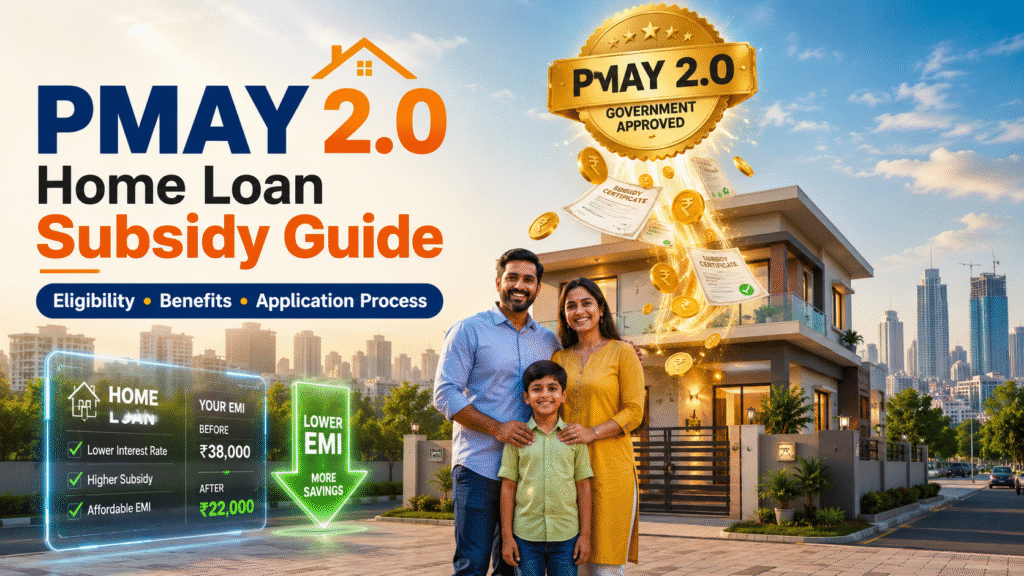
PMAY-U 2.0: How the 4% Home Loan Interest Subsidy Actually Works in 2026 | SSFinAdvisory
MoHUA UPDATE · PMAY-U 2.0 IS ACTIVE FOR FY 2026 · APPLICATIONS OPEN VIA OFFICIAL PORTAL
SSFinAdvisory
Loan Strategy, Explained Plainly
ssfinadvisory.com
Government Scheme Explainer
The 4% Home Loan Subsidy Middle-Class Families Keep Hearing About — Here’s What It Really Pays Out.
PMAY-U 2.0’s Interest Subsidy Scheme sounds simple in the headlines. After twenty-two years of sitting across the table from loan applicants, I can tell you the eligibility fine print is where most people either qualify without knowing it, or get quietly disqualified.
4%Interest subvention on eligible loans
₹1.80LMaximum total subsidy per family
2024–29Scheme window, still open in 2026
Somnath · SSFinAdvisory • Updated 4 August 2026 • 9 min read
Every few months, a version of the same headline does the rounds: “Modi government gives 4% home loan subsidy to middle class.” It’s true — but the way it’s usually reported leaves out the parts that actually decide whether you, specifically, will see a rupee of it. This is the version I’d give a client sitting across my desk.
01. What PMAY-U 2.0 Actually Is
Pradhan Mantri Awas Yojana–Urban 2.0 was approved in 2024, in the first budget of the Modi government’s third term, as the successor to the original 2015 PMAY-Urban mission. The goal is to help build or improve housing for 1 crore urban families over five years, running through 2029. It isn’t a single scheme — it’s an umbrella with four separate components, and only one of them is the interest subsidy that gets all the headlines.
Vertical 1
Beneficiary-Led Construction (BLC)
Direct central assistance to households building or extending a house on land they already own.
Vertical 2
Affordable Housing in Partnership (AHP)
Assistance for affordable housing projects built in partnership with states and private developers.
Vertical 3
Affordable Rental Housing (ARH)
Rental housing stock for urban migrant workers and low-income families who aren’t ready to buy.
Vertical 4
Interest Subsidy Scheme (ISS)
The one this article is about — a 4% interest subvention on home loans for eligible families.
Insider note: As of the Central Sanctioning and Monitoring Committee’s meeting in February 2026, the government approved another 2.88 lakh houses under PMAY-U 2. So this isn’t a scheme that quietly wound down after the initial announcement. It’s still being actively sanctioned.
02. What the 4% Subsidy Actually Pays
This is the part most reports get vague about. The Interest Subsidy Scheme gives a 4% interest subvention on a home loan of up to ₹25 lakh. But it isn’t credited as a lump sum against your loan the day it’s sanctioned — it’s disbursed as five annual instalments of ₹36,000 each, capping the total benefit at ₹1.80 lakh per family over five years.
| Income Category | Annual Household Income | Eligible For |
|---|---|---|
| EWS (Economically Weaker Section) | Up to ₹3 lakh | 4% subsidy, ISS/BLC/AHP |
| LIG (Low Income Group) | ₹3 lakh – ₹6 lakh | 4% subsidy, ISS/BLC/AHP |
| MIG (Middle Income Group) | ₹6 lakh – ₹9 lakh | 4% subsidy under ISS |
Unlike the earlier CLSS scheme (2017–2022), which gave EWS/LIG a higher subsidy rate than MIG, PMAY-U 2.0 uses a flat 4% rate across all three income categories — a genuine simplification, and one of the more middle-class-friendly changes in this version.
EMI without subsidy (illustrative)Full rate
Effective EMI burden after 4% subvention~18% lower cost of borrowing on eligible slab
Illustrative only — the subsidy is disbursed as annual instalments, not as an upfront EMI reduction, so your monthly EMI to the bank stays the same; the benefit arrives separately, once a year, for five years.
03. The Conditions That Actually Disqualify People
In my client conversations, this is where the surprises happen — not at the income slab, but here:
- No pucca house anywhere in India — in your name or any adult family member’s, in any city.
- No housing scheme benefit in the last 20 years — central, state, or local, under any name.
- Property must be registered in the woman’s name — the female head of household must be sole or joint owner. This is mandatory, not a preference, and applications without it are rejected outright.
- Loan from an NHB-registered lender — a scheduled bank, housing finance company, or microfinance institution.
- Property within a notified urban area — a statutory town per the 2011 Census, or a subsequently notified urban area.
- Loan must stay active — for each of the five instalments to release, the loan can’t be an NPA, and at least 50% of the original principal must still be outstanding.
Where I see people slip up, that last condition on outstanding principal catches aggressive prepayers off guard. If you’re planning to prepay your loan heavily in the first few years — which I generally recommend for interest savings — you need to weigh that against forfeiting later ISS instalments. It’s a genuine trade-off, and the right call depends on your loan size and rate.
Not sure if you qualify?
I review eligibility against the actual scheme guidelines, not just the headline numbers.
04. How to Apply
- Confirm your income category and check that you meet every condition above — not just the income cap.
- Keep Aadhaar, income proof, and property documents ready before you start the online form.
- Register and apply through the official PMAY-U portal, choosing the correct vertical (ISS, in this case).
- Take your home loan from an NHB-registered scheduled bank, HFC, or MFI — the subsidy is linked to the loan, not paid independently.
- Save your Application ID immediately; it’s what you’ll need to track status and instalment release.
05. Should You Actually Bank On This Subsidy?
My honest advice, after two decades of watching government housing schemes come and go: treat the ISS subsidy as a bonus, not as a load-bearing part of your affordability calculation. Qualify for the home loan on its own merits — income, credit score, EMI-to-income ratio — and let the ₹1.80 lakh, spread over five years, be the cushion, not the crutch. Schemes like this have historically seen slower disbursal and administrative delays at the state level, even when the intent at the central level is genuine.
What it’s genuinely useful for: shaving a real amount off your effective borrowing cost if you’re already a first-time buyer in the EWS/LIG/MIG bracket, buying within a notified urban area, and not planning to prepay aggressively in years one through five.
Want a second opinion before you apply?
I’ll check your eligibility against both the bank’s lending criteria and the scheme’s fine print — in one sitting. Book a Consultation
06. Frequently Asked Questions
Is the PMAY-U 2.0 interest subsidy still available in 2026?
Yes. The scheme runs 2024–2029, applications are open on the official portal, and the government approved fresh houses under it as recently as February 2026.
How much money do I actually get?
Up to ₹1.80 lakh total, paid as five annual instalments of ₹36,000 each, against a home loan of up to ₹25 lakh.
Who qualifies?
EWS, LIG, and MIG households (income up to ₹9 lakh a year) who don’t own a pucca house anywhere and haven’t used a housing scheme benefit in the last 20 years.
Why does the house have to be in a woman’s name?
It’s a mandatory scheme condition across every income category, meant to promote women’s property ownership — not optional paperwork.
What if I prepay my loan early?
Each instalment requires the loan to be active, with at least 50% of the principal still outstanding. Aggressive prepayment can cost you later instalments, so plan the two together.
Somnath Sarkar
Independent Loan Advisory Consultant, SSFinAdvisory
22+ years in banking across Axis Bank, Aditya Birla Housing Finance, Bank of Baroda, Standard Chartered Bank India, and HBL Global (an HDFC Bank subsidiary). Advises families on Home Loan, LAP, Working Capital, Secured Business Loan, and CGTMSE strategy at ssfinadvisory.com
SSFinAdvisory: Independent home loan & LAP advisory. Scheme details sourced from official PMAY-U communications current as of August 2026; always verify against the official portal before applying.