
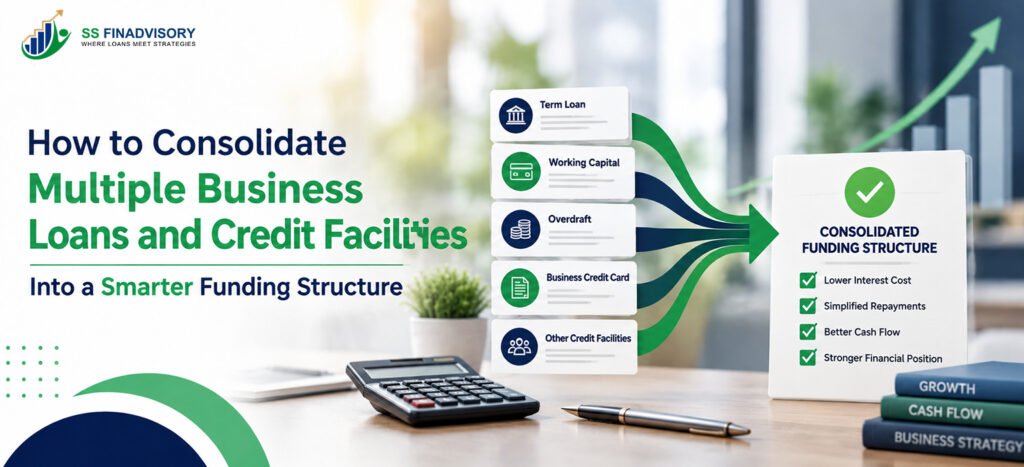
Multiple EMIs. Bullet repayments. CC interest piling up because you only pay the minimum. If that sounds like your current mix of business loans, you’re exactly who business loan consolidation is meant to help.
Most Indian promoters don’t wake up one morning and decide to take five facilities. It happens over years – a term loan for machinery, an overdraft for GST payments, a top-up to cover a delayed receivable. The structure becomes messy, and suddenly cash flow feels tight even when sales are fine.
Why Business Loan Consolidation Is Back On The Table
Consolidation makes sense when your funding structure is stopping the business from breathing. In India, this often shows up as EMIs bunched around the 7th and 10th of the month, irregular vendor payments, and constant juggling between current account and cash credit.
Instead of treating each facility as a separate problem, you step back and ask one question: what mix of loans, limits and tenures gives me the lowest risk and the smoothest cash flow for the next three to five years?
Step 1: Map Every Loan, Limit And Security
Before you consolidate business loans, you need a clean picture of what you already have. Most owners underestimate this step and depend on an internal Excel that hasn’t been updated since the last renewal.
Pull the latest sanction letters and repayment schedules for every facility – term loans, working capital limits, equipment loans, overdrafts, unsecured loans from NBFCs, even business credit cards if you revolve them. List outstanding amount, interest rate, EMI or interest cycle, security offered, guarantors and end date.
Now mark which loans are linked to core long-term assets and which are short-term plugs that stayed for too long. This is the base document for any banker or advisor to even start a serious discussion.
Step 2: Separate Long-Term Funding From Working Capital
One of the biggest reasons debt consolidation for business fails is that owners mix asset funding and working capital into a single large loan. On paper EMIs drop, but six months later the cash crunch returns because stock and receivables are still funded from the wrong place.
Match long-term assets – land, building, major machinery – with longer-tenure loans. Day-to-day needs like inventory, payroll gaps and GST dues should sit on revolving or short-tenure credit, not on a 12-year term loan that quietly eats up your eligibility.
If you want to go deeper into planning short-term finance, the detailed guide on calculating the right working capital requirement is a good next step before you change your structure.
Step 3: Decide Your Priority – EMI Relief Or Interest Saving?
Every business debt restructuring exercise must start with clarity on the main objective. For some MSMEs, survival comes first: they need lower monthly outgo immediately, even if total interest over the life of the loan goes up.
For others with stable cash flows, the aim is sharper – they want to cut total interest, shorten tenure and free property security. Both goals are valid, but the structure you choose will differ completely.
Be honest about your next 12–18 months. If cash flows are uncertain, you might accept a slightly higher rate for more flexibility, instead of chasing the lowest headline interest.
Step 4: Explore Security-Backed Consolidation Options
In many Indian businesses, property is already mortgaged across two or three lenders. Yet the value of that collateral is rarely optimised. Thoughtful business loan refinance using a single property-backed facility can simplify repayment and reduce overall cost.
If a large portion of your existing borrowing is short-term but backed by property, a structured facility similar to a loan against property or LAP can often replace scattered high-cost loans with one consolidated structure.
Advisory services like LAP Smart Leverage Advisory focus on analysing how much of your property’s value is under-used and how to re-structure against it without taking unnecessary risk.
Using Property Without Overcommitting
This is where many owners go wrong. They hear that a LAP-style product is cheaper, so they sweep all short-term borrowing into a long tenure just to cut the EMI. Two years later, the same working capital gap reappears and there is no property left to pledge.
A smarter approach is to only shift the relatively permanent portion of your borrowing into a property-backed structure and leave space for genuine business growth. The rest should be handled through tighter working capital planning and better use of revolving facilities.
Step 5: Clean Up And Right-Size Working Capital Limits
Working capital optimization is usually where the real monthly relief comes from. Many companies run with limits that were fixed years ago when turnover was lower, or with cash credit they never fully use but still pay charges on.
Start with two questions: is my current overall limit in line with my peak seasonal requirement, and does the structure (cash credit, overdraft, short-term loan) match how cash actually moves in and out of the business?
A structured review, like the approach used in Business Loan Working Capital Planning, looks at sales cycles, debtor days, stock rotation and payment terms to realign limits with reality.
Restructuring Existing Working Capital Loans
If your CC or OD account is always near full limit and interest is eating margins, consider a partial shift into a term facility with disciplined repayment. This working capital loan restructuring idea is explained in more detail in the guide on how businesses can reduce interest and improve cash flow.
The aim is simple: stop using permanent borrowing for temporary gaps and stop rolling temporary borrowing for permanent needs.
Step 6: Compare Lenders On More Than Just Rate
When owners hear “consolidation”, many immediately start collecting rate quotes. The lowest percentage on the term sheet looks attractive, but it is only one part of the decision.
Look closely at processing charges, prepayment conditions, commitment charges on unused limits, valuation and legal costs, review frequency and documentation expectations. Some lenders are comfortable with seasonal fluctuations common in India and design covenants around that; others expect a smooth monthly profile that doesn’t match your business at all.
If your plan involves future balance transfers, it helps to understand how different lenders behave at reset time. The article on comparing balance transfer with prepayment is written for home loans but the thought process on charges and long-term savings applies to business funding too.
When To Bring In An Advisor
If you have only one or two loans, you can usually handle the comparison yourself. Once you cross three lenders, multiple securities and different tenures, the structure becomes complex enough that an independent view helps.
A good advisor doesn’t simply chase a lower rate; they look at how risk is spread across banks, how much personal guarantee you’re giving, and what headroom remains for future borrowing.
Step 7: Execute In Phases, Not Overnight
The biggest mistake in business loan consolidation is trying to do everything in one shot. You close old limits, open new ones, shift banking entirely, and then a delayed sanction or documentation issue chokes daily operations.
Plan the execution in phases: first secure in-principle approval, then activate the new facility, test payouts and collections, and only then close old limits. For some businesses it even makes sense to keep a backup overdraft for a quarter while the new structure proves itself.
Document the new funding strategy clearly and share it with your finance team so that people on the ground know which facility to use for what purpose. Without that clarity, any consolidation will slowly drift back into chaos.
Conclusion
Done thoughtfully, business loan consolidation is less about chasing a new loan and more about building a funding structure that lets the business breathe. For Indian promoters, that usually means cleaning up working capital, using property carefully and matching loan tenures to real business cycles.
If you’d like an experienced view on your current mix of loans and limits in India, ss finadvisory can help you think through options and plan the next steps before you sign your next sanction letter.
Frequently Asked Questions
Q1. How does business loan consolidation actually reduce my monthly EMI burden?
Ans: Consolidation usually replaces several smaller loans with one or two better-structured facilities on longer tenures. When done after a proper analysis of your cash flow and security, the combined EMI often drops and interest days on working capital are reduced. The key is not to overextend tenure just for a lower EMI.
Q2. Is debt consolidation for business a good idea if my CIBIL score is average?
Ans: An average CIBIL score doesn’t automatically rule out restructuring, but it narrows the lender set and may affect pricing. In practice, lenders also weigh business performance, banking conduct and collateral quality. A clean track record on existing EMIs strengthens your case even with a moderate score.
Q3. Can I use business debt restructuring to shift from unsecured to property-backed loans?
Ans: Many owners use restructuring to replace high-cost unsecured borrowing with a property-backed facility, especially when collateral is under-used. This can simplify repayments and reduce rate volatility. The trade-off is that you lock in valuable property security, so you need to keep future borrowing needs in mind.
Q4. How should I plan working capital optimization during seasonal sales peaks?
Ans: Start by mapping your peak season requirement for stock and receivables and then align limits to that figure instead of a rough guess. Use revolving facilities for short bursts and avoid funding temporary spikes with long-tenure term loans. A structured review once a year keeps limits in line with real business cycles.
Q5. What’s the difference between business loan refinance and consolidation?
Ans: Refinance usually means replacing one existing loan with a new one on better terms, often from a different lender. Consolidation is wider – it can combine several facilities, change tenures and even redesign how much sits in term loans versus working capital. Many restructuring plans use refinance as one of the tools.
Q6. How common is business loan consolidation for MSMEs in India?
Ans: For MSMEs in India, formal consolidation is becoming more common as banking products and advisory services become more specialised. Many owners earlier managed with ad hoc top-ups and temporary limits, but that approach strains cash flow as borrowing grows. A structured review every few years helps keep debt aligned with the size and stage of the business.