
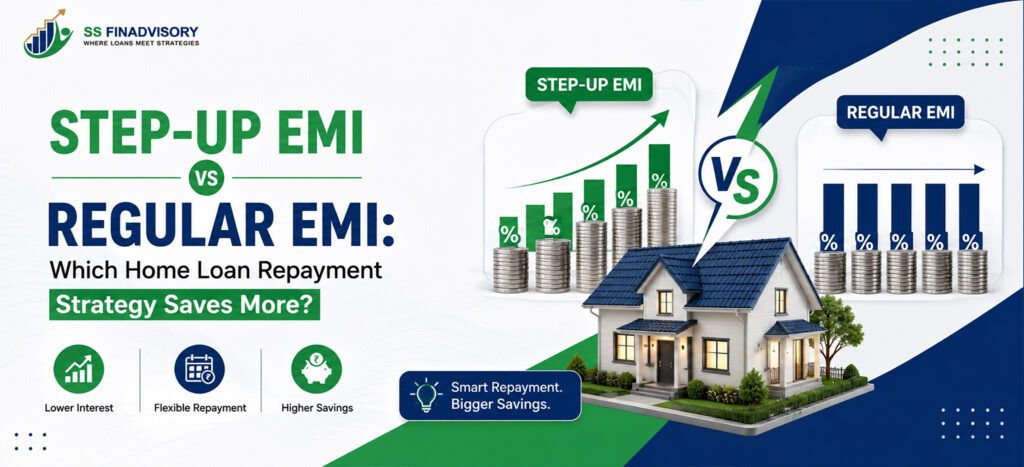
You’ve probably heard bankers talk about step up EMI vs regular EMI when pitching a new home loan, but no one clearly shows you which one actually saves more in India. You just want to know: will this structure help you close the loan faster, or quietly increase your interest outgo?
If you’re early in your career and expecting your salary to rise, a step up structure sounds attractive. If you’re already mid-career, the flat comfort of a regular EMI feels safer. The right choice depends less on what the bank is pushing and more on how disciplined you are with your home loan repayment strategy.
What Is A Step Up EMI And How Does It Really Work?
A step up EMI home loan starts with a lower EMI in the initial years and then increases the EMI periodically as your income is expected to rise. The catch is simple: lower EMIs at the start usually mean you are paying more interest in the early years, because a larger part of the instalment goes towards interest instead of principal.
Lenders in India use your current age, expected retirement age and income growth assumptions to design the increasing EMI strategy. On paper, it improves eligibility and makes the property appear more affordable, but you must see the complete amortisation schedule before agreeing to it.
Regular EMI: Straightforward, But Is It Always Better?
A regular EMI keeps the instalment broadly the same throughout the home loan tenure, except for changes due to interest rate movements. Many salaried borrowers like the predictability because budgeting for a fixed EMI is simpler month to month.
The big plus is that if you pay any extra towards prepayment or part-payment, the impact on interest savings is transparent. You can clearly see how each lump sum helps reduce home loan tenure without getting lost in a complicated step-up formula.
Step Up EMI Vs Regular EMI: Key Factors That Decide Savings
When comparing step up EMI vs regular EMI, don’t start with the EMI amount the relationship manager circles on the sheet. Start with three questions: how fast do you expect your income to grow, how disciplined are you with surplus cash, and how long do you actually want to keep this loan.
In many cases, a regular EMI combined with aggressive prepayment works out cheaper than a step-up design. But for a young professional who truly expects steady income jumps and finds it hard to prepay on their own, an automatic step-up can turn into a workable home loan interest savings tool.
How Step Up EMI Affects Interest And Tenure In India
In the Indian market, step-up structures are usually sold to younger borrowers with long tenures, often 20 years or more. The first few years look easy on the pocket, but those are exactly the years where interest forms the largest part of your EMI.
If the lender has stretched your tenure too far just to make the starting EMI look attractive, you might end up paying far more interest than under a conservative regular EMI plan. Before signing, compare total interest outgo for both options and see how many years it takes to realistically reduce home loan tenure under each.
Real-World Scenarios: Who Should Prefer Which Strategy?
Suppose a 28-year-old IT professional in Bengaluru takes a long home loan while expecting decent salary hikes every two or three years. For this profile, a thoughtfully designed increasing EMI strategy can help match EMI jumps with promotions and bonuses, without straining monthly cash flow in the early years.
Contrast that with a 45-year-old self-employed professional with variable income. For this person, a plain regular EMI with the flexibility to prepay big chunks during strong business years is often safer. The fewer moving parts in the structure, the easier it is to execute a disciplined home loan repayment strategy.
Using Strategy, Not Just Structure: Where Professional Advice Helps
Choosing between EMI patterns is just one part of the decision. How you combine that pattern with prepayments, balance transfer options and tax planning decides the real outcome. This is where a specialised advisory like Home Loan Strategy Optimisation can stress test both structures against your actual financial goals instead of generic charts.
If your EMIs already feel tight, you may find ideas in the guide on how to reduce home loan EMI without extending your tenure. Often small structural changes to the loan or better timing of prepayments give more relief than switching blindly to a step-up format.
How To Compare Two EMI Structures For Your Own Loan
Don’t rely only on the loan officer’s “this will save you a lot of interest” line. Ask for detailed amortisation schedules for both the step-up and the regular EMI options. Then compare year-by-year principal reduction, not just the first-year EMI.
Pay attention to three markers: total interest paid over the full tenure, the point at which half the principal is repaid, and how sensitive the plan is to missed increments. If one delayed promotion can break your step-up calculation, it’s a sign to stay with a simpler home loan repayment strategy.
Step Up EMI Vs Regular EMI: Common Misconceptions
Many borrowers assume that a step-up format automatically gives higher home loan interest savings. In practice, if the lender has stretched your tenure or built in steep EMI jumps, you might pay more, not less, over the life of the loan.
Another misconception is that you can’t prepay in a step-up loan. You usually can, and using prepayments aggressively in the first half of the tenure is one of the most effective ways to reduce home loan tenure under either structure.
Risk Checks Before Choosing A Step Up EMI
Before signing a step-up agreement, look at your job stability and industry prospects in India over the next decade. If your sector is cyclical or performance-linked, those future pay hikes are not guaranteed, but the higher EMIs certainly are.
Run a stress test: could you still manage the highest EMI under the plan if there was no increment for two years? If not, request a more moderate step-up curve or consider staying with a conservative regular EMI and planning voluntary prepayments instead.
Where Balance Transfer Fits Into The Picture
Life changes. You might start with a step-up structure and later find a better rate or a more comfortable EMI at another lender. In such cases a home loan balance transfer, combined with restructuring into a regular EMI, can reset your repayment journey.
For a deeper understanding of when shifting your loan actually makes sense, refer to the detailed comparison of home loan balance transfer versus prepayment. The same logic applies even if you currently have a step-up plan.
Planning EMI Around Overall Cash Flow
An EMI decision should not be made in isolation from your other goals. You still need money for emergencies, insurance premiums, children’s education, and long-term investments. A step-up schedule that looks fine in a spreadsheet can feel very different when school fees or parental medical expenses rise.
If a bank design increases EMIs too sharply, ask them to moderate the slope or shorten the tenure instead. You can also explore broader planning through services like working capital planning for business cash flows if your income depends on your enterprise’s liquidity.
When To Seek Independent Home Loan Advice
Most people in India compare offers only on rate and EMI. Very few look at structure, linked products, or the real cost of choosing one format over the other. That gap is exactly where expensive mistakes hide.
If the numbers feel confusing, speaking to a specialist who understands step-up design, prepayment rules and rate-reset behaviour across lenders can help. Advisory services that focus only on borrowers’ interests, not product sales, can often spot a more efficient way to reduce home loan tenure with the same income you already have.
Conclusion
Choosing between step up EMI vs regular EMI is less about the “smart” product and more about what fits your income pattern, discipline and long-term plans in India. Run the numbers on total interest, not just the first-year EMI, and think about how you’ll behave with future salary increases.
If you want an experienced eye to test your choices and design a repayment path around your real life, not just the bank’s sheet, ss finadvisory can help you shape a home loan strategy where the structure and your behaviour work together. Take the time now to pick the format you can live with for years, then stick to the plan.
Frequently Asked Questions
Q1. How does a step up EMI home loan work in India?
Ans: In a step-up structure, your EMI starts lower and then increases at predefined intervals, usually every year or few years. Lenders in India often design it assuming your income will rise steadily, which improves eligibility but can raise total interest if the tenure is very long.
Q2. Which is better for interest savings, step up EMI or regular EMI?
Ans: There is no single winner because it depends on your income growth and discipline with prepayments. A regular EMI combined with early prepayments can often beat a poorly designed step-up plan on total home loan interest savings, while a thoughtful step-up can work well for genuinely fast-rising careers.
Q3. Can a step up EMI strategy help reduce home loan tenure?
Ans: Yes, if the higher EMIs in later years are significantly above a comparable regular EMI, the extra amount goes to principal and can reduce home loan tenure. The effect is stronger if you also make occasional prepayments instead of using every salary hike entirely on lifestyle upgrades.
Q4. Is increasing EMI strategy better than making lump sum prepayments?
Ans: An increasing EMI strategy gives automatic discipline, while lump sum prepayments need you to act on your own. If you’re confident you’ll divert bonuses and surpluses to prepayment, a flat EMI with part-payments can be more flexible; if not, automatic EMI rises may work better for you.
Q5. How should I plan EMI if I want to close my loan before retirement?
Ans: Start with an EMI that is comfortable but slightly stretched so principal begins reducing quickly, then use increments to either raise EMI or make regular prepayments. Build a clear home loan repayment strategy with target dates and amounts, and revisit it every year to keep yourself on track.
Q6. Can ss finadvisory help me choose between step up and regular EMI?
Ans: Yes, the firm focuses on advisory-led planning, including step-up versus regular EMI structures, balance transfer decisions and EMI planning. A specialist can look at your cash flows, risks and goals and then suggest a structure that supports both comfort and long-term interest savings.