
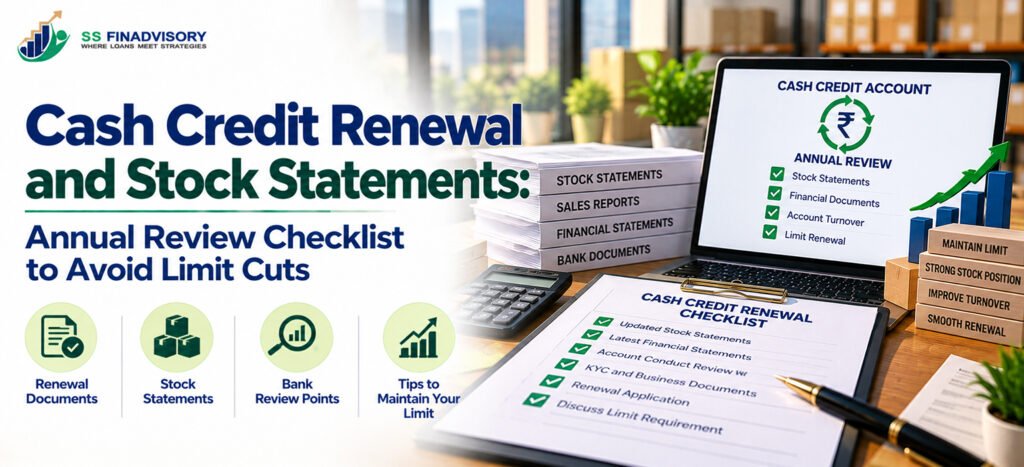
Cash credit renewal is the yearly review where your bank quietly decides how much working capital support it is still comfortable giving you. If you treat that review like routine paperwork, you invite last minute questions, frozen drawing power and limit cuts right when orders are strong and cash is tight.
If your MSME depends on bank limits to buy stock, pay vendors and manage GST or salaries during slow collections, you need a simple repeatable way to handle renewal. Used properly, services such as Business Loan & Working Capital Planning turn cash credit renewal into part of a wider funding plan instead of a yearly scramble.
What Your Bank Really Looks At During Renewal
The annual review is a fresh credit decision. The credit team reads your financials, stock statements, drawing power calculations, bureau data and account conduct, then decides whether your limits are justified, need trimming or can grow.
They also match limits with turnover, margins and order book. If you are weighing term funding against cash based limits, earlier guides such as Working Capital Loan vs Cash Credit help you see how banks size each facility against your actual business scale.
Why Cash Credit Renewal Gets Stuck Or Delayed
Most renewals get stuck because information is missing or inconsistent, not because a bank suddenly turns unfriendly. We see the same triggers again and again, outdated financials, stock and debtor statements that do not reconcile to the balance sheet, unreported term borrowings, regular overdrawings and EMI or cheque returns showing up in statements.
External signals matter too. Weak CIBIL MSME Rank or bureau data that shows stress across group entities makes credit teams nervous even when the main account looks tidy. Where facilities are spread across many banks and NBFCs, cleaning up the structure with something like business loan consolidation often makes the file easier to understand before the renewal memo is written.
Stock Statements, Drawing Power And Reality
Banks treat monthly stock and book debt statements as a live picture of your working capital position, so if those numbers are guesswork, drawing power is also guesswork. For cash credit, the bank starts from eligible stock and receivables, applies margins and ageing filters, then works out how much you are allowed to draw for that month.
When stock statements swing sharply from one month to the next without matching sales or purchase trends, credit teams assume the reporting is weak and begin tightening eligibility or margins. If part of your working capital also comes from a structure such as a Loan Against Property for Working Capitalpoor stock reporting can also trigger questions about double funding of the same inventory.
Stock Statement Mistakes That Hurt MSMEs
Many MSMEs submit neat looking stock statements that fall apart when auditors or bank inspectors test them. Common problems are obsolete stock shown at full value, goods under job work left inside stock totals, consignment stock for others counted as your own and debtor lists full of invoices that sit far beyond normal credit terms.
Another quiet mistake is counting book debts where you have already discounted bills or taken invoice finance, which inflates drawing power on paper. If you also handle bigger contracts on guarantees and LCs, it helps to revisit how those limits sit in your working capital cycle using posts such as Bank Guarantee and Letter of Credit for Small Businesses before renewal meetings.
Preparing Stock And Debtor Data Before Review
Before your renewal month, sit with your accountant and reconcile stock and debtor summaries with your last audited balance sheet, line by line. Totals should match after you account for purchases, sales and write offs, and any big gap should have a short written explanation ready for the credit team. If you’d rather hand this part over, it’s the kind of work our home Loan age Limit team handles every week.
Once that is done, fix a standard stock statement format that separates raw material, WIP and finished goods and shows ageing bands for debtors, with a clear flag on slow moving or obsolete items. If you also want to reduce interest while you clean up data, the article titled How Businesses Can Reduce Working Capital Interest Costs Without Cutting Their Credit Limit gives you practical options to discuss with your banker at the same time.
Cash Credit Renewal Checklist For MSMEs
A practical renewal checklist starts around three months before your limit expiry date. First, close provisional financials for the year even if the audit will take longer, because banks often begin their assessment on those provisional numbers. It’s one of the first things we look at in any Msme Loan prepayment charges rbi project.
Next, check that stock statements for at least the last six months are complete, signed and backed by purchase and sales registers. At this stage many promoters also speak with an outside adviser or a strong msme loan consultant to see how their ratios and documentation will read in a credit note.
Documents Banks Commonly Ask At Renewal
- Latest audited financials with schedules and notes
- Provisional financials if audit is still in progress
- Six to twelve months of stock and debtor statements with ageing
- Bank statements for all current and loan accounts in the group
- Details of fresh term loans, unsecured loans and contingent liabilities
Some banks also ask for order book details, major customer concentration and segment wise profitability. Where limits are backed by property, staying up to date on topics like a loan against property for MSMEs and keeping tax receipts and insurance clean stops valuation issues from slowing down approvals.
How Account Behaviour Shapes Renewal
Even with perfect paperwork, poor behaviour in the account can drag down your renewal result. Frequent overdrawings, irregular interest servicing, cheque returns and delays in submitting stock statements all signal liquidity stress, so banks respond with tighter margins, lower limits or fresh conditions. We run into this a lot when clients come to us for home Loan for Business owners.
If you are always at the top of your limit, that tells the bank some core working capital needs term funding instead. For some promoters, shifting a chunk of stable funding to a structure similar to a Use a Loan Against Property for Working Capital improves how cash credit conduct looks in the system.
Planning For Cash Credit Limit Enhancement
If you want cash credit limit enhancement at renewal, you need numbers that show the current limit is genuinely tight for a growing business, not just for one large order. Banks react better to steady turnover growth over more than one year and clean conduct than to urgent calls about new tenders.
Expansion backed by fresh investment or property also strengthens your case, especially when you plan the mix of products with some care. Many promoters compare structures such as Business Loan vs Loan Against Property for different pieces of funding instead of trying to push every rupee into cash credit.
How Banks View Working Capital Finance For Small Business
For banks, working capital finance for small business looks attractive only when limits behave in a predictable band and pricing covers the risk. They like to see that some core working capital is coming from your own funds and long term borrowing, not from stretched cash credit alone.
They also track customer and supplier concentration, actual debtor days and how often creditor payments slip. Owners who spend a little time with concepts explained in Business Loan vs Working Capital Loan early in their growth phase usually choose a mix of limits that holds up better at renewal.
When To Involve A Consultant In Renewal
Bringing in a seasoned adviser before renewal talks start can save weeks of back and forth with the bank. Once your file already includes term loans, cash credit, guarantees and LCs, it is hard to stand back on your own and see where the story feels weak.
In many cases that adviser is a local specialist who acts as a business loan for new business guide to first time borrowers and growing MSMEs that need help structuring limits for long term use, not just the next sanction.
Choosing And Using The Right Advisor
An effective advisor does more than assemble documents. They translate your business model into credit language and know where typical files fall short.
Look for someone who regularly works in your cluster or who has a strong background similar to a working capital loan consultant kolkata so they understand your industry cycle and can push back when a suggested structure will age badly. Good advisers also look beyond cash credit renewal and will discuss options such as loan against property for business or term loans for capex when those fit better than stretching working capital limits.
Using Advisory Support After Renewal Season
Renewal is only one milestone. The same habits that keep renewal simple also help you negotiate better pricing and new lines during the rest of the year.
For MSMEs that prefer a single view on their funding structure, topics such as a cash credit limit enhancement request or using business loan advisory services alongside a loan against property for working capital become part of one plan instead of scattered ideas you discuss only when the bank calls for papers.
Conclusion
Handled well, cash credit renewal becomes a routine meeting backed by reconciled numbers, honest stock statements and a funding mix that fits how your business really runs. Treated as a last minute scramble, the same review turns into limit cuts, tougher conditions and long explanations that take time away from operations.
If your next review is a few months away, start pulling data now, clean up stock reporting, look at account behaviour with a cold eye and decide where you want limits to sit instead of waiting for the bank to decide for you. When you are short on time or internal bandwidth, specialists like ss finadvisory can help you apply this checklist in your own context so renewal and future borrowing work in line with your plans instead of slowing them down.
Frequently Asked Questions
Q1. How often do banks renew cash credit limits in India
Ans. Most banks in India review and renew cash credit limits once every year based on your latest financials and account conduct. Some also do interim reviews if your turnover changes sharply or if there are signs of stress in the account. The sanction letter usually mentions the review period, so it is good practice to check those dates a few months in advance.
Q2. What happens if stock statements are not submitted on time
Ans. If you do not submit stock statements on time, banks may treat your drawing power as nil or drastically lower and can treat any outstanding as irregular. Repeated delays send a signal that records are weak or inventory levels are uncertain. Over time, this can hurt both your renewal decision and the internal rating the bank assigns to your account.
Q3. Can I get cash credit limit enhancement without fresh collateral
Ans. Banks sometimes increase limits without fresh collateral if your turnover, profitability and internal rating have improved and existing security already covers a higher exposure comfortably. They also look at conduct in the account, such as regular interest servicing and absence of overdrawings. A clear projection backed by orders or contracts can strengthen your case.
Q4. How is drawing power calculated on stock and book debts
Ans. Drawing power on stock and book debts is typically calculated by taking eligible inventory and receivables, then applying the margins and ageing rules mentioned in your sanction terms. Old or slow moving stock and long overdue debtors are often excluded or heavily discounted. Each bank has its own policy, so it is important to confirm the exact calculations with your relationship manager.
Q5. What is the difference between working capital loan and cash credit
Ans. A working capital loan is usually a fixed sum disbursed upfront and repaid in instalments over a set tenure. Cash credit is a revolving limit where you can draw, repay and redraw within the sanctioned amount, and interest is charged on daily utilisation. Many MSMEs use a mix of both depending on how stable their working capital needs are.
Q6. Should small businesses use consultants for cash credit renewal
Ans. Many small businesses find consultants helpful for renewal because they understand how bankers think and what credit teams expect to see in a file. A good adviser can clean up documentation, anticipate questions and suggest better structures before you sit across from the bank. The decision depends on your comfort with numbers and the complexity of your borrowing.