
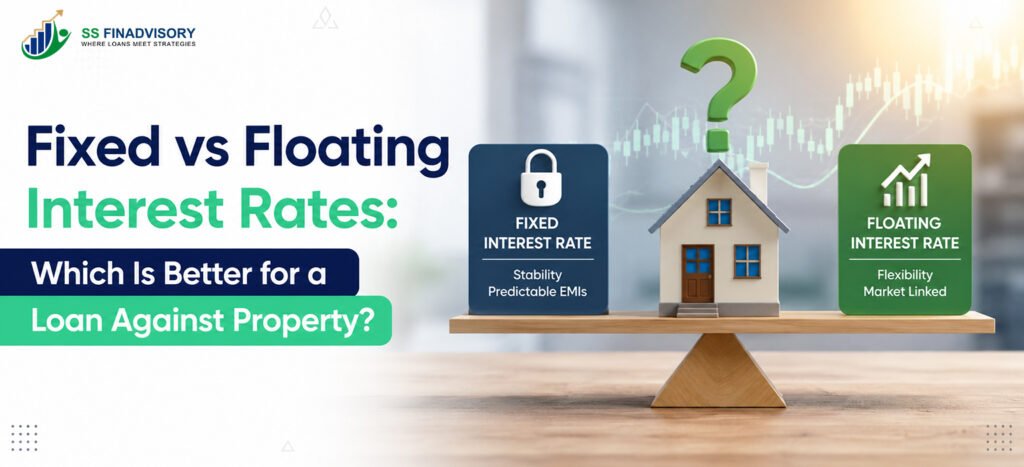
If you are planning a loan against property, the fixed vs floating interest rate choice often feels trickier than the loan amount itself. Get this wrong and the EMI can quietly choke your monthly cash flow for years.
The bank’s sales pitch will sound simple. The reality isn’t. Rates move, policies change, and your own income doesn’t stay the same forever. This guide breaks down how each interest type behaves on a LAP, what it does to your EMI, and how to pick the option that actually fits your risk appetite.
What Fixed And Floating Really Mean For A LAP
A fixed interest loan keeps the rate unchanged for an agreed period, usually three to ten years on a loan against property. Your EMI and interest outgo are easy to predict, which helps if you like planning cash flows down to the rupee.
With a floating interest loan, the rate moves with the bank’s external benchmark or internal reference rate. Your EMI may change when the lender revises rates, or they may keep EMI constant and adjust tenure, which matters a lot if you want to close the loan on a fixed date.
Fixed Vs Floating Interest Rate: Key Differences
When you compare interest types, you need to see how they behave in real life, not just on a brochure. Most mortgage interest options for LAP in India fall into three buckets: pure fixed, fixed for a few years then floating, and fully floating from day one.
Banks usually price fixed higher than floating at the start, because they are taking on the risk of future rate movements. That extra 0.75%–1.5% looks small, but over a 15-year term it can easily mean several lakh rupees of extra interest.
How Fixed Rates Affect Your EMI And Risk
Pick a fixed rate and your EMI hardly moves during the locked period, so the EMI impact of a rate hike in the system is shielded for you. This suits borrowers whose income is stable but not very flexible, such as retirees living on rental income or fixed pensions.
The trade-off is cost. For long tenures, you usually end up paying more interest compared to a floating loan that benefits from at least some periods of lower rates. Many banks also reserve the right to reset even “fixed” rates after a certain number of years, so the word fixed on the brochure doesn’t always mean fixed for the full loan term.
When A Fixed Rate Makes Sense
Fixed works well if your priority is peace of mind over savings. A business owner who already deals with erratic cash flows may prefer a predictable LAP EMI rather than tracking every RBI policy move. This is especially true when your loan planning is tied to meeting other fixed commitments like children’s school fees.
It can also suit borrowers who expect rates to rise meaningfully over the next few years and don’t want to bet against that view. Just be clear on how long the fixed period actually lasts and what happens after it ends.
How Floating Rates Affect Your EMI And Tenure
Floating rates rise and fall with market conditions, making them more sensitive to bank interest rates revisions. When the RBI hikes the repo rate, most floating LAPs see an increase in either EMI or tenure within a few months.
In falling-rate cycles, floating loans reward you. Your cost drops without any effort from your side, as long as the lender passes on cuts promptly. Over longer terms like 12–15 years, even two or three solid rate-cut phases can significantly reduce your total interest.
When A Floating Rate Is Usually Better
If your income is expected to grow, a floating option often lines up better with how your finances will look over time. Many salaried borrowers and professionals prefer the flexibility, especially when comparing mortgage financing offers across banks and housing finance companies.
Floating also makes sense when you plan to prepay aggressively. If you intend to close the loan in seven to eight years instead of running the full tenure, you’ll feel rate cuts more than rate hikes, because you’re more active in managing the balance.
Practical Loan Rate Comparison For LAP
Don’t just look at the headline rate when doing a loan rate comparison. Two offers that look similar on paper can behave very differently once you factor in reset clauses, conversion fees, and switching costs.
- Check the benchmark: Is the loan linked to repo, T-bill, or an internal MCLR? External benchmarks tend to be more transparent.
- Understand reset frequency: Quarterly and semi-annual resets respond faster to market moves than annual ones.
- Ask about spread: The spread over the benchmark often stays fixed, so negotiate this hard at the start.
The fine print can matter more than a 0.10% difference in the quoted rate, especially for a high-ticket LAP.
How Banks Actually Set LAP Interest Type
On a LAP interest type decision, banks look at three main things: your credit profile, property type, and loan-to-value ratio. A strong CIBIL score and lower LTV give you more room to negotiate both rate and structure.
Self-employed borrowers often see a slightly higher spread or stricter conditions for fixed periods. Don’t ignore processing fees and switching charges, because they eat into the benefit of tiny rate differences.
Choosing Between Fixed And Floating For Your Situation
The right choice isn’t about theory, it’s about your risk comfort and timelines. Start by listing your major cash commitments over the next five to ten years before you decide between a fixed interest loan and a floating option.
If most of your income is variable, consider keeping at least part of your obligations predictable. Some lenders allow a mix structure, where a portion of the LAP is on fixed and the rest on floating, which can balance risk and opportunity.
Fixed Vs Floating Interest Rate: A Simple Framework
Use a simple checklist when weighing fixed vs floating interest rate. First, ask how much EMI increase you can handle without stress. Second, decide how long you realistically expect to keep this loan.
Finally, compare at least two bank interest rates in detail using an amortisation schedule, not just an EMI calculator. Look at total interest paid under different rate scenarios, not just the first year’s outgo.
Hidden Costs And Common Mistakes
Many borrowers skip reading clauses on conversion charges when moving from fixed to floating or vice versa. On high-ticket mortgage interest options, even a 0.50% switch fee can run into tens of thousands.
Another mistake is stretching tenure to keep EMIs low without realising how much extra you pay over time. A fifteen-year LAP that could’ve been paid off in ten often ends up consuming money that could have gone into retirement or business growth.
How To Use An Interest Rate Guide Wisely
An online interest rate guide is useful only if you plug in realistic assumptions. Don’t test your LAP affordability at best-case rates. Build in a buffer of at least 1% higher than the current quote.
If a 1% hike pushes your EMI beyond comfort, either reduce the loan amount, increase tenure, or reconsider pledging the property at all. No loan is cheap enough to justify long-term stress at home.
Aligning Your LAP With Long-Term Plans
Think of your LAP as part of a bigger loan planning exercise, not as a standalone product. If you already have home, car, and business loans, another EMI changes your entire risk profile.
Map your expected cash flows for the next decade: planned career moves, business expansions, or potential breaks from work. The more uncertainty you see ahead, the more you should value stability over tiny rate differences.
Conclusion
Choosing between a fixed interest loan and a floating interest loan on a LAP isn’t about finding the “perfect” answer; it’s about matching risk and comfort. For many Indian borrowers, a mix of predictability and flexibility, guided by honest EMI maths, works better than chasing the lowest number on a rate sheet.
If you still feel unsure about fixed vs floating interest rate after running the numbers, speak with an advisor who can walk through real scenarios on your income and property, such as the team at ss finadvisory, and lock in a structure that supports your goals instead of straining them.