
Last Updated: May 2026 | Reading Time: 9 minutes
You’ve found the perfect plot of land in your hometown. Or you’ve inherited a piece of ancestral property and want to build your dream house on it. Or maybe you’ve got an empty plot purchased years ago, and now construction is finally on the cards. You walk into a bank expecting to take a “home loan” — and you walk out completely confused.
Plot loan. Home loan. Composite loan. Construction loan. Land loan. The bank executive uses these terms interchangeably, but they’re actually four distinct products — each with its own LTV cap, tenure limit, interest rate, and most critically, very different tax treatment. Picking the wrong one can cost you ₹2-5 lakh in lost tax benefits over your loan tenure. Picking the right one can unlock ₹3-5 lakh in deductions you’d otherwise miss.
This guide breaks down every option available to you in 2026 — whether you want to buy a plot, build on owned land, or do both simultaneously. By the end, you’ll know exactly which product fits your situation, the eligibility rules, the tax angles, and the single 5-year deadline that determines whether you save lakhs or lose them. Let’s get into it.
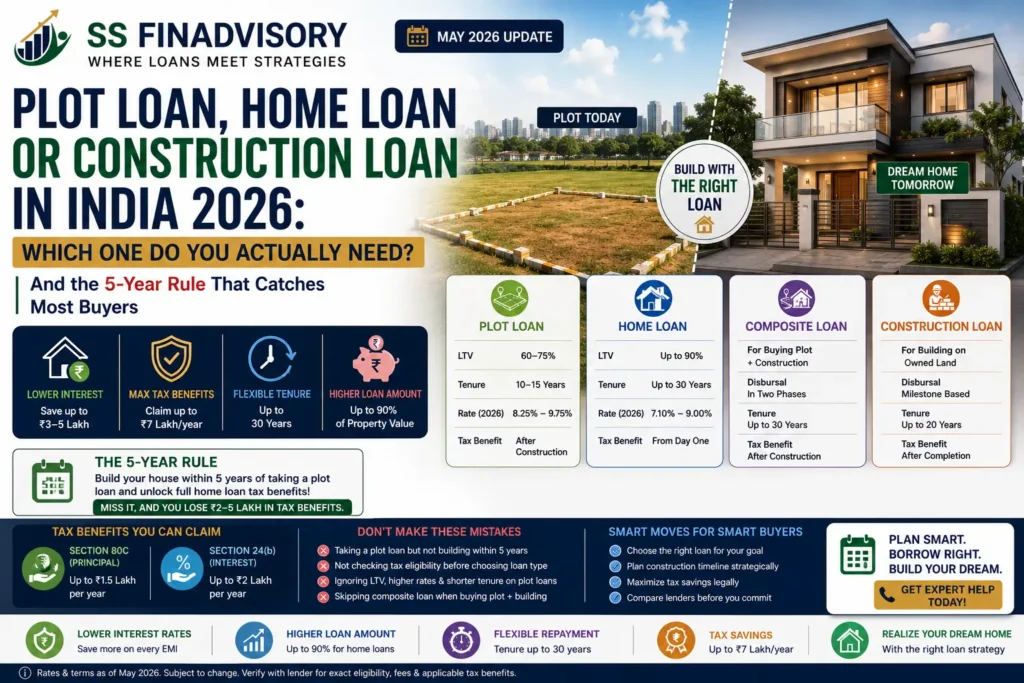
The 4 Loan Products Every Plot/Construction Buyer Must Know
Before anything else, understand that “home loan” is only one of four distinct products. Each serves a different purpose:
1. Plot Loan (Land Loan)
A loan exclusively for purchasing a residential plot with no immediate plans to construct. The land must be a non-agricultural residential plot, typically within municipal limits or designated residential zones.
2. Home Loan (Standard)
A loan for purchasing a ready-to-move or under-construction property (apartment, villa, independent house). The most common product — also the one with maximum tax benefits.
3. Composite Loan (Plot + Construction)
A combined loan for buying a plot AND constructing a house on it within a defined timeframe (typically 2-3 years). The bank disburses funds in two phases — first for plot purchase, then in tranches for construction.
4. Construction Loan (Self-Construction)
A loan for building a house on land you already own — whether inherited, gifted, or previously purchased. Disbursed in stages linked to construction milestones (foundation, slab, plastering, etc.).
Critical Distinction: Confusing these products is the single biggest reason buyers in Tier 2/3 cities end up with the wrong loan. A plot loan cannot be used to construct; a home loan cannot be used for buying raw land. Knowing what to ask for is half the battle.
Plot Loan vs Home Loan: Side-by-Side Comparison 2026
Here’s how the most-confused pair stacks up:
| Parameter | Plot Loan | Home Loan |
|---|---|---|
| Purpose | Buy a residential plot only | Buy / construct a house |
| LTV (Loan-to-Value) | 60-75% of plot value | Up to 90% of property value |
| Max Tenure | 10-15 years (some lenders 20) | Up to 30 years |
| Interest Rate (2026) | 8.25% – 9.75% | 7.10% – 9.00% |
| Down Payment Required | 25-40% of plot value | 10-25% of property value |
| Tax Benefit (Principal) | Section 80C eligible only after construction | Section 80C from day one |
| Tax Benefit (Interest) | Section 24(b) only after construction completion | Section 24(b) from possession |
| NRI Eligibility | Most banks don’t offer | Widely available |
| Property Type | Residential plots within municipal limits only | Ready/under-construction houses |
| Processing Fee | 0.5% – 1% | 0.25% – 1% |
The numbers tell the story: plot loans are stricter and costlier than home loans in almost every dimension. This is because banks consider raw land riskier collateral — it doesn’t generate rental income, can stay undeveloped indefinitely, and is harder to liquidate quickly than a built property.
The 5-Year Rule: The Single Most Important Tax Concept
This is where most plot loan borrowers either save or lose lakhs.
The rule in simple terms:
If you build a house on your purchased plot within 5 years of taking the plot loan, you become eligible for full home loan tax benefits — retroactive on the entire interest paid.
If you don’t construct within 5 years, all the tax benefits you would have claimed get permanently lost.
How the Tax Treatment Works
While the plot remains undeveloped (no construction):
- Principal repayment qualifies for Section 80C deduction (up to ₹1.5 lakh)
- Interest paid is NOT deductible
- No Section 24(b) benefit available
Once construction is completed (within 5 years):
- Convert your plot loan to a regular home loan by submitting completion certificate to the bank
- Now claim full Section 24(b) interest deduction (up to ₹2 lakh annually)
- All pre-construction interest can be claimed in 5 equal installments after possession
If construction isn’t done within 5 years:
- Section 80C benefit on principal continues
- Section 24(b) on interest is permanently denied
- The plot effectively becomes a “land asset” for tax purposes
The math: On a ₹40 lakh plot loan over 15 years at 9%, the interest paid in the first 5 years is approximately ₹15-17 lakh. Missing the 5-year window means losing up to ₹2 lakh × 5 = ₹10 lakh in tax deductions that you’d otherwise have been entitled to.
Composite Loan: The Often-Overlooked Best Option
If you’re buying a plot AND planning to construct soon (within 2-3 years), the composite loan is usually the smartest product — but bank executives often don’t proactively suggest it because their plot loan and home loan teams are separate.
How Composite Loan Works
- Single sanction covers both land purchase and construction
- First tranche disbursed for plot purchase
- Subsequent tranches released against construction milestones (foundation, slab, walls, finishing)
- Tenure can extend up to 30 years (matching regular home loans)
- LTV improves to 80-85% on combined land + construction cost
Why Composite Beats Plot Loan + Separate Construction Loan
Single approval, single processing fee, single documentation cycle — saves time and ₹30-50K in duplicate charges.
Better tax treatment from day one — since the intent to construct is built into the loan, banks often allow you to start claiming Section 24(b) once construction begins, rather than waiting for completion.
Lower interest rate than a pure plot loan — banks price composite loans similarly to home loans because of guaranteed construction.
One conversion not needed — no separate process to convert plot loan to home loan post-construction.
Construction Loan: For Building on Owned Land
If you already own a plot (purchased earlier, inherited, gifted), you don’t need a plot loan — you need a construction loan (also called a “self-construction home loan”).
Key Features
| Parameter | Construction Loan |
|---|---|
| LTV | 75-90% of estimated construction cost |
| Tenure | Up to 30 years (same as home loan) |
| Interest Rate | 7.25% – 9.00% (same as home loan) |
| Disbursement | Tranched, linked to construction milestones |
| Pre-EMI Option | Available during construction phase |
| Tax Benefit | Same as home loan from possession |
What You’ll Need
- Clear title documents of the plot (sale deed, mutation, encumbrance certificate)
- Approved building plan from local municipal authority
- Detailed construction estimate from a registered architect or engineer
- Contractor agreement (if using one)
- Land valuation by bank-approved valuer
- Income and KYC documents (same as regular home loan)
Insider tip: Banks finance only the construction cost, not the land value. If your land is worth ₹30 lakh and construction estimate is ₹40 lakh, the bank lends up to 90% of the ₹40 lakh = ₹36 lakh. The ₹30 lakh land value gets factored into your collateral assessment but doesn’t add to the loan amount.
Plot Loan Eligibility & Restrictions Most Lenders Don’t Disclose
Plot loans come with several non-obvious restrictions. Know these before applying:
Location Restrictions
- Plot must be within municipal corporation, municipality, or panchayat limits
- Most banks won’t finance plots in rural areas, gram panchayat-level villages, or undeveloped outskirts
- Agricultural land conversion to residential is required first
Plot Type Restrictions
- Only residential layout plots are financed
- Commercial plots, industrial plots, agricultural land — generally not eligible
- DTCP (Directorate of Town and Country Planning) or RERA approval helps
Builder/Layout Restrictions
- Plots in approved layouts by reputed developers get easier financing
- Government-approved housing board allotments are gold-standard
- Plots in unauthorized layouts often face rejection regardless of borrower profile
NRI Restrictions
- Most banks do NOT offer plot loans to NRIs — a major gap in the lending market
- NRIs typically need to use NRO funds or pay outright cash for plot purchases
- Construction loans on owned land are sometimes available for NRIs
The Hidden Costs in Plot & Construction Loans
Beyond interest and EMI, expect these costs:
Pre-Sanction Charges
- Property legal verification: ₹5,000-15,000
- Title search: ₹3,000-10,000
- Valuation fee: ₹5,000-10,000
- Processing fee: 0.5-1% of loan amount
Post-Sanction Charges
- Stamp duty on registration: 4-9.5% of plot value (state-dependent)
- Registration fee: 1% (often capped)
- MODT charges: 0.2-0.5% of loan amount
- Architect & approval fees: ₹50,000-2 lakh for construction
- Municipal approval and plan sanctioning: ₹20,000-1 lakh
For a ₹40 lakh plot + ₹50 lakh construction project, total ancillary costs typically run ₹6-12 lakh beyond the loan amount.
7-Step Strategy for Buyers Building on Their Own Plot
Step 1: Determine Your Real Need
Are you buying a plot to construct soon (composite loan), buying a plot as investment (plot loan), or constructing on existing land (construction loan)? Get this clear first.
Step 2: Verify Plot Eligibility BEFORE Choosing the Bank
Make sure your plot falls within municipal limits, has clear title, and is in an approved layout. Get a legal opinion from a property lawyer — ₹5,000-10,000 well spent.
Step 3: Compare At Least 3 Lenders
Public sector banks (SBI, BoB) typically offer the lowest plot loan rates. NBFCs like Bajaj Housing Finance and LIC Housing are more flexible on eligibility but charge slightly higher rates.
Step 4: Lock the 5-Year Construction Timeline Mentally
If you’re taking a pure plot loan, build a detailed construction timeline starting before year 4. Don’t risk missing the 5-year tax window.
Step 5: Plan for Composite Loan If Construction Is Within 2-3 Years
The composite loan saves money, time, and tax complications. Specifically ask: “Do you offer a combined plot + construction loan?”
Step 6: Budget for the Full Cost Picture
A plot purchase isn’t just plot price + EMI. Stamp duty, registration, legal, valuation, architect, municipal approvals, and contingencies easily add 15-25% to total cost. Plan accordingly.
Step 7: Document Everything for Tax Filing
Keep your sanction letter, interest certificates, construction approval, completion certificate, and architect’s certification carefully. You’ll need them for Section 24(b) claims after construction ends.
Common Mistakes That Cost Plot Buyers Lakhs
- Taking a plot loan and never building — losing all interest deductions permanently
- Buying agricultural land assuming you can convert it later — conversion processes are slow, expensive, and sometimes impossible
- Not getting layout approval verified — financing falls through right before disbursement
- Choosing pure plot loan when composite would have worked — paying higher rates and missing tax efficiency
- Forgetting to convert plot loan to home loan post-construction — leaving Section 24(b) benefits unclaimed
- Ignoring municipal limit rules — assuming all plots are eligible
- Underestimating ancillary costs — running out of funds mid-construction
Frequently Asked Questions
Q1. What is the difference between a plot loan and a home loan? A plot loan finances only the purchase of a residential plot (no construction included). A home loan finances buying or constructing a residential house. Plot loans have stricter LTV (60-75%), shorter tenure (10-15 years), and limited tax benefits compared to home loans.
Q2. Can I get tax benefits on a plot loan in India 2026? Yes, but conditionally. Section 80C deduction on principal is available immediately. Section 24(b) interest deduction is available only after you complete construction on the plot within 5 years and convert the plot loan to a regular home loan.
Q3. What is a composite loan, and how is it different from a plot loan? A composite loan combines plot purchase and construction financing into a single product. It typically has better LTV (80-85%), longer tenure (up to 30 years), and immediate tax benefits — making it superior to taking separate plot and construction loans.
Q4. Can I get a home loan to build a house on land I already own? Yes. This is called a construction loan (or self-construction home loan). LTV is calculated on construction cost (75-90%), not land value. Tenure extends up to 30 years, and tax benefits match a regular home loan after possession.
Q5. What is the maximum LTV ratio for plot loans in India 2026? Plot loans typically have an LTV of 60-75% of the plot value, depending on the lender, location, and your credit profile. This means you need to arrange 25-40% as down payment from your own funds.
Q6. Can NRIs take a plot loan in India? Most Indian banks do NOT offer plot loans to NRIs. NRIs can take home loans on built properties and construction loans on owned land, but raw plot purchases are typically restricted to resident Indians.
Final Word: Choose the Loan That Matches Your Plan, Not the One the Bank Suggests
The Indian banking system has built four distinct products for plot, home, and construction financing — but most branch executives default to suggesting whatever their team is targeting that quarter. The borrower’s job is to walk in informed, ask for the right product by name, and refuse to be slotted into a suboptimal one.
The decision framework is actually simple:
- Buying a plot AND constructing within 2-3 years? → Composite Loan
- Buying just a plot as investment, may build later? → Plot Loan (and start the 5-year construction countdown)
- Buying a ready-built house or apartment? → Standard Home Loan
- Building on land you already own? → Construction Loan
Every other variation is a sub-case of these four. Match your situation to the product, ask for it specifically, and don’t let the bank push you into the wrong category.
The 5-year construction rule is the single most important tax deadline for plot buyers in India. Mark it on your calendar from the day you take the loan. Build within those 5 years and you unlock ₹5-10 lakh in legitimate tax savings. Miss it, and that money is gone forever.
A plot purchase isn’t just a financial decision — it’s a 5-year commitment to construct. Treat it that way from day one, and the Indian tax system will reward you generously. Treat it as just a land transaction, and you’ll quietly leave money on the table for the next 15 years.
The right loan is the one that matches your actual plan. Now you know what to ask for.
Disclaimer: LTV ratios, interest rates, tax provisions, and lender policies mentioned are accurate as of May 2026 based on publicly available data from major Indian banks, NBFCs, and the Income Tax Act, 1961. Individual loan terms vary by lender and borrower profile. Please consult your bank and a qualified Chartered Accountant before making major financial decisions.