
Last Updated: May 2026 | Reading Time: 9 minutes
If you’re a home loan borrower in India, your monthly EMI is no longer in your control. It’s determined every two months by 6 people sitting in a room at the Reserve Bank of India headquarters in Mumbai — the Monetary Policy Committee (MPC) — who decide whether to raise, cut, or hold the repo rate.
In 2025, the MPC cut the repo rate by 125 basis points total — taking it from 6.50% down to 5.25%. For an EBLR-linked borrower with a ₹50 lakh home loan over 20 years, that translated to roughly ₹3,050 in monthly EMI savings and approximately ₹7.34 lakh in lifetime interest savings.
But here’s the part most borrowers don’t realize: millions of borrowers in India didn’t actually receive these savings. They’re either stuck on MCLR-linked loans (where transmission is partial), unaware that they need to formally request a rate reset, or paying higher “spread” margins that erode the benefit. Meanwhile, the next MPC meeting (June 3-5, 2026) could swing either way — and most borrowers are completely unprepared for either scenario.
This guide gives you the complete framework to understand RBI’s repo rate, how it affects your specific home loan, the difference between EBLR and MCLR that determines your savings, and the 8 concrete steps you can take to protect your EMI from future rate moves. Whether the RBI hikes, cuts, or holds — you’ll know exactly what to do. Let’s get into it.
What Is the Repo Rate and Why It Controls Your EMI
The repo rate is the interest rate at which the Reserve Bank of India lends short-term money to commercial banks. Think of it as the “wholesale price” of money for banks — when this wholesale price drops, banks can offer loans to retail customers (like you) at lower rates. When the wholesale price rises, retail loan rates also rise.
In 2026, the RBI uses the repo rate as its primary monetary policy tool to manage two competing priorities:
- Inflation control — when prices rise too fast (e.g., from high crude oil costs), the RBI raises the repo rate to slow down spending and cool inflation
- Economic growth — when growth slows, the RBI cuts the repo rate to make borrowing cheaper and stimulate spending
For floating-rate home loan borrowers, every repo rate change can directly increase or decrease your EMI within 90 days — provided your loan is linked to the right benchmark.
Current Status: Where Things Stand in May 2026
Here’s the latest snapshot you need to know:
| Indicator | Status (May 2026) |
|---|---|
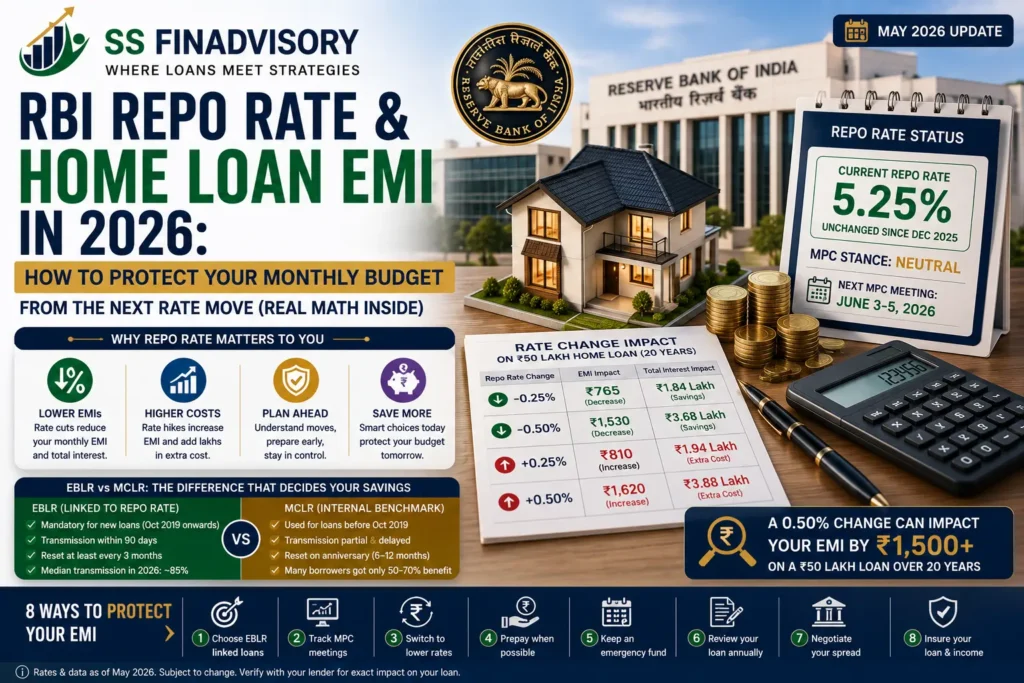
| Repo Rate | 5.25% (unchanged since December 2025) |
| MPC Stance | Neutral |
| Last Action | Hold (April 8, 2026 MPC meeting) |
| 2025 Cumulative Cut | 125 basis points (from 6.50% to 5.25%) |
| Next MPC Meeting | June 3-5, 2026 |
| CPI Inflation (Q1 FY27 Projection) | 4.6% |
| Standing Deposit Facility (SDF) | 5.00% |
| Marginal Standing Facility (MSF) | 5.50% |
The neutral stance means RBI is in “wait and watch” mode — neither committed to cutting nor raising rates in the near term. This stability is helpful for borrower budgeting but limits further EMI reductions in the short run.
EBLR vs MCLR: The Critical Difference That Decides Your Savings
This is the single most important distinction every home loan borrower must understand. Your loan is linked to one of these two benchmarks — and the difference between them can mean lakhs of rupees over your loan tenure.
EBLR (External Benchmark Lending Rate) — Modern System
- Mandatory for all new floating-rate retail and MSME loans since October 1, 2019
- Typically linked directly to the repo rate
- Mandatory transmission within 90 days of any repo rate change
- Reset frequency: at least once every 3 months
- Median transmission of rate changes in 2026: approximately 85% within one quarter
MCLR (Marginal Cost of Funds-based Lending Rate) — Older System
- Used for loans sanctioned before October 2019
- Linked to the bank’s internal cost of funds, not the repo rate directly
- Transmission depends on bank’s funding dynamics, often partial and delayed
- Reset frequency: at the loan’s anniversary date (every 6-12 months)
- Many MCLR borrowers received only 50-70% of the 125 bps RBI cut in 2025
What This Means in Real Numbers
Consider two borrowers with identical ₹50 lakh, 20-year loans taken in 2018:
- Borrower A (still on MCLR): Currently paying around 8.75%
- Borrower B (switched to EBLR in 2020): Currently paying around 7.75%
The 1% difference on ₹50 lakh over remaining tenure translates to approximately ₹10-12 lakh in extra interest for Borrower A — purely because they didn’t switch systems when given the option.
Action point: Check your loan sanction letter or your latest statement. If it mentions “MCLR” anywhere and your loan was taken before October 2019, you’re likely on the older system and losing money every month.
The Rate-Cut Math: How Much You Should Be Saving in 2026
If your home loan is EBLR-linked, the 125 bps cumulative repo cut of 2025 should have meaningfully reduced your EMI by now. Here’s the math for different loan amounts:
| Outstanding Loan | Old EMI (8.50% rate) | New EMI (7.25% rate) | Monthly Savings | Lifetime Savings (20 yrs) |
|---|---|---|---|---|
| ₹30 Lakh | ₹26,035 | ₹23,711 | ₹2,324 | ₹5,57,760 |
| ₹50 Lakh | ₹43,391 | ₹39,518 | ₹3,873 | ₹9,29,520 |
| ₹75 Lakh | ₹65,087 | ₹59,278 | ₹5,809 | ₹13,94,160 |
| ₹1 Crore | ₹86,782 | ₹79,037 | ₹7,745 | ₹18,58,800 |
| ₹1.5 Crore | ₹1,30,173 | ₹1,18,556 | ₹11,617 | ₹27,88,080 |
Critical Check: Compare your current EMI to your December 2024 EMI. If the reduction is less than what the table shows, your bank has not fully transmitted the rate cut. You’re entitled to ask for a reset.
What Happens When RBI Hikes the Repo Rate
While 2026 currently looks like a stable rate environment, hikes are always possible — especially if crude oil prices spike, the rupee weakens, or inflation flares up. When a hike happens, your bank will give you two choices:
Choice 1: Keep EMI Same, Extend Tenure
This is what most banks default to without asking you. Your monthly payment stays the same, but additional months get tacked onto your loan.
Why this is dangerous: If multiple hikes happen, you can hit “negative amortization” — where your EMI doesn’t even cover the new interest amount, causing your outstanding principal to actually grow despite payments. Your loan can extend by years.
Choice 2: Keep Tenure Same, Increase EMI
Your monthly payment rises but your loan ends on the original date.
Why this is mathematically superior: You pay marginally more each month but finish your loan on time, avoiding additional years of interest cost. On a ₹50 lakh loan, a 0.5% rate hike absorbed via EMI increase costs ₹1,500 more per month but saves you 12-18 months of total tenure.
Action point: When you receive a rate change notification, explicitly request the EMI increase option (not the tenure extension default). It’s mathematically the better choice in 9 out of 10 scenarios.
The 8 Steps to Protect Your EMI From Any Repo Rate Move
Here’s the systematic playbook for any borrower in 2026:
Step 1: Identify Your Loan Type
Check your sanction letter. If you see “MCLR” or “Base Rate” and your loan was taken before October 2019, your benchmark is outdated. EBLR borrowers are already protected by mandatory 90-day transmission.
Step 2: Switch From MCLR to EBLR (If Applicable)
Most banks charge a small conversion fee (₹5,000-25,000 depending on outstanding amount) to switch. If your remaining tenure is over 10 years, the savings from EBLR transmission will exceed the conversion fee within 6-12 months. Worth it almost always.
Step 3: Verify Full Rate Transmission
Compare your current rate to: Repo Rate (5.25%) + Your Bank’s Spread. If your bank’s spread was 2.50% at sanction, your current rate should be approximately 7.75%. If you’re paying significantly more, request a written explanation.
Step 4: Track Your Reset Dates
EBLR loans reset at least every 3 months, but the specific reset date depends on when your loan was sanctioned. Mark your reset date in your calendar. This is when your bank must apply the latest repo-linked rate.
Step 5: Choose EMI Increase Over Tenure Extension
When rates rise and the bank offers you a choice, always choose EMI increase if you can afford it. Tenure extension feels easier but costs significantly more in total interest.
Step 6: Prepay Strategically During Rate Pauses
The current “pause” mode is the ideal time for prepayments. With rates unlikely to drop further in the short term, every rupee of principal you prepay now saves maximum interest. Even ₹50,000 of annual prepayment can reduce your total tenure by 1-2 years.
Step 7: Maintain an EMI Buffer Fund
Set aside 3-6 months of EMI in a liquid mutual fund or savings account. This protects you against rate hikes, job changes, or temporary income disruptions. It’s the single best home loan stress reducer.
Step 8: Monitor the MPC Calendar
RBI MPC meetings happen 6 times a year (typically February, April, June, August, October, December). Mark these dates. The 5-day window around each meeting is when you should review your loan status and consider actions.
What to Watch Before the Next MPC Meeting
For the June 3-5, 2026 MPC meeting and beyond, four indicators will determine whether RBI cuts, holds, or hikes:
- CPI Inflation: RBI’s Q1 FY27 projection is 4.0%. If actual CPI prints above 4.5%, a hike becomes more likely
- Crude Oil Price: Currently elevated due to West Asia tensions. A drop below $85/barrel improves rate-cut probability
- US Federal Reserve Stance: If the Fed cuts, RBI gets more room to cut too. If Fed holds or hikes, RBI faces currency pressure
- Rupee Stability: If INR weakens past ₹87/USD, imported inflation rises, reducing RBI’s room to cut
Track these four numbers in the financial press in the 30 days before each MPC meeting. They tell you what’s coming before the official announcement.
Common Mistakes Borrowers Make Around Rate Changes
- Doing nothing after a rate cut announcement — assuming the bank will automatically pass benefits at full speed (they often delay)
- Choosing tenure extension during rate hikes — feels easier, costs lakhs more
- Staying on MCLR out of inertia — losing ₹500-2,000 per month versus EBLR equivalent
- Not maintaining an EMI buffer — leaving yourself one bad month away from a missed EMI
- Ignoring spread negotiations — the spread component (bank’s margin above repo) is also negotiable, especially for long-term customers
- Watching only the headline repo rate — the spread, transmission timing, and reset date matter equally
- Panicking during a hike cycle — short-term hikes rarely justify expensive balance transfers; calculate break-even first
When to Consider a Balance Transfer After a Rate Move
A balance transfer to a different lender makes sense if:
- Your current bank refuses to fully pass on RBI rate cuts
- A competing lender offers 0.5%+ lower rate at your profile
- Your remaining tenure is more than 3-5 years
- Break-even period (transfer cost ÷ monthly EMI saving) is under 18 months
For full details on balance transfer math and process, the framework is the same regardless of repo rate movements — focus on net savings after all charges.
Frequently Asked Questions
Q1. What is the current RBI repo rate in May 2026? The RBI repo rate stands at 5.25%, unchanged since December 2025. The next MPC meeting is scheduled for June 3-5, 2026, which will decide if rates remain stable, get cut, or hike.
Q2. How quickly does a repo rate cut reduce my home loan EMI? For EBLR-linked loans (mandatory for all loans sanctioned after October 2019), the rate change is mandatorily transmitted within 90 days. For MCLR-linked loans, transmission is partial and delayed, depending on the bank’s reset cycle.
Q3. Should I switch my home loan from MCLR to EBLR in 2026? Yes, if your loan was sanctioned before October 2019 and your remaining tenure is 10+ years. The one-time conversion fee (₹5,000-25,000) is typically recovered within 6-12 months through faster and fuller rate transmission. The savings over the full tenure run into lakhs.
Q4. When RBI hikes the repo rate, should I extend my tenure or increase my EMI? Increase your EMI if you can afford to. Tenure extension may feel easier in the short term, but it costs significantly more interest over the loan’s life and risks “negative amortization” during prolonged rate-hike cycles. EMI increase keeps your loan on schedule.
Q5. How much can I save when RBI cuts the repo rate by 25 basis points? For a ₹50 lakh loan over 20 years on EBLR, a 25 bps cut typically reduces your EMI by roughly ₹770-800 per month, saving about ₹1.8-1.9 lakh in lifetime interest. The exact savings depend on your bank’s spread and reset timing.
Q6. Can I prepay my home loan during a rate pause to maximize savings? Yes, this is actually the smartest time to prepay. With rates unlikely to fall further in the short term, every rupee of principal prepaid now saves maximum compounded interest over remaining tenure. Floating-rate loans have zero prepayment penalty (RBI mandate) — use this fully.
Final Word: Be the Borrower Who Acts, Not the One Who Reacts
The RBI’s MPC will keep doing its job — meeting six times a year, analyzing economic data, and adjusting the repo rate to balance growth and inflation. Whether the next move is a cut, a hold, or a hike, the impact on your home loan is automatic only if your loan is correctly structured and your eyes are open.
The borrowers who emerge wealthier from any rate cycle aren’t the ones who got lucky with timing. They’re the ones who:
- Understood whether they’re on EBLR or MCLR — and switched when needed
- Tracked their reset dates and ensured full transmission
- Chose EMI increase over tenure extension during hike cycles
- Prepaid aggressively during rate pauses when each rupee saves maximum interest
- Maintained an EMI buffer fund to survive any short-term shock
- Watched the MPC calendar and reviewed their loan every 60 days
A home loan is a 20-year relationship with your bank. Repo rates will swing many times over those two decades. Each swing creates either a windfall or a setback — depending entirely on how prepared you are.
The next MPC meeting is on June 3-5, 2026. Three weeks from now. By then, you should know your benchmark type, your reset date, your current spread, your bank’s transmission record, and your action plan for each possible outcome — cut, hold, or hike.
The RBI sets the macroeconomic stage. But on your stage — your home loan, your EMI, your financial life — you’re the one with the script. Use it well.
Disclaimer: Repo rate, MPC schedule, and transmission rules mentioned are accurate as of May 2026 based on publicly available RBI announcements and major lender disclosures. Interest rates and EMI calculations are indicative; actual figures depend on individual loan terms, bank policies, and borrower profile. Please consult your bank and a qualified financial advisor for personalized guidance.