
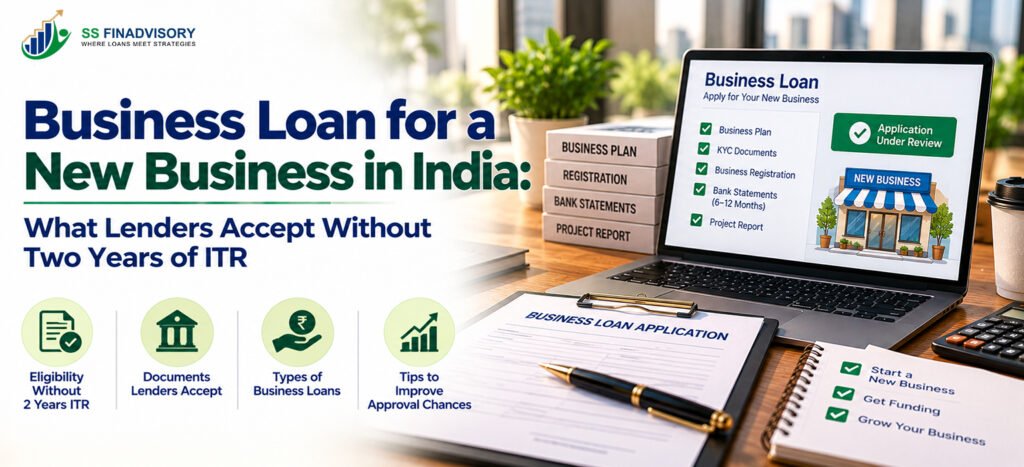
A business loan for new business in India without two full years of ITR is harder to pull off, but it is still possible if you understand what lenders treat as comfort in place of tax returns. It matters when you are close to launch, already on GST, or have early orders and do not want to wait two more years just to build tax history.
We will walk through how lenders think when the business has no ITR trail, where collateral and promoter income carry more weight, and which structures usually work for first time borrowers. Along the way we will point you to guides like CMA Data for Bank Loan so you can prepare numbers that a credit manager will actually read instead of guessing in front of the branch manager.
Why Banks Push So Hard For Two Years Of ITR
Banks like ITRs because they are a quick way to see that income is stable, tax compliant and roughly matches what comes into the bank account. For an existing unit, ITR plus audited financials and a sensible CMA pack usually tell a complete story, similar to what we prepare in our Business Loan & Working Capital Planning mandates.
A new unit does not offer that comfort, so underwriters get nervous that repayment rests only on projections. Projections are easy to type and hard to hit, so the focus shifts to promoter profile and collateral, and to how clearly you have planned short term cash needs instead of just listing project cost and expected profit.
How Banks Actually Fund A New Business
When someone asks for funding for a new company, they usually end up with one of two structures. There is either a term facility for machinery or setup, or a loan against property for business where funds are routed into the project through capital and smaller unsecured limits later.
For true startups, clean unsecured working capital lines are rare and usually go to promoters with strong salary or other running units. Secured products such as a loan against property for business expansion are more common because the bank leans on property value and secondary income, not on a thin set of projections.
Who Realistically Gets Funded Without Two Years Of ITR
Banks that lend without a full ITR track look for strength somewhere else in the file. That can be clean personal credit and salaried income, mortgageable property, or an existing concern where you have already handled choices like a Working Capital Loan vs Cash Credit structure without stress on the accounts.
If you are a first time founder with no property, a weak CIBIL and no steady income, formal lenders will either decline or offer very small tickets. In that situation you are usually better off cleaning personal credit, building some GST and bank statement history, and reading guides such as how to get loan against property before you start serious visits to branches.
Structures That Work When You Do Not Have ITR History
Lenders in India do have ways to fund a new business when full vintage ITRs are missing, but the structure looks different from a standard MSME loan. Many first time promoters raise funds through a property backed facility, often a loan against property for working capitalthen use that pool for both setup and early cash flow.
For smaller tickets, some founders take a personal loan against salary and infuse it as capital into the firm. Others begin with a small overdraft backed by fixed deposits or a corporate guarantee, and later shift into more structured limits after studying options under business loan vs working capital loan once operations stabilise a bit.
Using Property Backed Loans As Startup Funding
If your family owns residential or commercial property with clear title, a structure similar to a Loan Against Property for Working Capital can be adapted for startup needs. In these cases the lender looks mainly at property value and your wider repayment capacity, not the thin business history.
You will still need full KYC, basic income proof such as salary slips or rent receipts, and a short project note explaining why you need funds and how cash will flow. Before you sign, it helps to compare terms with posts like Loan Against Property for MSMEs so tenure, rate and structure match your real plan instead of just chasing the maximum possible amount.
Cash Credit And Other Working Capital Limits
Some banks offer cash credit or overdraft backed partly or fully by property or fixed deposits for new units. In those cases, later expansion or any cash credit limit enhancement usually depends on how cleanly you have run the account in the first year, including how often you hit the limit and how consistently you route sales through it. If you’d rather hand this part over, it’s the kind of work our Reduce Working Capital Interest team handles every week.
Before you apply, be honest about how much stock and receivables you really need to carry in the first few quarters. It is worth reading how firms in our guide How Businesses Can Reduce Working Capital Interest Costs Without Cutting Their Credit Limit structure limits so EMI and interest outgo do not choke your early cash flow.
Government Schemes For New MSMEs
There are government backed schemes that support first generation entrepreneurs, especially in manufacturing and services. Approvals still go through banks, and a good msme loan consultant can help you match your profile to schemes where you genuinely fit instead of chasing every subsidy or guarantee you hear about.
These programmes may relax collateral rules or accept a shorter ITR history, but they are still paperwork heavy. So your projections, basic CMA estimates and business plan need to be ready before you step into a branch or apply through any online portal.
Documents Lenders Actually Read For New Businesses
Banks will not skip documentation just because the business is new, they simply shift weight to different papers. They check KYC, net worth proofs and whatever income record exists, similar to what they do when they compare loan against property options for different borrower types.
For a new unit, many lenders also ask for a project report, CMA style estimates and a clear plan for how your projections line up with CMA Data for Bank Loan standards, even if you are not taking a formal CC limit from day one.
Promoter Financials And Credit Behaviour
When your company has no track record, your own financial behaviour becomes the proxy. Lenders read your bank statements, credit card conduct and existing loans in detail, just as they would for income proof for loan against property in a regular mortgage file.
If your CIBIL score is weak or there are fresh delays, it is usually smarter to spend some months fixing those issues before you take a new project file into the market. Poor recent conduct drags down even a strong proposal that has good collateral.
Business Plan, CMA And Projections
A written plan is not a side document, it is how you show lenders that you understand your own numbers. At minimum, prepare revenue assumptions, cost structure, break even timing and working capital cycle, then group them cleanly in the style credit teams expect for CMA Data for Bank Loan level analysis. It’s one of the first things we look at in any Loan Against Property documents project.
We see many founders spend hours on pitch decks and almost no time on cash flow. That is backwards, because the cash flow page is often the one sheet that decides whether you even get a term sheet from a serious lender.
How Consultants Help First Time Borrowers
If you are approaching formal finance for the first time, working with a business loan consolidation or advisory firm can help you avoid predictable mistakes. That might mean fixing documentation before you move from one bank to another or deciding between a property backed structure and a pure working capital line.
For property heavy files, many promoters in eastern India sit with a business loan consultant in kolkata who already understands local banks, realistic collateral margins and which products each lender is comfortable clearing for new units, especially where a loan against property consultant Kolkata is involved.
Specialised Working Capital Advice
If your project is trading heavy or seasonal, advisory from a working capital loan consultant kolkata level specialist can save real money over the life of the facility. The goal is not just the first sanction, it is a structure that matches your actual cash cycle. We run into this a lot when clients come to us for Loan Against Property Interest rates.
Independent reading helps too. Articles such as Working Capital Loan for MSMEs or our explainer on Working Capital Loan vs Cash Credit show practical ways to keep interest down once the limit is in place.
Common Mistakes With The First Business Loan
We see many founders rush into the first sanction letter they can get instead of working back from realistic cash flow and risk. Quite a few also lock property into long tenure loans without comparing their options on topics such as home loan vs loan against property for their exact case and time horizon.
Another frequent mistake is signing without reading the fine print for prepayment, renewal and security cover. That creates trouble later when you want to refinance into a better structure such as a co applicant loan against property or rework limits under a Loan Against Property for Business Expansion setup.
Conclusion
Getting a business loan for new business in India without two years of ITR is possible, but the approval usually rests on your profile, collateral and how seriously you have built your projections. Founders who treat income proof, property structure and cash flow planning as part of the project itself tend to get better terms and fewer surprises once repayments start. Getting it right early saves a lot of rework, and it’s a regular part of our Loan Against Property approval tips work.
If you want help structuring your first proposal or choosing between a loan against property for business and pure working capital lines, reach out to ss finadvisory before you start moving applications from bank to bank.
Frequently Asked Questions
Q1. Can a new business get a loan without any ITR
Ans. Some lenders do consider new business loans without ITR if there is strong collateral, clear promoter income and a sound project report. Expect more scrutiny of personal credit history and property documents. Ticket sizes are usually smaller at first and pricing can be higher than for seasoned firms.
Q2. Which is better for a new unit, business loan or loan against property
Ans. For many first time promoters, a loan against property is more realistic because banks rely less on business history. It can also offer longer tenure and larger limits. The trade off is that you are putting family property at risk, so the project and repayment plan need to be thought through carefully.
Q3. How long should a new business operate before approaching banks
Ans. There is no fixed rule, but running for some months with clean GST filings and bank statements puts you in a better position. Lenders can then see real sales, margins and repayment behaviour. Waiting that extra time often opens better products and pricing.
Q4. What documents should I prepare before meeting the bank
Ans. At minimum, prepare KYC documents, basic income proofs, recent bank statements and a clear business plan with realistic projections. Property papers are needed if you are offering collateral. Carrying a simple project write up and CMA style cash flow often makes the discussion more concrete.
Q5. Are government schemes enough to fund a new MSME completely
Ans. Government schemes can help with margin money, guarantees or concessional rates, but they rarely cover every rupee you need. Banks still assess your project and expect you to bring some equity. Treat schemes as support, not as the only pillar of your finance plan.
Q6. Can I use a personal loan to start my business
Ans. Many founders do start with personal loans because approval depends on salary and credit score rather than business vintage. It is convenient but can be expensive and puts pressure on personal cash flow. If you choose this route, keep the ticket small and plan to refinance into a business facility once operations stabilise.